

210
H . F I R K E T
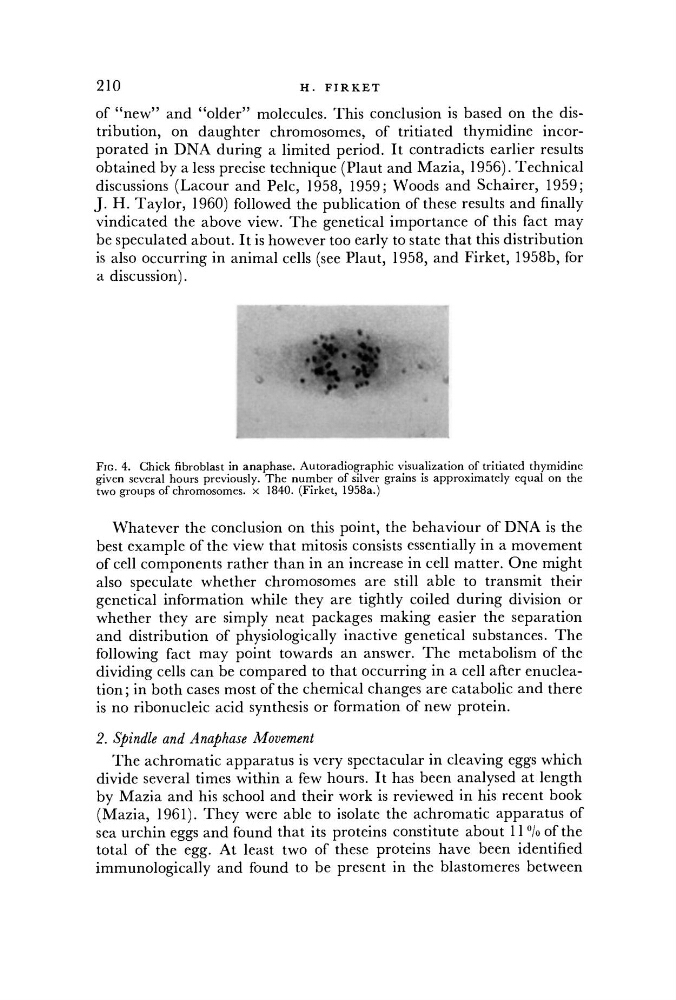
FIG. 4. Chick fibroblast in anaphase. Autoradiographic visualization of tritiated thymidine
given several hours previously. The number of silver grains is approximately equal on the
two groups of chromosomes, x 1840. (Firket, 1958a.)
Whatever the conclusion on this point, the behaviour of D N A is the
best example of the view that mitosis consists essentially in a movement
of cell components rather than in an increase in cell matter. One might
also speculate whether chromosomes are still able to transmit their
genetical information while they are tightly coiled during division or
whether they are simply neat packages making easier the separation
and distribution of physiologically inactive genetical substances. The
following fact may point towards an answer. The metabolism of the
dividing cells can be compared to that occurring in a cell after enucleation; in both cases most of the chemical changes are catabolic and there
is no ribonucleic acid synthesis or formation of new protein.
2. Spindle and Anaphase Movement
The achromatic apparatus is very spectacular in cleaving eggs which
divide several times within a few hours. It has been analysed at length
by Mazia and his school and their work is reviewed in his recent book
(Mazia, 1961). They were able to isolate the achromatic apparatus of
sea urchin eggs and found that its proteins constitute about 11 °/o of the
total of the egg. At least two of these proteins have been identified
immunologically and found to be present in the blastomeres between
of "new" and "older" molecules. This conclusion is based on the distribution, on daughter chromosomes, of tritiated thymidine incorporated in D N A during a limited period. It contradicts earlier results
obtained by a less precise technique (Plaut and Mazia, 1956). Technical
discussions (Lacour and Pelc, 1958, 1959; Woods and Schairer, 1959;
J. H. Taylor, 1960) followed the publication of these results and finally
vindicated the above view. The genetical importance of this fact may
be speculated about. It is however too early to state that this distribution
is also occurring in animal cells (see Plaut, 1958, and Firket, 1958b, for
a discussion).
H . F I R K E T
FIG. 4. Chick fibroblast in anaphase. Autoradiographic visualization of tritiated thymidine
given several hours previously. The number of silver grains is approximately equal on the
two groups of chromosomes, x 1840. (Firket, 1958a.)
Whatever the conclusion on this point, the behaviour of D N A is the
best example of the view that mitosis consists essentially in a movement
of cell components rather than in an increase in cell matter. One might
also speculate whether chromosomes are still able to transmit their
genetical information while they are tightly coiled during division or
whether they are simply neat packages making easier the separation
and distribution of physiologically inactive genetical substances. The
following fact may point towards an answer. The metabolism of the
dividing cells can be compared to that occurring in a cell after enucleation; in both cases most of the chemical changes are catabolic and there
is no ribonucleic acid synthesis or formation of new protein.
2. Spindle and Anaphase Movement
The achromatic apparatus is very spectacular in cleaving eggs which
divide several times within a few hours. It has been analysed at length
by Mazia and his school and their work is reviewed in his recent book
(Mazia, 1961). They were able to isolate the achromatic apparatus of
sea urchin eggs and found that its proteins constitute about 11 °/o of the
total of the egg. At least two of these proteins have been identified
immunologically and found to be present in the blastomeres between
of "new" and "older" molecules. This conclusion is based on the distribution, on daughter chromosomes, of tritiated thymidine incorporated in D N A during a limited period. It contradicts earlier results
obtained by a less precise technique (Plaut and Mazia, 1956). Technical
discussions (Lacour and Pelc, 1958, 1959; Woods and Schairer, 1959;
J. H. Taylor, 1960) followed the publication of these results and finally
vindicated the above view. The genetical importance of this fact may
be speculated about. It is however too early to state that this distribution
is also occurring in animal cells (see Plaut, 1958, and Firket, 1958b, for
a discussion).