

208
H .
F I R K E T
charge is linked with the coiling of chromosomes. However, other
authors have postulated very different functions for this chromosomal
R N A (see p. 211).
The centromere (or kinetochore) is the part of the chromosome by
which it can be attached to the spindle. It is known classically that
when a chromosome is broken, for instance by irradiation, the part
lacking a centromere cannot be attached, and is not affected by
anaphase movements, but is included at random in one of the daughter
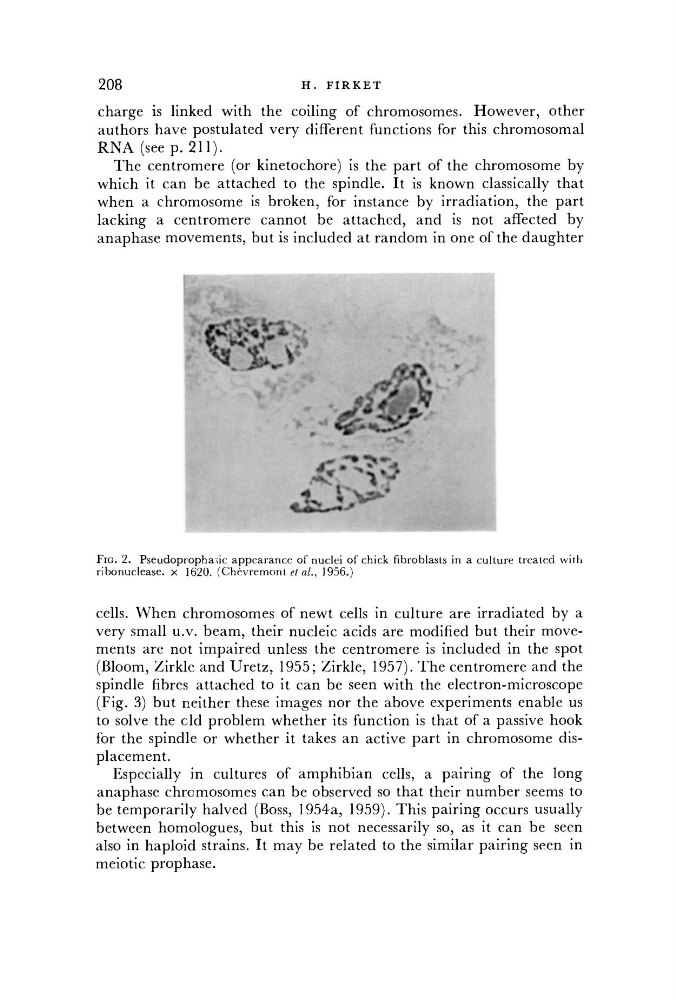
FIG. 2. Pseudoprophaiic appearance of nuclei of chick fibroblasts in a culture treated with
ribonuclease. x 1620. (Chevremont et al., 1956.)
cells. When chromosomes of newt cells in culture are irradiated by a
very small u.v. beam, their nucleic acids are modified but their movements are not impaired unless the centromere is included in the spot
(Bloom, Zirkle and Uretz, 1955; Zirkle, 1957). The centromere and the
spindle fibres attached to it can be seen with the electron-microscope
(Fig. 3) but neither these images nor the above experiments enable us
to solve the eld problem whether its function is that of a passive hook
for the spindle or whether it takes an active part in chromosome displacement.
Especially in cultures of amphibian cells, a pairing of the long
anaphase chromosomes can be observed so that their number seems to
be temporarily halved (Boss, 1954a, 1959). This pairing occurs usually
between homologues, but this is not necessarily so, as it can be seen
also in haploid strains. It may be related to the similar pairing seen in
meiotic prophase.
91IHI
H .
F I R K E T
charge is linked with the coiling of chromosomes. However, other
authors have postulated very different functions for this chromosomal
R N A (see p. 211).
The centromere (or kinetochore) is the part of the chromosome by
which it can be attached to the spindle. It is known classically that
when a chromosome is broken, for instance by irradiation, the part
lacking a centromere cannot be attached, and is not affected by
anaphase movements, but is included at random in one of the daughter
FIG. 2. Pseudoprophaiic appearance of nuclei of chick fibroblasts in a culture treated with
ribonuclease. x 1620. (Chevremont et al., 1956.)
cells. When chromosomes of newt cells in culture are irradiated by a
very small u.v. beam, their nucleic acids are modified but their movements are not impaired unless the centromere is included in the spot
(Bloom, Zirkle and Uretz, 1955; Zirkle, 1957). The centromere and the
spindle fibres attached to it can be seen with the electron-microscope
(Fig. 3) but neither these images nor the above experiments enable us
to solve the eld problem whether its function is that of a passive hook
for the spindle or whether it takes an active part in chromosome displacement.
Especially in cultures of amphibian cells, a pairing of the long
anaphase chromosomes can be observed so that their number seems to
be temporarily halved (Boss, 1954a, 1959). This pairing occurs usually
between homologues, but this is not necessarily so, as it can be seen
also in haploid strains. It may be related to the similar pairing seen in
meiotic prophase.
91IHI