

440
U. ULLMANN
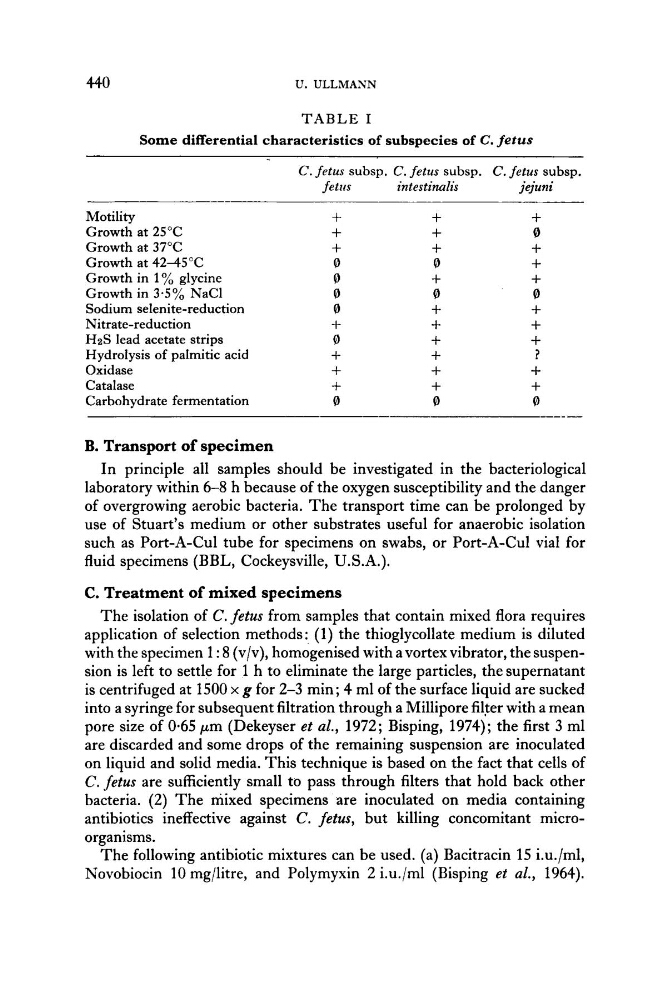
T A B L E I
Some differential characteristics of subspecies of C. fetus
C. fetus subsp. C. fetus subsp. C. fetus subsp.
fetus
intestinalis
jejuni
Motility
Growth at 25°C
Growth at 37°C
Growth at 4 2 4 5 ° C
Growth in 1% glycine
Growth in 3.5% NaCl
Sodium selenite-reduction
Nitrate-reduction
H2S lead acetate strips
Hydrolysis of palmitic acid
Oxidase
Catalase
Carbohydrate fermentation
+
+
+
0
0
0
0
+
0
+
+
+
0
+
+
+
0
+
0
+
+
+
+
+
+
0
+
0
+
+
+
0
+
+
+
?
+
+
0
B. Transport of specimen
In principle all samples should be investigated in the bacteriological
laboratory within 6-8 h because of the oxygen susceptibility and the danger
of overgrowing aerobic bacteria. The transport time can be prolonged by
use of Stuart’s medium or other substrates useful for anaerobic isolation
such as Port-A-Cul tube for specimens on swabs, or Port-A-Cul vial for
fluid specimens (BBL, Cockeysville, U.S.A.).
C. Treatment of mixed specimens
The isolation of C. fetus from samples that contain mixed flora requires
application of selection methods: (1) the thioglycollate medium is diluted
with the specimen 1 : 8 (v/v), homogenised with a vortex vibrator, the suspension is left to settle for 1 h to eliminate the large particles, the supernatant
is centrifuged at 1500 x g for 2-3 min; 4 ml of the surface liquid are sucked
into a syringe for subsequent filtration through a Millipore filter with a mean
pore size of 0.65 pm (Dekeyser et al., 1972; Bisping, 1974); the first 3 ml
are discarded and some drops of the remaining suspension are inoculated
on liquid and solid media. This technique is based on the fact that cells of
C. fetus are sufficiently small to pass through filters that hold back other
bacteria. (2) The mixed specimens are inoculated on media containing
antibiotics ineffective against C. fetus, but killing concomitant microorganisms.
The following antibiotic mixtures can be used. (a) Bacitracin 15 i.u./ml,
Novobiocin 10 mg/litre, and Polymyxin 2 i.u./ml (Bisping et al., 1964).
U. ULLMANN
T A B L E I
Some differential characteristics of subspecies of C. fetus
C. fetus subsp. C. fetus subsp. C. fetus subsp.
fetus
intestinalis
jejuni
Motility
Growth at 25°C
Growth at 37°C
Growth at 4 2 4 5 ° C
Growth in 1% glycine
Growth in 3.5% NaCl
Sodium selenite-reduction
Nitrate-reduction
H2S lead acetate strips
Hydrolysis of palmitic acid
Oxidase
Catalase
Carbohydrate fermentation
+
+
+
0
0
0
0
+
0
+
+
+
0
+
+
+
0
+
0
+
+
+
+
+
+
0
+
0
+
+
+
0
+
+
+
?
+
+
0
B. Transport of specimen
In principle all samples should be investigated in the bacteriological
laboratory within 6-8 h because of the oxygen susceptibility and the danger
of overgrowing aerobic bacteria. The transport time can be prolonged by
use of Stuart’s medium or other substrates useful for anaerobic isolation
such as Port-A-Cul tube for specimens on swabs, or Port-A-Cul vial for
fluid specimens (BBL, Cockeysville, U.S.A.).
C. Treatment of mixed specimens
The isolation of C. fetus from samples that contain mixed flora requires
application of selection methods: (1) the thioglycollate medium is diluted
with the specimen 1 : 8 (v/v), homogenised with a vortex vibrator, the suspension is left to settle for 1 h to eliminate the large particles, the supernatant
is centrifuged at 1500 x g for 2-3 min; 4 ml of the surface liquid are sucked
into a syringe for subsequent filtration through a Millipore filter with a mean
pore size of 0.65 pm (Dekeyser et al., 1972; Bisping, 1974); the first 3 ml
are discarded and some drops of the remaining suspension are inoculated
on liquid and solid media. This technique is based on the fact that cells of
C. fetus are sufficiently small to pass through filters that hold back other
bacteria. (2) The mixed specimens are inoculated on media containing
antibiotics ineffective against C. fetus, but killing concomitant microorganisms.
The following antibiotic mixtures can be used. (a) Bacitracin 15 i.u./ml,
Novobiocin 10 mg/litre, and Polymyxin 2 i.u./ml (Bisping et al., 1964).