

416
E. A. FREUNDT ET AL.
T A B L E V
Titration of haemolysin and complement
Reciprocal
Reciprocal dilution of complement
dilutions of
Control
Row haemolysin 30 38 47 59 73 92 114 143 179 (no C’)
1
25
0
0
0
0
1
3
4
4
4
4
2
50
o
o
o
o
a
2
4
4
4
4
3
100
0
0
0
0
0
1
3
4
4
4
4
200
0
0
0
0
0
0
2
4
4
4
5
400
0
0
0
0
1
2
3
4
4
4
6
800
1
1
2
3
3
4
4
4
4
4
Control (no
7 haemolysin) 4
4
4
4
4
4
4
4
4
4
dilution is prepared by diluting one volume (0.2 ml) with seven volumes
(1.4 ml) of distilled water. This is then diluted to 1: 30 with 3.2 ml of
diluent. The other dilutions are prepared according to the scheme set out
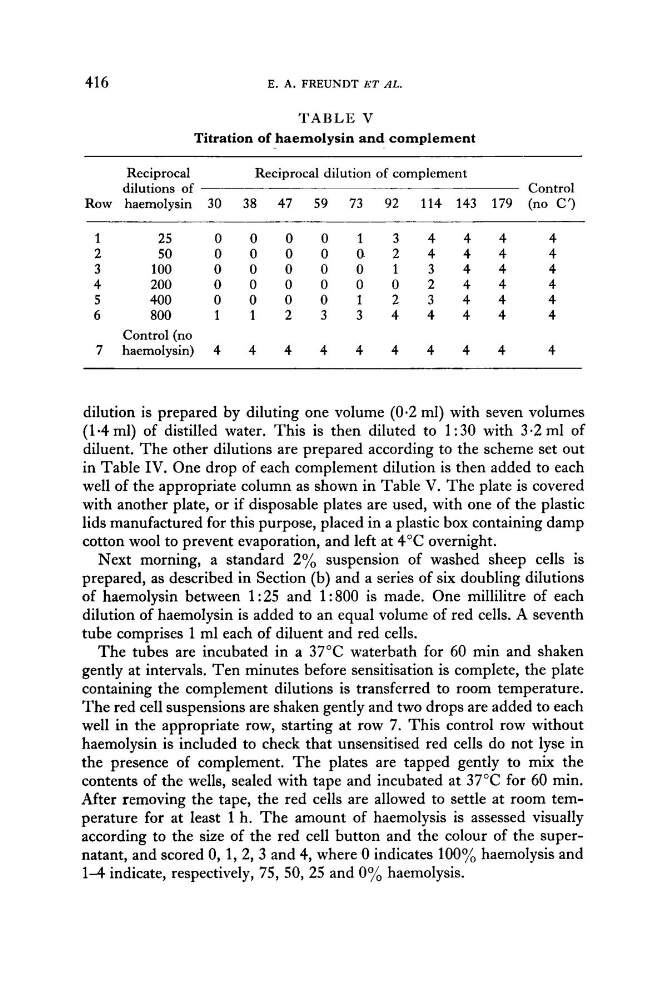
in Table IV. One drop of each complement dilution is then added to each
well of the appropriate column as shown in Table V. The plate is covered
with another plate, or if disposable plates are used, with one of the plastic
lids manufactured for this purpose, placed in a plastic box containing damp
cotton wool to prevent evaporation, and left at 4°C overnight.
Next morning, a standard 2% suspension of washed sheep cells is
prepared, as described in Section (b) and a series of six doubling dilutions
of haemolysin between 1 :25 and 1 : 800 is made. One millilitre of each
dilution of haemolysin is added to an equal volume of red cells. A seventh
tube comprises 1 ml each of diluent and red cells.
The tubes are incubated in a 37°C waterbath for 60 min and shaken
gently at intervals. Ten minutes before sensitisation is complete, the plate
containing the complement dilutions is transferred to room temperature.
The red cell suspensions are shaken gently and two drops are added to each
well in the appropriate row, starting at row 7. This control row without
haemolysin is included to check that unsensitised red cells do not lyse in
the presence of complement. The plates are tapped gently to mix the
contents of the wells, sealed with tape and incubated at 37°C for 60 min.
After removing the tape, the red cells are allowed to settle at room temperature for at least 1 h. The amount of haemolysis is assessed visually
according to the size of the red cell button and the colour of the supernatant, and scored 0, 1, 2, 3 and 4, where 0 indicates 100% haemolysis and
1 4 indicate, respectively, 75, 50, 25 and 0% haemolysis.
E. A. FREUNDT ET AL.
T A B L E V
Titration of haemolysin and complement
Reciprocal
Reciprocal dilution of complement
dilutions of
Control
Row haemolysin 30 38 47 59 73 92 114 143 179 (no C’)
1
25
0
0
0
0
1
3
4
4
4
4
2
50
o
o
o
o
a
2
4
4
4
4
3
100
0
0
0
0
0
1
3
4
4
4
4
200
0
0
0
0
0
0
2
4
4
4
5
400
0
0
0
0
1
2
3
4
4
4
6
800
1
1
2
3
3
4
4
4
4
4
Control (no
7 haemolysin) 4
4
4
4
4
4
4
4
4
4
dilution is prepared by diluting one volume (0.2 ml) with seven volumes
(1.4 ml) of distilled water. This is then diluted to 1: 30 with 3.2 ml of
diluent. The other dilutions are prepared according to the scheme set out
in Table IV. One drop of each complement dilution is then added to each
well of the appropriate column as shown in Table V. The plate is covered
with another plate, or if disposable plates are used, with one of the plastic
lids manufactured for this purpose, placed in a plastic box containing damp
cotton wool to prevent evaporation, and left at 4°C overnight.
Next morning, a standard 2% suspension of washed sheep cells is
prepared, as described in Section (b) and a series of six doubling dilutions
of haemolysin between 1 :25 and 1 : 800 is made. One millilitre of each
dilution of haemolysin is added to an equal volume of red cells. A seventh
tube comprises 1 ml each of diluent and red cells.
The tubes are incubated in a 37°C waterbath for 60 min and shaken
gently at intervals. Ten minutes before sensitisation is complete, the plate
containing the complement dilutions is transferred to room temperature.
The red cell suspensions are shaken gently and two drops are added to each
well in the appropriate row, starting at row 7. This control row without
haemolysin is included to check that unsensitised red cells do not lyse in
the presence of complement. The plates are tapped gently to mix the
contents of the wells, sealed with tape and incubated at 37°C for 60 min.
After removing the tape, the red cells are allowed to settle at room temperature for at least 1 h. The amount of haemolysis is assessed visually
according to the size of the red cell button and the colour of the supernatant, and scored 0, 1, 2, 3 and 4, where 0 indicates 100% haemolysis and
1 4 indicate, respectively, 75, 50, 25 and 0% haemolysis.