

IX. IDENTIFICATION OF MYCOPLASMAS
415
coniplement is also available commercially (Wellcome Reagents Ltd,
Beckenham, Kent, England). In our experience, guinea pig serum which is
separated rapidly in the cold and stored frozen in small amounts (0-2 and
0.5 ml are convenient) gives superior results to preserved complement.
The former invariably has a higher titre and annoying "trace" reactions
which sometimes occur even with excess of preserved complement are
not observed. Providing storage is below - 50°C, complement maintains
its titre for many months. Storage at -25 to -30°C is unsatisfactory.
During a test, complement is removed from the freezing cabinet only when
both serum and antigen are in the wells, and tubes for diluting the complement are ready on ice. It is then rapidly thawed in lukewarm water,
appropriately diluted (vide infra) and kept on ice. Plates are transferred to
the refrigerator as soon as complement has been added.
(d) Haemolytic serum (haemolysin). Antiserum to sheep erythrocytes
prepared in rabbits is available commercially (e.g. Wellcome Reagents Ltd).
It is stable for long periods at 4"C, but should not be diluted to the required
concentration until immediately before use.
(e) Titration of haemolysin and complement. The optimal concentration of
haemolysin and the titre of complement are determined in a single chessboard titration (Bradstreet and Taylor, 1962; Taylor 1967).
Using a micropipette, two drops of buffered diluent are placed in each
of 70 wells (7 rows of 10 columns) in a microtitre plate (Table V). Wells in
the last (tenth) column receive a third drop of diluent in place of complement, and serve as controls to establish that the haemolysin does not lyse
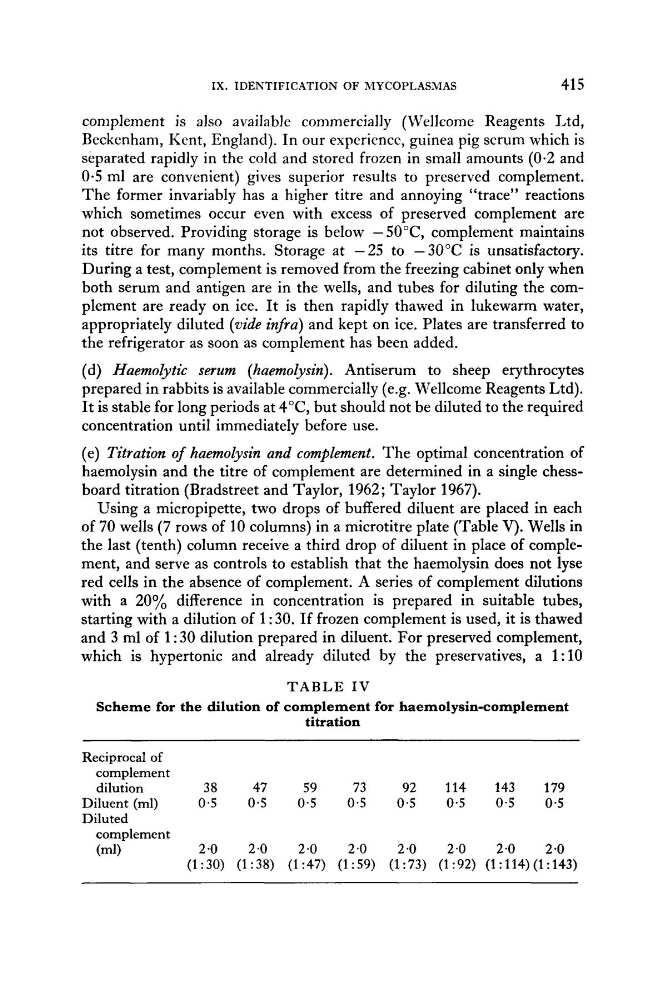
red cells in the absence of complement. A series of complement dilutions
with a 20% difference in concentration is prepared in suitable tubes,
starting with a dilution of 1 : 30. If frozen complement is used, it is thawed
and 3 ml of 1 : 30 dilution prepared in diluent. For preserved complement,
which is hypertonic and already diluted by the preservatives, a 1:lO
T A B L E IV
Scheme for the dilution of complement for haemolysin-complement
titration
Reciprocal of
complement
dilution
38
47
59
73
92
114
143
179
Diluent (ml)
0.5
0.5
0.5
0.5
0.5
0.5
0.5
0.5
Diluted
complement
(mu
2.0
2.0
2.0
2.0
2.0
2.0
2.0
2.0
(1:30) (1:38) (1:47) (1:59) (1:73) (1:92) (1:114)(1:143)
415
coniplement is also available commercially (Wellcome Reagents Ltd,
Beckenham, Kent, England). In our experience, guinea pig serum which is
separated rapidly in the cold and stored frozen in small amounts (0-2 and
0.5 ml are convenient) gives superior results to preserved complement.
The former invariably has a higher titre and annoying "trace" reactions
which sometimes occur even with excess of preserved complement are
not observed. Providing storage is below - 50°C, complement maintains
its titre for many months. Storage at -25 to -30°C is unsatisfactory.
During a test, complement is removed from the freezing cabinet only when
both serum and antigen are in the wells, and tubes for diluting the complement are ready on ice. It is then rapidly thawed in lukewarm water,
appropriately diluted (vide infra) and kept on ice. Plates are transferred to
the refrigerator as soon as complement has been added.
(d) Haemolytic serum (haemolysin). Antiserum to sheep erythrocytes
prepared in rabbits is available commercially (e.g. Wellcome Reagents Ltd).
It is stable for long periods at 4"C, but should not be diluted to the required
concentration until immediately before use.
(e) Titration of haemolysin and complement. The optimal concentration of
haemolysin and the titre of complement are determined in a single chessboard titration (Bradstreet and Taylor, 1962; Taylor 1967).
Using a micropipette, two drops of buffered diluent are placed in each
of 70 wells (7 rows of 10 columns) in a microtitre plate (Table V). Wells in
the last (tenth) column receive a third drop of diluent in place of complement, and serve as controls to establish that the haemolysin does not lyse
red cells in the absence of complement. A series of complement dilutions
with a 20% difference in concentration is prepared in suitable tubes,
starting with a dilution of 1 : 30. If frozen complement is used, it is thawed
and 3 ml of 1 : 30 dilution prepared in diluent. For preserved complement,
which is hypertonic and already diluted by the preservatives, a 1:lO
T A B L E IV
Scheme for the dilution of complement for haemolysin-complement
titration
Reciprocal of
complement
dilution
38
47
59
73
92
114
143
179
Diluent (ml)
0.5
0.5
0.5
0.5
0.5
0.5
0.5
0.5
Diluted
complement
(mu
2.0
2.0
2.0
2.0
2.0
2.0
2.0
2.0
(1:30) (1:38) (1:47) (1:59) (1:73) (1:92) (1:114)(1:143)