

362
w. B . REDMOND et al.
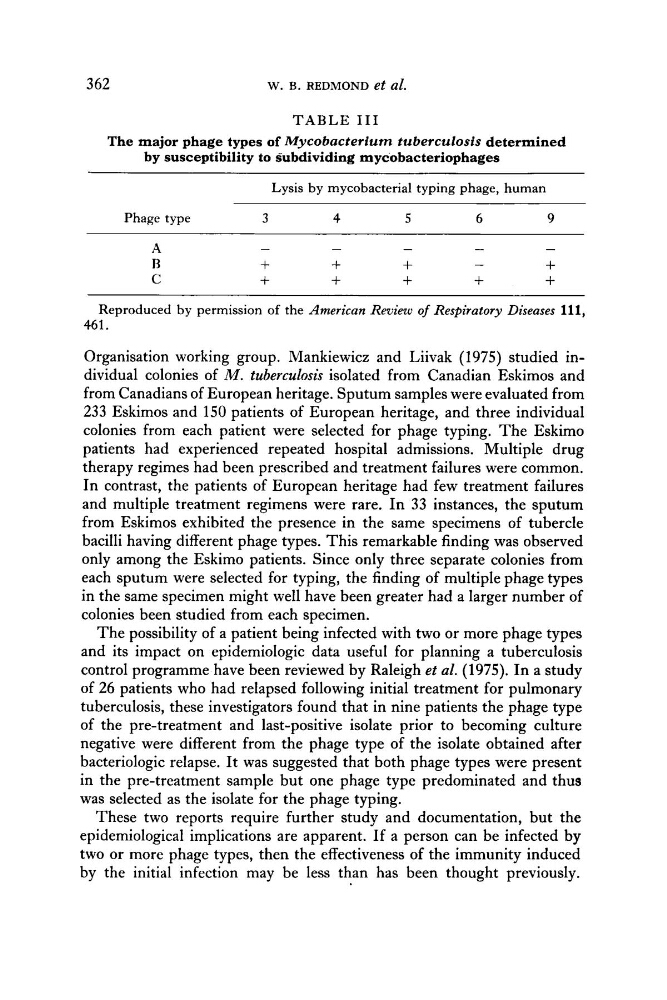
T A B L E I 1 1
The major phage types of Mycobacterium tuberculosis determined
by susceptibility to subdividing mycobacteriophages
Lysis by mycobacterial typing phage, human
Phage type
3
4
5
6
9
-
-
-
-
-
A
+
B
+
+
+
c
+
+
+
+
+
-
Reproduced by permission of the American Review of Respiratory Diseases 111,
461.
Organisation working group. Mankiewicz and Liivak (1975) studied individual colonies of M. tuberculosis isolated from Canadian Eskimos and
from Canadians of European heritage. Sputum samples were evaluated from
233 Eskimos and 150 patients of European heritage, and three individual
colonies from each patient were selected for phage typing. The Eskimo
patients had experienced repeated hospital admissions. Multiple drug
therapy regimes had been prescribed and treatment failures were common.
I n contrast, the patients of European heritage had few treatment failures
and multiple treatment regimens were rare. I n 33 instances, the sputum
from Eskimos exhibited the presence in the same specimens of tubercle
bacilli having different phage types. This remarkable finding was observed
only among the Eskimo patients. Since only three separate colonies from
each sputum were selected for typing, the finding of multiple phage types
in the same specimen might well have been greater had a larger number of
colonies been studied from each specimen.
The possibility of a patient being infected with two or more phage types
and its impact on epidemiologic data useful for planning a tuberculosis
control programme have been reviewed by Raleigh et al. (1975). In a study
of 26 patients who had relapsed following initial treatment for pulmonary
tuberculosis, these investigators found that in nine patients the phage type
of the pre-treatment and last-positive isolate prior to becoming culture
negative were different from the phage type of the isolate obtained after
bacteriologic relapse. It was suggested that both phage types were present
in the pre-treatment sample but one phage type predominated and thus
was selected as the isolate for the phage typing.
These two reports require further study and documentation, but the
epidemiological implications are apparent. If a person can be infected by
two or more phage types, then the effectiveness of the immunity induced
by the initial infection may be less than has been thought previously.
w. B . REDMOND et al.
T A B L E I 1 1
The major phage types of Mycobacterium tuberculosis determined
by susceptibility to subdividing mycobacteriophages
Lysis by mycobacterial typing phage, human
Phage type
3
4
5
6
9
-
-
-
-
-
A
+
B
+
+
+
c
+
+
+
+
+
-
Reproduced by permission of the American Review of Respiratory Diseases 111,
461.
Organisation working group. Mankiewicz and Liivak (1975) studied individual colonies of M. tuberculosis isolated from Canadian Eskimos and
from Canadians of European heritage. Sputum samples were evaluated from
233 Eskimos and 150 patients of European heritage, and three individual
colonies from each patient were selected for phage typing. The Eskimo
patients had experienced repeated hospital admissions. Multiple drug
therapy regimes had been prescribed and treatment failures were common.
I n contrast, the patients of European heritage had few treatment failures
and multiple treatment regimens were rare. I n 33 instances, the sputum
from Eskimos exhibited the presence in the same specimens of tubercle
bacilli having different phage types. This remarkable finding was observed
only among the Eskimo patients. Since only three separate colonies from
each sputum were selected for typing, the finding of multiple phage types
in the same specimen might well have been greater had a larger number of
colonies been studied from each specimen.
The possibility of a patient being infected with two or more phage types
and its impact on epidemiologic data useful for planning a tuberculosis
control programme have been reviewed by Raleigh et al. (1975). In a study
of 26 patients who had relapsed following initial treatment for pulmonary
tuberculosis, these investigators found that in nine patients the phage type
of the pre-treatment and last-positive isolate prior to becoming culture
negative were different from the phage type of the isolate obtained after
bacteriologic relapse. It was suggested that both phage types were present
in the pre-treatment sample but one phage type predominated and thus
was selected as the isolate for the phage typing.
These two reports require further study and documentation, but the
epidemiological implications are apparent. If a person can be infected by
two or more phage types, then the effectiveness of the immunity induced
by the initial infection may be less than has been thought previously.