

VII. IDENTIFICATION OF ATYPICAL MYCOBACTERIA
327
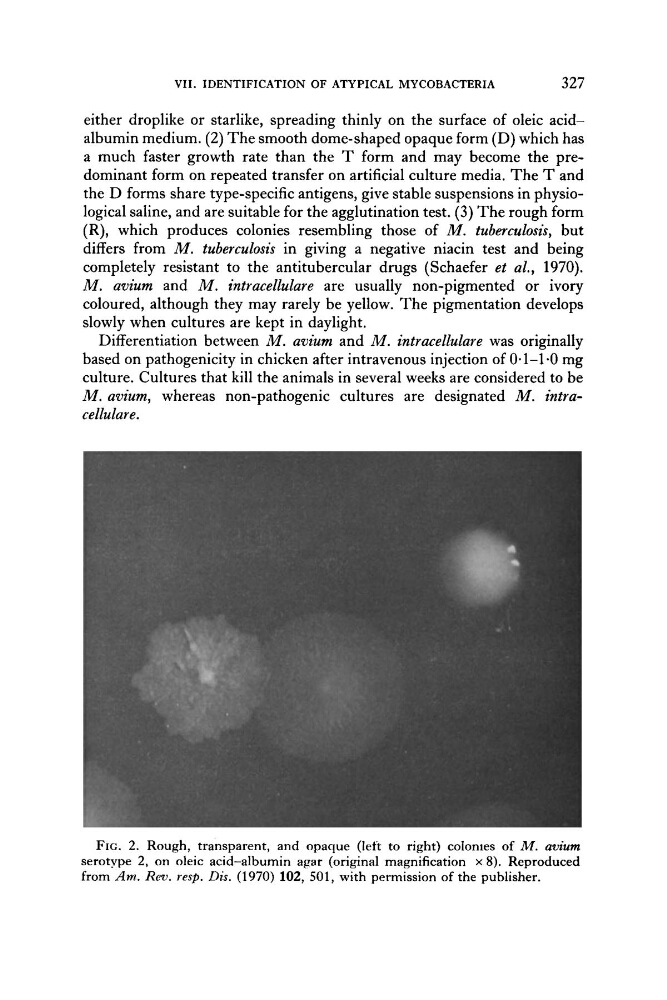
either droplike or starlike, spreading thinly on the surface of oleic acidalbumin medium. (2) The smooth dome-shaped opaque form (D) which has
a much faster growth rate than the T form and may become the predominant form on repeated transfer on artificial culture media. The T and
the D forms share type-specific antigens, give stable suspensions in physiological saline, and are suitable for the agglutination test. (3) The rough form
(R), which produces colonies resembling those of M. tuberculosis, but
differs from M . tuberculosis in giving a negative niacin test and being
completely resistant to the antitubercular drugs (Schaefer et al., 1970).
M . avium and M . intracellulare are usually non-pigmented or ivory
coloured, although they may rarely be yellow. The pigmentation develops
slowly when cultures are kept in daylight.
Differentiation between M. avium and M . intracellulare was originally
based on pathogenicity in chicken after intravenous injection of 0.1-1-0 mg
culture. Cultures that kill the animals in several weeks are considered to be
M . avium, whereas non-pathogenic cultures are designated M . intracellulare.
FIG. 2. Rough, transparent, and opaque (left to right) colonies of M . avium
serotvpe 2, on oleic acid-albumin agar (original magnification x 8). Reproduced
from A m . Rev. resp. Dis. (1970) 102, 501, with permission of the publisher.
327
either droplike or starlike, spreading thinly on the surface of oleic acidalbumin medium. (2) The smooth dome-shaped opaque form (D) which has
a much faster growth rate than the T form and may become the predominant form on repeated transfer on artificial culture media. The T and
the D forms share type-specific antigens, give stable suspensions in physiological saline, and are suitable for the agglutination test. (3) The rough form
(R), which produces colonies resembling those of M. tuberculosis, but
differs from M . tuberculosis in giving a negative niacin test and being
completely resistant to the antitubercular drugs (Schaefer et al., 1970).
M . avium and M . intracellulare are usually non-pigmented or ivory
coloured, although they may rarely be yellow. The pigmentation develops
slowly when cultures are kept in daylight.
Differentiation between M. avium and M . intracellulare was originally
based on pathogenicity in chicken after intravenous injection of 0.1-1-0 mg
culture. Cultures that kill the animals in several weeks are considered to be
M . avium, whereas non-pathogenic cultures are designated M . intracellulare.
FIG. 2. Rough, transparent, and opaque (left to right) colonies of M . avium
serotvpe 2, on oleic acid-albumin agar (original magnification x 8). Reproduced
from A m . Rev. resp. Dis. (1970) 102, 501, with permission of the publisher.