

280
T. BERGAN
Such a situation necessitates periodic, although cautious, modification of
the international typing sets.
Another point of significance is the discriminative ability of individual
phages. This decides the ability of the phages to differentiate bacterial
cultures from separate outbreaks. Several phages in the international
working set of S. sonnei, e.g. phages IVA, V, and XI, lyse so many bacterial
isolates that they have little discriminative value. A number of phages have
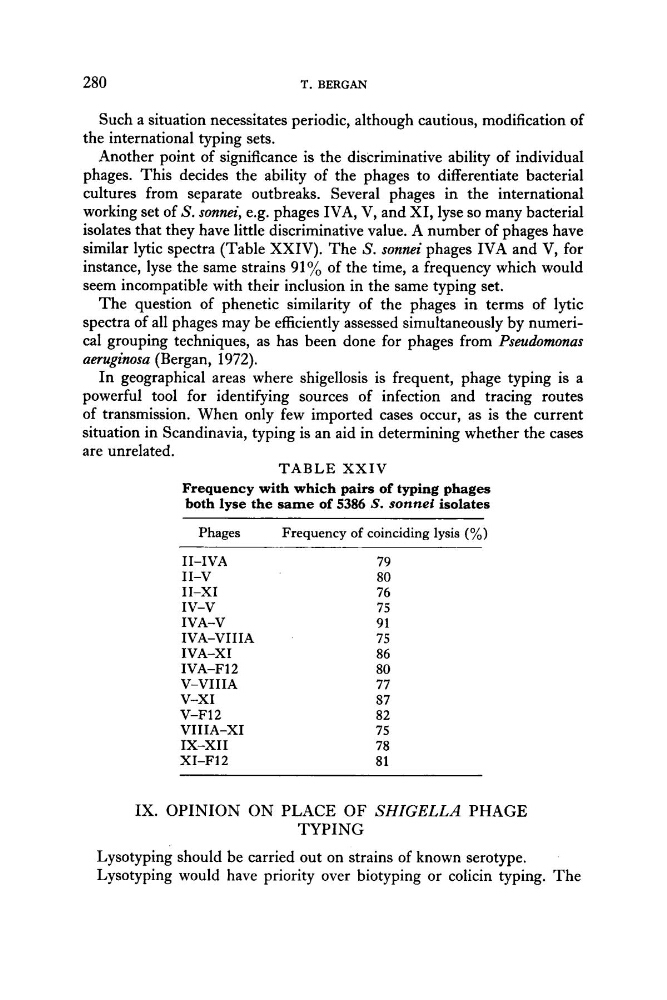
similar lytic spectra (Table XXIV). The S. sonnei phages IVA and V, for
instance, lyse the same strains 91% of the time, a frequency which would
seem incompatible with their inclusion in the same typing set.
The question of phenetic similarity of the phages in terms of lytic
spectra of all phages may be efficiently assessed simultaneously by numerical grouping techniques, as has been done for phages from Pseudomonas
aeruginosa (Bergan, 1972).
In geographical areas where shigellosis is frequent, phage typing is a
powerful tool for identifying sources of infection and tracing routes
of transmission. When only few imported cases occur, as is the current
situation in Scandinavia, typing is an aid in determining whether the cases
are unrelated.
T A B L E X X I V
Frequency with which pairs of typing phages
both lyse the same of 5386 S. sonnei isolates
Frequency of coinciding lysis (%)
Phages
11-IVA
I I-v
I I-XI
IV-v
IVA-V
IVA-VI I I A
IVA-XI
IVA-F12
V-VIIIA
v-XI
V-F12
VIIIA-XI
IX-XI1
XI-F12
79
80
76
75
91
75
86
80
77
57
82
75
78
81
IX. OPINION ON PLACE OF SHIGELLA PHAGE
TYPING
Lysotyping should be carried out on strains of known serotype.
Lysotyping would have priority over biotyping or colicin typing. The
T. BERGAN
Such a situation necessitates periodic, although cautious, modification of
the international typing sets.
Another point of significance is the discriminative ability of individual
phages. This decides the ability of the phages to differentiate bacterial
cultures from separate outbreaks. Several phages in the international
working set of S. sonnei, e.g. phages IVA, V, and XI, lyse so many bacterial
isolates that they have little discriminative value. A number of phages have
similar lytic spectra (Table XXIV). The S. sonnei phages IVA and V, for
instance, lyse the same strains 91% of the time, a frequency which would
seem incompatible with their inclusion in the same typing set.
The question of phenetic similarity of the phages in terms of lytic
spectra of all phages may be efficiently assessed simultaneously by numerical grouping techniques, as has been done for phages from Pseudomonas
aeruginosa (Bergan, 1972).
In geographical areas where shigellosis is frequent, phage typing is a
powerful tool for identifying sources of infection and tracing routes
of transmission. When only few imported cases occur, as is the current
situation in Scandinavia, typing is an aid in determining whether the cases
are unrelated.
T A B L E X X I V
Frequency with which pairs of typing phages
both lyse the same of 5386 S. sonnei isolates
Frequency of coinciding lysis (%)
Phages
11-IVA
I I-v
I I-XI
IV-v
IVA-V
IVA-VI I I A
IVA-XI
IVA-F12
V-VIIIA
v-XI
V-F12
VIIIA-XI
IX-XI1
XI-F12
79
80
76
75
91
75
86
80
77
57
82
75
78
81
IX. OPINION ON PLACE OF SHIGELLA PHAGE
TYPING
Lysotyping should be carried out on strains of known serotype.
Lysotyping would have priority over biotyping or colicin typing. The