

V. BACTERIOPHAGE TYPING OF SHIGELLA
279
epidemic strains. In general, there is no relationship between lysotype and
antibiotic susceptibility, biotype, colicin type, or pathogenicity (Grunow,
1965a; Lhsz16 and Kerekes, 1969; Mulczyk et al., 1967a, b Rische et al.,
1965 ; Rische, 1966). Accordingly, colicin typing may be useful in subdividing a lysotype which dominates in a particular locality (Meitert et al.,
1975 ; Pfeifer and Kruger, 1968). In contrast, there is an association between
serogroup and sensitivity to phages in many instances. Still, the situation
on this point requires further elucidation. Lhsz16 et al. (1973a, b) reported
that there was no correlation between phage type and serotype.
If one or a few lysotypes dominate, a differentiation may be achieved by
the addition of local phages (Trifonovh and Bratovh, 1975; Quynh, 1967,
1969; ZieschC, 1975).
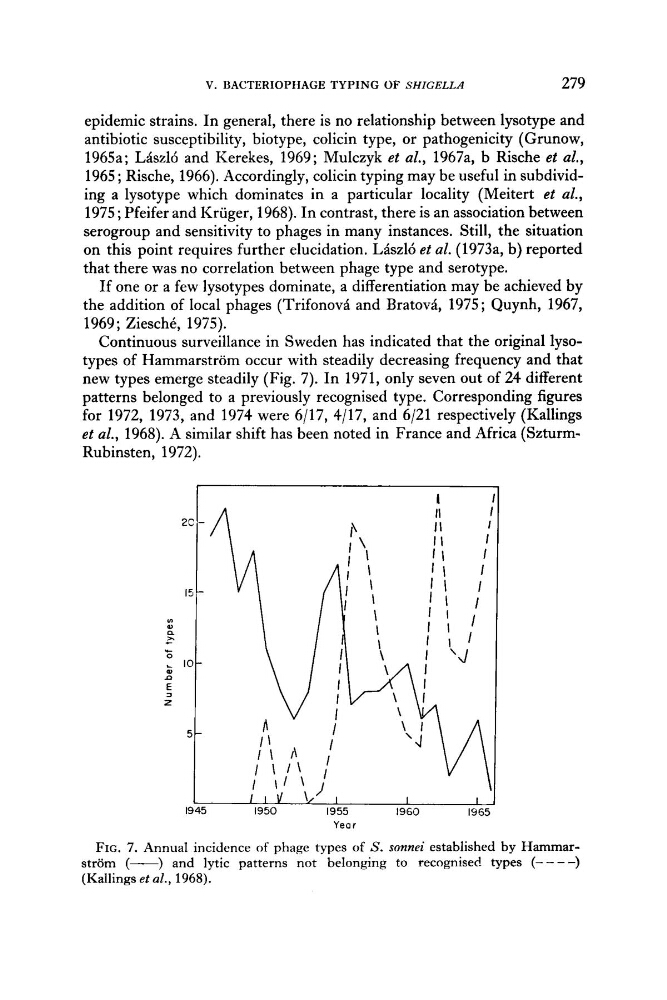
Continuous surveillance in Sweden has indicated that the original lysotypes of Hammarstrom occur with steadily decreasing frequency and that
new types emerge steadily (Fig. 7). In 1971, only seven out of 24 different
patterns belonged to a previously recognised type. Corresponding figures
for 1972, 1973, and 1974 were 6/17, 4/17, and 6/21 respectively (Kallings
et al., 1968). A similar shift has been noted in France and Africa (SzturmRubinsten, 1972).
1
II
2c -
IS -
In
a l
0
x
n
c
r
L
10n
5
z
5 -
L
I
I
1945
1950
1955
1960
1965
Year
FIG. 7. Annual incidence of phage types of S. sonnei established by Hammarstrom (-)
and lytic patterns not belonging to recognised types (----)
(Kallings et al., 1968).
279
epidemic strains. In general, there is no relationship between lysotype and
antibiotic susceptibility, biotype, colicin type, or pathogenicity (Grunow,
1965a; Lhsz16 and Kerekes, 1969; Mulczyk et al., 1967a, b Rische et al.,
1965 ; Rische, 1966). Accordingly, colicin typing may be useful in subdividing a lysotype which dominates in a particular locality (Meitert et al.,
1975 ; Pfeifer and Kruger, 1968). In contrast, there is an association between
serogroup and sensitivity to phages in many instances. Still, the situation
on this point requires further elucidation. Lhsz16 et al. (1973a, b) reported
that there was no correlation between phage type and serotype.
If one or a few lysotypes dominate, a differentiation may be achieved by
the addition of local phages (Trifonovh and Bratovh, 1975; Quynh, 1967,
1969; ZieschC, 1975).
Continuous surveillance in Sweden has indicated that the original lysotypes of Hammarstrom occur with steadily decreasing frequency and that
new types emerge steadily (Fig. 7). In 1971, only seven out of 24 different
patterns belonged to a previously recognised type. Corresponding figures
for 1972, 1973, and 1974 were 6/17, 4/17, and 6/21 respectively (Kallings
et al., 1968). A similar shift has been noted in France and Africa (SzturmRubinsten, 1972).
1
II
2c -
IS -
In
a l
0
x
n
c
r
L
10n
5
z
5 -
L
I
I
1945
1950
1955
1960
1965
Year
FIG. 7. Annual incidence of phage types of S. sonnei established by Hammarstrom (-)
and lytic patterns not belonging to recognised types (----)
(Kallings et al., 1968).