

162
A. SARAGEA ET A L
The medium is melted, cooled at 40°C, and bovine serum added to
20% and poured in Petri dishes. A ditch (7 x 0.5 cm in a plate of 10 cm)
is cut in the agar on the diameter of the plate, 0.5 ml diphtherial antitoxin
(500 U.A./ml) is dropped in the ditch. The plate is left for 1-2 h at 37°C
with open lid and then the ditch is filled with melted agar. The cultures to be
tested are streaked in strips perpendicular on the ditch. Precipitation lines
occur in the right angle where antitoxin meets the toxin produced by
toxigenic cultures. The medium should be controlled by reference strains
C. diphtheriae toxf and tox-.
C. Slide agglutination for serological identification
Agglutinant polyvalent diphtherial antiserum, prepared on rabbits is
used diluted 1/10-1/20. The diluent is a 0.1 M phosphate buffer solution
(15.7 g Na2HP04 + 2Hz0, 1.8 g NaH2P04 + HzO, 4.9 g NaCl, 1000 ml
distilled water, pH = 7.6, autoclaved 20 min at 110°C.
The control is the 1/20 diluted rabbit serum, in the phosphate buffer
solution.
On a slide, deposit one drop of diphtherial antiserum and one drop of
control normal rabbit serum, both diluted as recommended.
Suspend in each drop a loop from the culture (of 2448 h on Loeffler
slant) to be tested. The culture should be taken from the top of the medium;
do not touch the liquid from the bottom. Agglutination is produced
within 1-2 min.
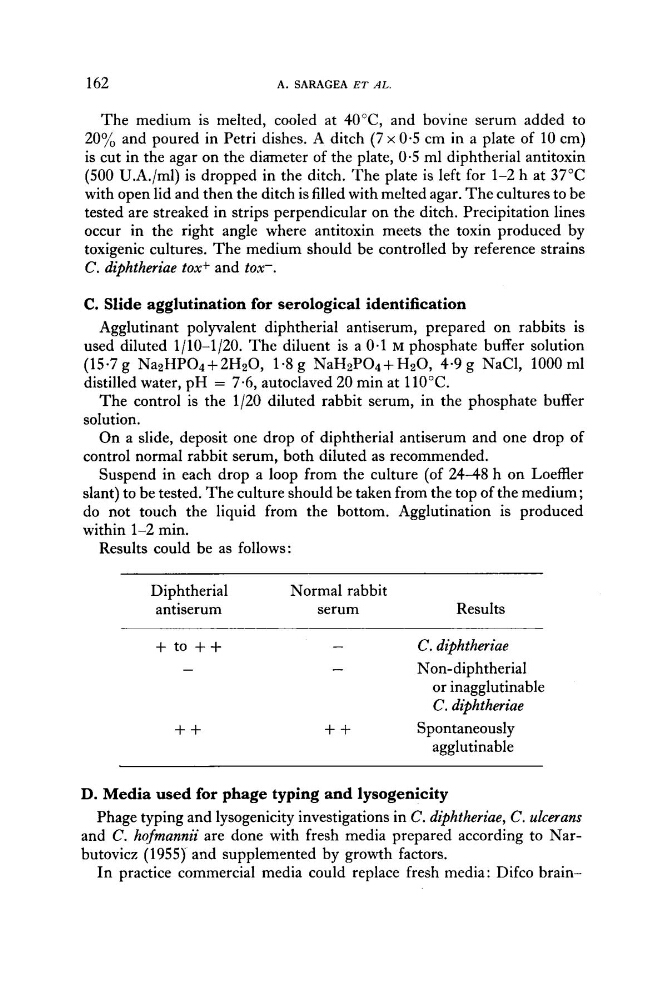
Results could be as follows:
Diphtherial
Normal rabbit
antiserum
serum
Results
+ t o + +
-
C. diphtheriae
__
-
-
Non-diphtherial
or inagglutinable
C. d$htheriae
+ +
+ +
Spontaneously
agglutinable
D. Media used for phage typing and lysogenicity
Phage typing and lysogenicity investigations in C. diphtheriae, C. ulcerans
and C. hofmannii are done with fresh media prepared according to Narbutovicz (1955)' and supplemented by growth factors.
In practice commercial media could replace fresh media: Difco brain-
A. SARAGEA ET A L
The medium is melted, cooled at 40°C, and bovine serum added to
20% and poured in Petri dishes. A ditch (7 x 0.5 cm in a plate of 10 cm)
is cut in the agar on the diameter of the plate, 0.5 ml diphtherial antitoxin
(500 U.A./ml) is dropped in the ditch. The plate is left for 1-2 h at 37°C
with open lid and then the ditch is filled with melted agar. The cultures to be
tested are streaked in strips perpendicular on the ditch. Precipitation lines
occur in the right angle where antitoxin meets the toxin produced by
toxigenic cultures. The medium should be controlled by reference strains
C. diphtheriae toxf and tox-.
C. Slide agglutination for serological identification
Agglutinant polyvalent diphtherial antiserum, prepared on rabbits is
used diluted 1/10-1/20. The diluent is a 0.1 M phosphate buffer solution
(15.7 g Na2HP04 + 2Hz0, 1.8 g NaH2P04 + HzO, 4.9 g NaCl, 1000 ml
distilled water, pH = 7.6, autoclaved 20 min at 110°C.
The control is the 1/20 diluted rabbit serum, in the phosphate buffer
solution.
On a slide, deposit one drop of diphtherial antiserum and one drop of
control normal rabbit serum, both diluted as recommended.
Suspend in each drop a loop from the culture (of 2448 h on Loeffler
slant) to be tested. The culture should be taken from the top of the medium;
do not touch the liquid from the bottom. Agglutination is produced
within 1-2 min.
Results could be as follows:
Diphtherial
Normal rabbit
antiserum
serum
Results
+ t o + +
-
C. diphtheriae
__
-
-
Non-diphtherial
or inagglutinable
C. d$htheriae
+ +
+ +
Spontaneously
agglutinable
D. Media used for phage typing and lysogenicity
Phage typing and lysogenicity investigations in C. diphtheriae, C. ulcerans
and C. hofmannii are done with fresh media prepared according to Narbutovicz (1955)' and supplemented by growth factors.
In practice commercial media could replace fresh media: Difco brain-