

130
A. SARAGEA E?’ AL.
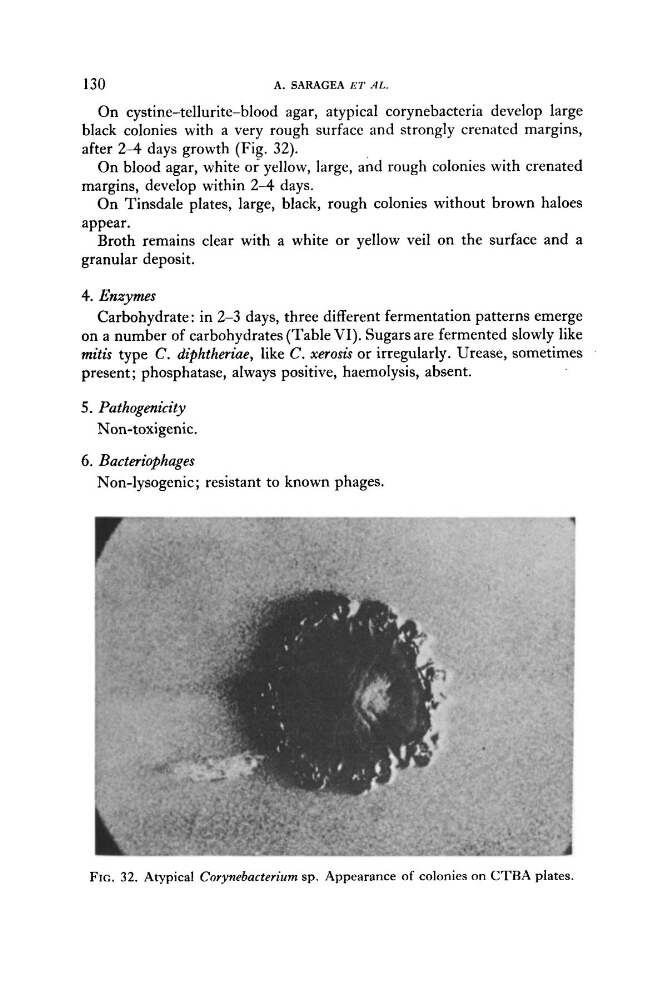
On cystine-tellurite-blood agar, atypical corynebacteria develop large
black colonies with a very rough surface and strongly crenated margins,
after 2-4 days growth (Fig. 32).
On blood agar, white o r yellow, large, and rough colonies with crenated
margins, develop within 2-4 days.
On Tinsdale plates, large, black, rough colonies without brown haloes
appear.
Broth remains clear with a white or yellow veil on the surface and a
granular deposit.
4. Enzymes
Carbohydrate : in 2-3 days, three different fermentation patterns emerge
on a number of carbohydrates (Table VI). Sugars are fermented slowly like
mitis type C. diphtheriae, like C . xerosis or irregularly. Urease, sometimes
present ; phosphatase, always positive, haemolysis, absent.
5 . Pathogenicity
Non-toxigenic.
6. Bacteriophages
Non-lysogenic ; resistant to known phages.
FIG. 32. Atypical Corynebacterium sp. Appearance of colonies on CTRA plates.
A. SARAGEA E?’ AL.
On cystine-tellurite-blood agar, atypical corynebacteria develop large
black colonies with a very rough surface and strongly crenated margins,
after 2-4 days growth (Fig. 32).
On blood agar, white o r yellow, large, and rough colonies with crenated
margins, develop within 2-4 days.
On Tinsdale plates, large, black, rough colonies without brown haloes
appear.
Broth remains clear with a white or yellow veil on the surface and a
granular deposit.
4. Enzymes
Carbohydrate : in 2-3 days, three different fermentation patterns emerge
on a number of carbohydrates (Table VI). Sugars are fermented slowly like
mitis type C. diphtheriae, like C . xerosis or irregularly. Urease, sometimes
present ; phosphatase, always positive, haemolysis, absent.
5 . Pathogenicity
Non-toxigenic.
6. Bacteriophages
Non-lysogenic ; resistant to known phages.
FIG. 32. Atypical Corynebacterium sp. Appearance of colonies on CTRA plates.