

IV. INVESTIGATION OF C. DIPHTHERIAE
129
mycobacteria, led the authors to assume that these forms were “variants”
representing a degradation of the type species C. diphtheriae. These variants
are very similar to type VI described by Wright and Christison (1935).
1. Habitat
Nasopharynx, skin and conjunctiva in humans.
2. Morphology
Variable, either very long or very small, often gigantic, branched rods,
club-shaped, containing big metachromatic Gram-positive bodies, which
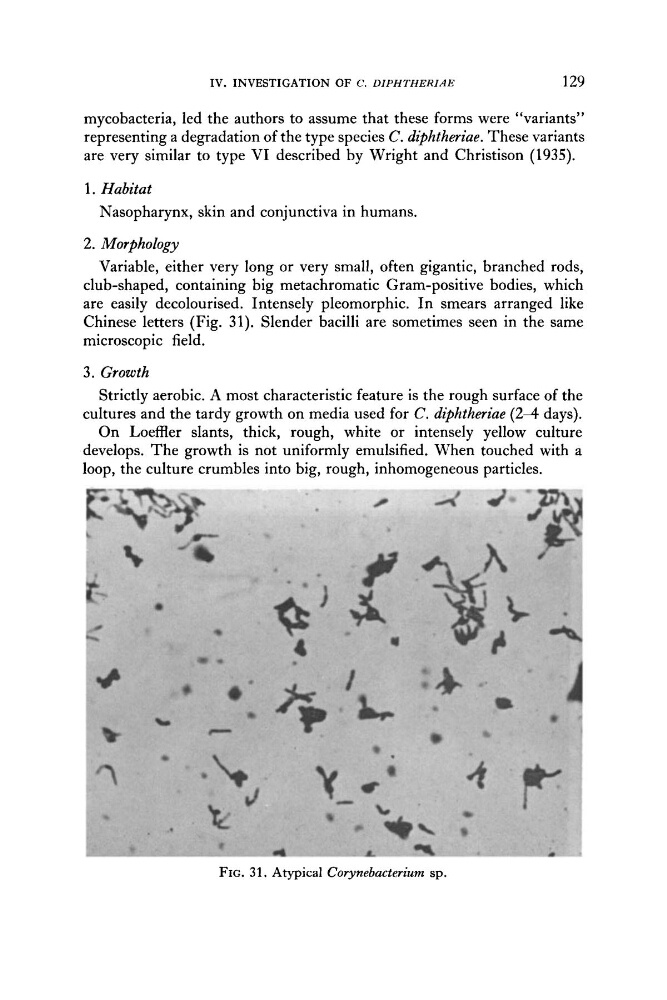
are easily decolourised. Intensely pleomorphic. I n smears arranged like
Chinese letters (Fig. 31). Slender bacilli are sometimes seen in the same
microscopic field.
3 . Growth
Strictly aerobic. A most characteristic feature is the rough surface of the
cultures and the tardy growth on media used for C. diphtheriae ( 2 4 days).
On Loeffler slants, thick, rough, white or intensely yellow culture
develops. The growth is not uniformly emulsified. When touched with a
loop, the culture crumbles into big, rough, inhomogeneous particles.
FIG. 31. Atypical Corynebucterium sp.
129
mycobacteria, led the authors to assume that these forms were “variants”
representing a degradation of the type species C. diphtheriae. These variants
are very similar to type VI described by Wright and Christison (1935).
1. Habitat
Nasopharynx, skin and conjunctiva in humans.
2. Morphology
Variable, either very long or very small, often gigantic, branched rods,
club-shaped, containing big metachromatic Gram-positive bodies, which
are easily decolourised. Intensely pleomorphic. I n smears arranged like
Chinese letters (Fig. 31). Slender bacilli are sometimes seen in the same
microscopic field.
3 . Growth
Strictly aerobic. A most characteristic feature is the rough surface of the
cultures and the tardy growth on media used for C. diphtheriae ( 2 4 days).
On Loeffler slants, thick, rough, white or intensely yellow culture
develops. The growth is not uniformly emulsified. When touched with a
loop, the culture crumbles into big, rough, inhomogeneous particles.
FIG. 31. Atypical Corynebucterium sp.