

114
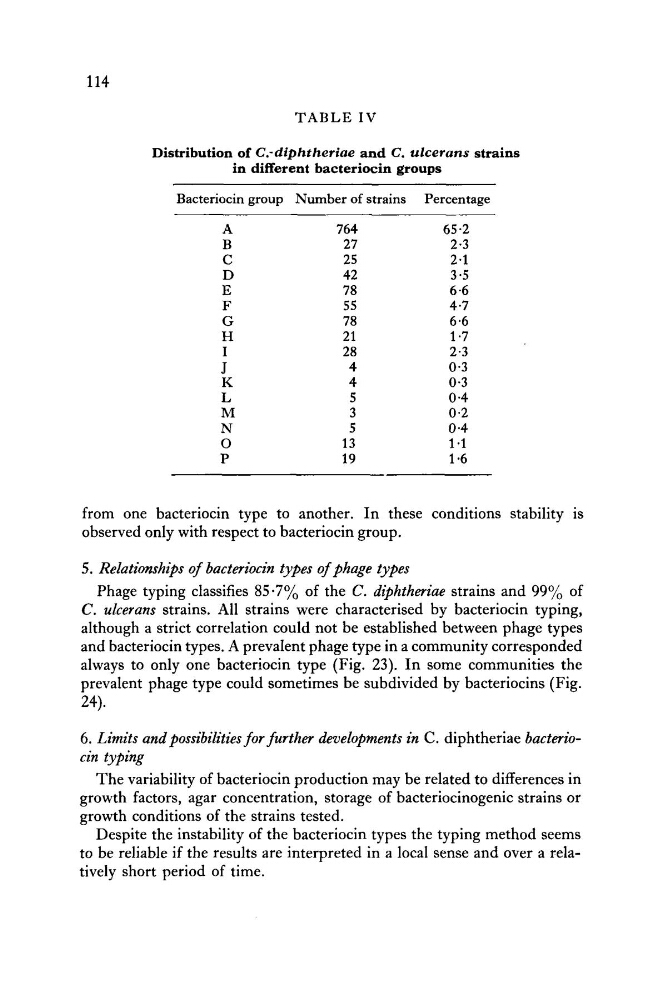
T A B L E IV
Distribution of C.-diphtheriae and C. ulcerans strains
in different bacteriocin groups
Bacteriocin group Number of strains Percentage
A
B
C
D
E
F
G
H
I
J
K
L
M
N
0
P
764
27
25
42
78
55
78
21
28
4
4
5
3
5
13
19
65.2
2.3
2.1
3.5
6.6
4.7
6.6
1 *7
2.3
0.3
0.3
0.4
0 . 2
0.4
1 *1
1 -6
from one bacteriocin type to another. I n these conditions stability is
observed only with respect to bacteriocin group.
5. Relationships of bacteriocin types of phage types
Phage typing classifies 85.7% of the C. diphtheriae strains and 99% of
C. ulcerans strains. All strains were characterised by bacteriocin typing,
although a strict correlation could not be established between phage types
and bacteriocin types. A prevalent phage type in a community corresponded
always to only one bacteriocin type (Fig. 23). I n some communities the
prevalent phage type could sometimes be subdivided by bacteriocins (Fig.
24).
6. Limits and possibilities for further developments in C . diphtheriae bacteriocin typing
The variability of bacteriocin production may be related to differences in
growth factors, agar concentration, storage of bacteriocinogenic strains or
growth conditions of the strains tested.
Despite the instability of the bacteriocin types the typing method seems
to be reliable if the results are interpreted in a local sense and over a relatively short period of time.
T A B L E IV
Distribution of C.-diphtheriae and C. ulcerans strains
in different bacteriocin groups
Bacteriocin group Number of strains Percentage
A
B
C
D
E
F
G
H
I
J
K
L
M
N
0
P
764
27
25
42
78
55
78
21
28
4
4
5
3
5
13
19
65.2
2.3
2.1
3.5
6.6
4.7
6.6
1 *7
2.3
0.3
0.3
0.4
0 . 2
0.4
1 *1
1 -6
from one bacteriocin type to another. I n these conditions stability is
observed only with respect to bacteriocin group.
5. Relationships of bacteriocin types of phage types
Phage typing classifies 85.7% of the C. diphtheriae strains and 99% of
C. ulcerans strains. All strains were characterised by bacteriocin typing,
although a strict correlation could not be established between phage types
and bacteriocin types. A prevalent phage type in a community corresponded
always to only one bacteriocin type (Fig. 23). I n some communities the
prevalent phage type could sometimes be subdivided by bacteriocins (Fig.
24).
6. Limits and possibilities for further developments in C . diphtheriae bacteriocin typing
The variability of bacteriocin production may be related to differences in
growth factors, agar concentration, storage of bacteriocinogenic strains or
growth conditions of the strains tested.
Despite the instability of the bacteriocin types the typing method seems
to be reliable if the results are interpreted in a local sense and over a relatively short period of time.