

1.4. Criteria for Optimal
Planning
29
The maximum revenue is designated by t- We note from the analysis that
max/ 2+3 = max[/ 2 (I>2i, Qu) + max fz(D 3t) Q 2 «)]
Finally we maximize all three reservoirs together such that
max/i+2+3 = max[/i(Dii, Qot) + max/ 2 +3]
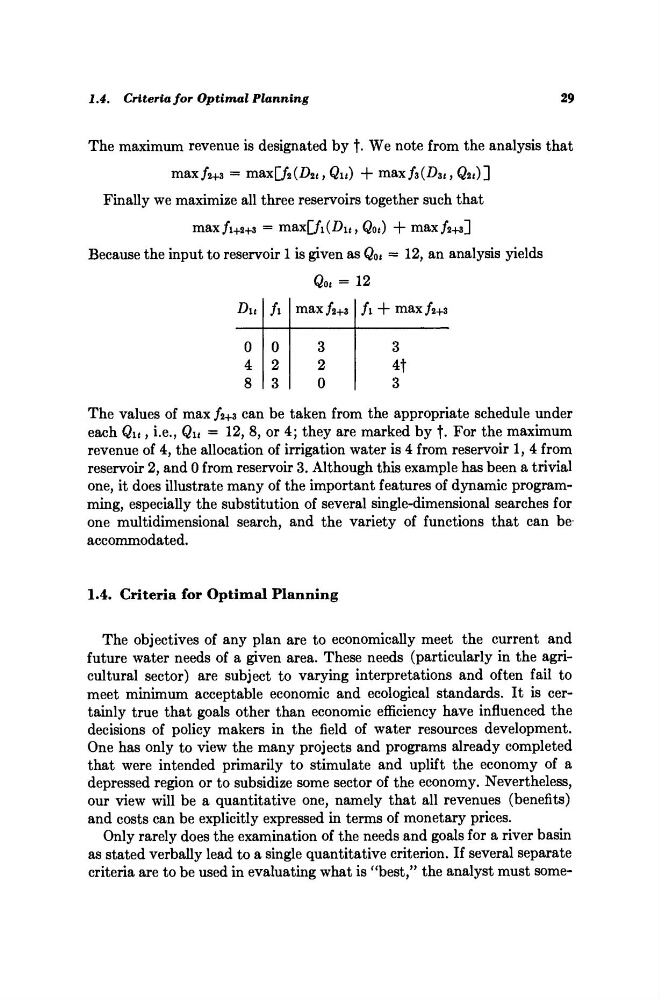
Because the input to reservoir 1 is given as Qot = 12, an analysis yields
Q ot = 12
D u
fx max/ 2+ 3 fi + max/ 2+ 3
0
0
3
3
4
2
2
4t
8
3
0
3
The values of max /2+3 can be taken from the appropriate schedule under
each Qu , i.e., Qu = 12, 8, or 4; they are marked by f. For the maximum
revenue of 4, the allocation of irrigation water is 4 from reservoir 1, 4 from
reservoir 2, and 0 from reservoir 3. Although this example has been a trivial
one, it does illustrate many of the important features of dynamic programming, especially the substitution of several single-dimensional searches for
one multidimensional search, and the variety of functions that can be
accommodated.
1.4. Criteria for Optimal Planning
The objectives of any plan are to economically meet the current and
future water needs of a given area. These needs (particularly in the agricultural sector) are subject to varying interpretations and often fail to
meet minimum acceptable economic and ecological standards. It is certainly true that goals other than economic efficiency have influenced the
decisions of policy makers in the field of water resources development.
One has only to view the many projects and programs already completed
that were intended primarily to stimulate and uplift the economy of a
depressed region or to subsidize some sector of the economy. Nevertheless,
our view will be a quantitative one, namely that all revenues (benefits)
and costs can be explicitly expressed in terms of monetary prices.
Only rarely does the examination of the needs and goals for a river basin
as stated verbally lead to a single quantitative criterion. If several separate
criteria are to be used in evaluating what is "best," the analyst must some-
Planning
29
The maximum revenue is designated by t- We note from the analysis that
max/ 2+3 = max[/ 2 (I>2i, Qu) + max fz(D 3t) Q 2 «)]
Finally we maximize all three reservoirs together such that
max/i+2+3 = max[/i(Dii, Qot) + max/ 2 +3]
Because the input to reservoir 1 is given as Qot = 12, an analysis yields
Q ot = 12
D u
fx max/ 2+ 3 fi + max/ 2+ 3
0
0
3
3
4
2
2
4t
8
3
0
3
The values of max /2+3 can be taken from the appropriate schedule under
each Qu , i.e., Qu = 12, 8, or 4; they are marked by f. For the maximum
revenue of 4, the allocation of irrigation water is 4 from reservoir 1, 4 from
reservoir 2, and 0 from reservoir 3. Although this example has been a trivial
one, it does illustrate many of the important features of dynamic programming, especially the substitution of several single-dimensional searches for
one multidimensional search, and the variety of functions that can be
accommodated.
1.4. Criteria for Optimal Planning
The objectives of any plan are to economically meet the current and
future water needs of a given area. These needs (particularly in the agricultural sector) are subject to varying interpretations and often fail to
meet minimum acceptable economic and ecological standards. It is certainly true that goals other than economic efficiency have influenced the
decisions of policy makers in the field of water resources development.
One has only to view the many projects and programs already completed
that were intended primarily to stimulate and uplift the economy of a
depressed region or to subsidize some sector of the economy. Nevertheless,
our view will be a quantitative one, namely that all revenues (benefits)
and costs can be explicitly expressed in terms of monetary prices.
Only rarely does the examination of the needs and goals for a river basin
as stated verbally lead to a single quantitative criterion. If several separate
criteria are to be used in evaluating what is "best," the analyst must some-