

28
1.
Introduction
drawn by each reservoir for a single time period t; we want to maximize
the irrigation revenue. Note that the reservoir releases have been listed in
multiples of four units for simplicity. Finally, assume that Qo t = 12 (all
flows are in thousand acre-feet).
Quantity of water withdrawn, D, t
(10* acre-ft)
Reservoir, j
0
4
8
12
Objective function data,
f t (D it ) (10* dollars)
1
0
2
3
3
2
0
2
3
4
3
0
1
2
3
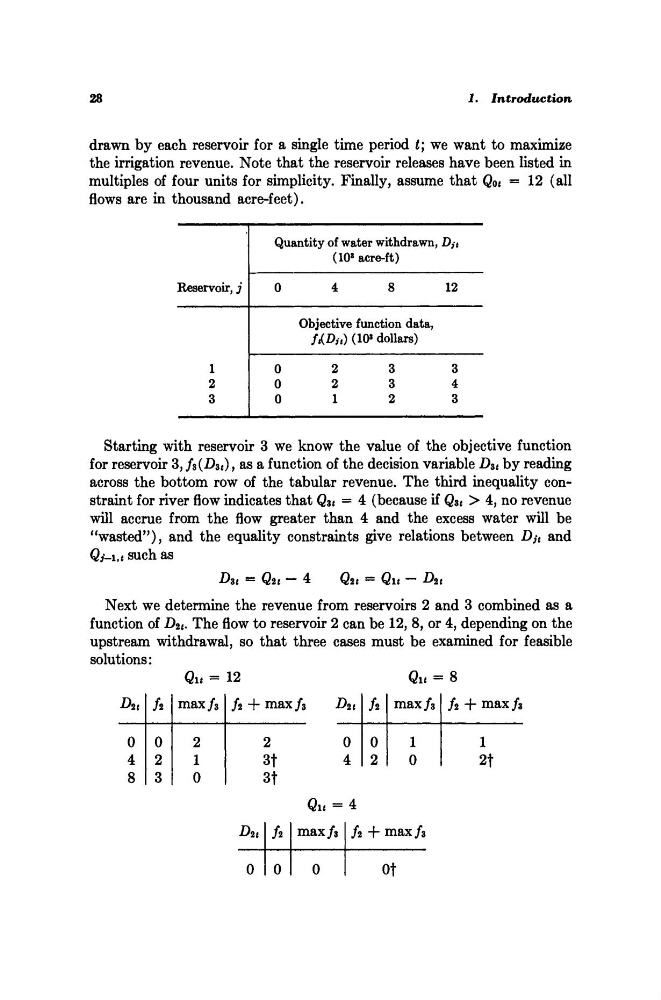
Starting with reservoir 3 we know the value of the objective function
for reservoir 3, fz(Dzt), as a function of the decision variable Dzt by reading
across the bottom row of the tabular revenue. The third inequality constraint for river flow indicates that Qzt = 4 (because if Qzt > 4, no revenue
will accrue from the flow greater than 4 and the excess water will be
"wasted"), and the equality constraints give relations between Dj t and
Q/_i,t such as
Dzt = Qu — 4
Qu = Qu — D 2t
Next we determine the revenue from reservoirs 2 and 3 combined as a
function of D 2t . The flow to reservoir 2 can be 12, 8, or 4, depending on the
upstream withdrawal, so that three cases must be examined for feasible
solutions:
Qu = 12
Qu = • • 8
Dtt /* max/3 / 2 + max/3
D 2t
h max/ 3 / 2 + max/3
0 0
2
2
0 0
1
1
4 2
1
3t
4 2
0
2t
8 3
0
3t
Qu = 4
Dtt
/·
max/3 / 2 + max/s
0 0
0
ot
1.
Introduction
drawn by each reservoir for a single time period t; we want to maximize
the irrigation revenue. Note that the reservoir releases have been listed in
multiples of four units for simplicity. Finally, assume that Qo t = 12 (all
flows are in thousand acre-feet).
Quantity of water withdrawn, D, t
(10* acre-ft)
Reservoir, j
0
4
8
12
Objective function data,
f t (D it ) (10* dollars)
1
0
2
3
3
2
0
2
3
4
3
0
1
2
3
Starting with reservoir 3 we know the value of the objective function
for reservoir 3, fz(Dzt), as a function of the decision variable Dzt by reading
across the bottom row of the tabular revenue. The third inequality constraint for river flow indicates that Qzt = 4 (because if Qzt > 4, no revenue
will accrue from the flow greater than 4 and the excess water will be
"wasted"), and the equality constraints give relations between Dj t and
Q/_i,t such as
Dzt = Qu — 4
Qu = Qu — D 2t
Next we determine the revenue from reservoirs 2 and 3 combined as a
function of D 2t . The flow to reservoir 2 can be 12, 8, or 4, depending on the
upstream withdrawal, so that three cases must be examined for feasible
solutions:
Qu = 12
Qu = • • 8
Dtt /* max/3 / 2 + max/3
D 2t
h max/ 3 / 2 + max/3
0 0
2
2
0 0
1
1
4 2
1
3t
4 2
0
2t
8 3
0
3t
Qu = 4
Dtt
/·
max/3 / 2 + max/s
0 0
0
ot