

18
1.
Introduction
is linear in the variables xi 9 x%, and x Z} whereas the function
2#i
2 + X1X2 + 3 exp(xz)
is nonlinear in the same variables.
Although the linear programming problem can be stated in many related
forms, we will write it as follows [Dantzig, 1963; Wilde and Beightler,
1967]:
Maximize
/(*) -
Σ«*<
(1.1a)
i—1
subject to
η
Σ
difCi
— bj < 0
j = 1,..
. , m
(Lib)
Xi>0
i = 1,.. . , η
(1-lc)
where the a's, b's, and c's are constants and the x's are the variables whose
values are sought. (If equality constraints are involved in the problem,
*2
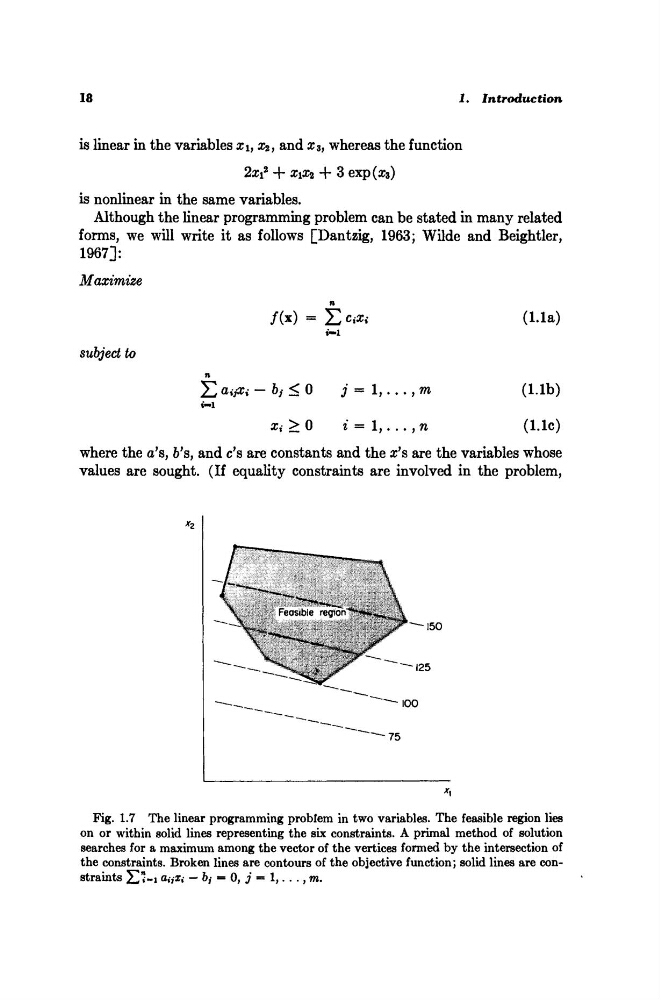
Fig. 1.7 The linear programming problem in two variables. The feasible region lies
on or within solid lines representing the six constraints. A primal method of solution
searches for a maximum among the vector of the vertices formed by the intersection of
the constraints. Broken lines are contours of the objective function; solid lines are constraints
"-ι OijZi — &,= 0, j = 1,.. ., m.
1.
Introduction
is linear in the variables xi 9 x%, and x Z} whereas the function
2#i
2 + X1X2 + 3 exp(xz)
is nonlinear in the same variables.
Although the linear programming problem can be stated in many related
forms, we will write it as follows [Dantzig, 1963; Wilde and Beightler,
1967]:
Maximize
/(*) -
Σ«*<
(1.1a)
i—1
subject to
η
Σ
difCi
— bj < 0
j = 1,..
. , m
(Lib)
Xi>0
i = 1,.. . , η
(1-lc)
where the a's, b's, and c's are constants and the x's are the variables whose
values are sought. (If equality constraints are involved in the problem,
*2
Fig. 1.7 The linear programming problem in two variables. The feasible region lies
on or within solid lines representing the six constraints. A primal method of solution
searches for a maximum among the vector of the vertices formed by the intersection of
the constraints. Broken lines are contours of the objective function; solid lines are constraints
"-ι OijZi — &,= 0, j = 1,.. ., m.