

154
6. Water Quality and Pollution
Considerations
2. Nonlinearities appear in the OP problem. Since the reservoir releases
(Qimt)
and the water quality (BEimt )
are both independent variables,
every time that these variables are paired, nonlinear equations are formed.
For example, in Eq. (6.11) the product (BEi mt)
(Qimt) is nonlinear, as are
the other terms. Similar pairings occur between the variables in Eq. (6.12).
If nonlinear functions form part of the constraints or the objective function in the OP problem, the out-of-kilter algorithm can no longer be used.
Instead, the following alternative algorithm is proposed for solving the
OP problem.
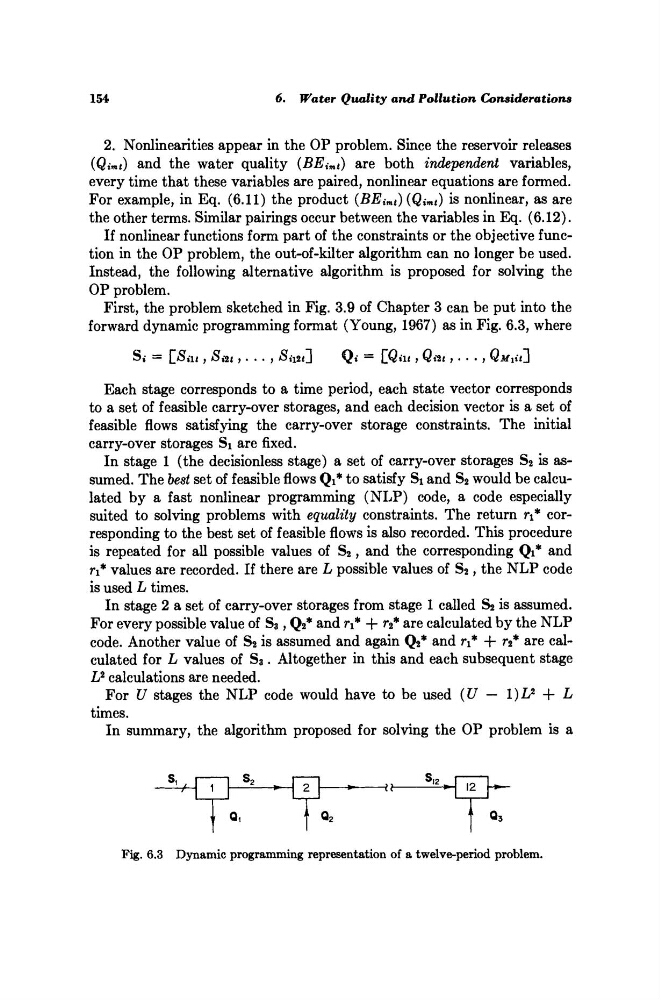
First, the problem sketched in Fig. 3.9 of Chapter 3 can be put into the
forward dynamic programming format (Young, 1967) as in Fig. 6.3, where
Si = [jSilt , Si2t y · · . ; $ιΊ2*1
Qi = [Qilt > QiU · · · · > QM\it]
Each stage corresponds to a time period, each state vector corresponds
to a set of feasible carry-over storages, and each decision vector is a set of
feasible flows satisfying the carry-over storage constraints. The initial
carry-over storages Si are fixed.
In stage 1 (the decisionless stage) a set of carry-over storages S2 is assumed. The best set of feasible flows Qi* to satisfy Si and S2 would be calculated by a fast nonlinear programming (NLP) code, a code especially
suited to solving problems with equality constraints. The return ri* corresponding to the best set of feasible flows is also recorded. This procedure
is repeated for all possible values of S 2 , and the corresponding Qi* and
n* values are recorded. If there are L possible values of S2, the NLP code
is used L times.
In stage 2 a set of carry-over storages from stage 1 called S2 is assumed.
For every possible value of S3, Q2* and ri* + r 2 * are calculated by the NLP
code. Another value of S2 is assumed and again Q 2 * and ri* + r 2 * are calculated for L values of S 3 . Altogether in this and each subsequent stage
L
2 calculations are needed.
For U stages the NLP code would have to be used (U — 1)L
2 + L
times.
In summary, the algorithm proposed for solving the OP problem is a
12
Fig. 6.3 Dynamic programming representation of a twelve-period problem.
6. Water Quality and Pollution
Considerations
2. Nonlinearities appear in the OP problem. Since the reservoir releases
(Qimt)
and the water quality (BEimt )
are both independent variables,
every time that these variables are paired, nonlinear equations are formed.
For example, in Eq. (6.11) the product (BEi mt)
(Qimt) is nonlinear, as are
the other terms. Similar pairings occur between the variables in Eq. (6.12).
If nonlinear functions form part of the constraints or the objective function in the OP problem, the out-of-kilter algorithm can no longer be used.
Instead, the following alternative algorithm is proposed for solving the
OP problem.
First, the problem sketched in Fig. 3.9 of Chapter 3 can be put into the
forward dynamic programming format (Young, 1967) as in Fig. 6.3, where
Si = [jSilt , Si2t y · · . ; $ιΊ2*1
Qi = [Qilt > QiU · · · · > QM\it]
Each stage corresponds to a time period, each state vector corresponds
to a set of feasible carry-over storages, and each decision vector is a set of
feasible flows satisfying the carry-over storage constraints. The initial
carry-over storages Si are fixed.
In stage 1 (the decisionless stage) a set of carry-over storages S2 is assumed. The best set of feasible flows Qi* to satisfy Si and S2 would be calculated by a fast nonlinear programming (NLP) code, a code especially
suited to solving problems with equality constraints. The return ri* corresponding to the best set of feasible flows is also recorded. This procedure
is repeated for all possible values of S 2 , and the corresponding Qi* and
n* values are recorded. If there are L possible values of S2, the NLP code
is used L times.
In stage 2 a set of carry-over storages from stage 1 called S2 is assumed.
For every possible value of S3, Q2* and ri* + r 2 * are calculated by the NLP
code. Another value of S2 is assumed and again Q 2 * and ri* + r 2 * are calculated for L values of S 3 . Altogether in this and each subsequent stage
L
2 calculations are needed.
For U stages the NLP code would have to be used (U — 1)L
2 + L
times.
In summary, the algorithm proposed for solving the OP problem is a
12
Fig. 6.3 Dynamic programming representation of a twelve-period problem.