

6.4. Optimization
of the Model Including
Water
Quality
153
6.3.5. Other
Constraints
(a)
FUTURE POLLUTION LOADS
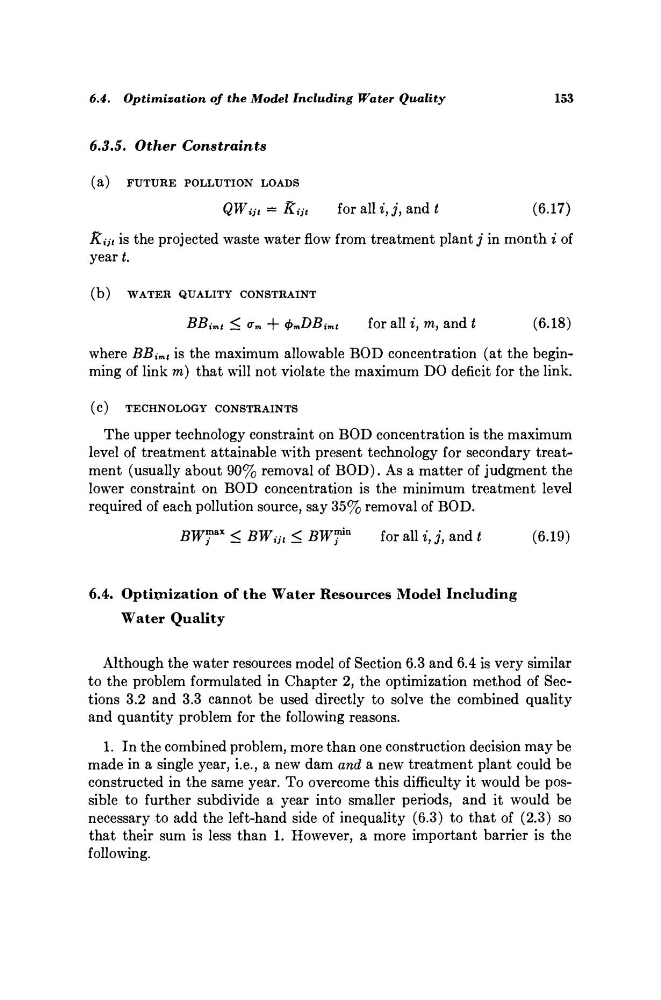
QWijt
= Rijt
for all i, j, and t
(6-17)
Rijt is the projected waste water flow from treatment plant j in month i of
year t.
(b)
WATER QUALITY CONSTRAINT
BBimt < σ τη +mDB im t
for all i, m, and ί
(6.18)
where 5^ lme is the maximum allowable BOD concentration (at the beginming of link m) that will not violate the maximum DO deficit for the link.
(c)
TECHNOLOGY CONSTRAINTS
The upper technology constraint on BOD concentration is the maximum
level of treatment attainable with present technology for secondary treatment (usually about 90% removal of BOD). As a matter of judgment the
lower constraint on BOD concentration is the minimum treatment level
required of each pollution source, say 35% removal of BOD.
BW?*
X
< BWi Jt
< BWf
n
for all i, j, and t
(6.19)
6.4. Optimization of the Water Resources Model Including
Water Quality
Although the water resources model of Section 6.3 and 6.4 is very similar
to the problem formulated in Chapter 2, the optimization method of Sections 3.2 and 3.3 cannot be used directly to solve the combined quality
and quantity problem for the following reasons.
1. In the combined problem, more than one construction decision may be
made in a single year, i.e., a new dam and a new treatment plant could be
constructed in the same year. To overcome this difficulty it would be possible to further subdivide a year into smaller periods, and it would be
necessary to add the left-hand side of inequality (6.3) to that of (2.3) so
that their sum is less than 1. However, a more important barrier is the
following.
of the Model Including
Water
Quality
153
6.3.5. Other
Constraints
(a)
FUTURE POLLUTION LOADS
QWijt
= Rijt
for all i, j, and t
(6-17)
Rijt is the projected waste water flow from treatment plant j in month i of
year t.
(b)
WATER QUALITY CONSTRAINT
BBimt < σ τη +
for all i, m, and ί
(6.18)
where 5^ lme is the maximum allowable BOD concentration (at the beginming of link m) that will not violate the maximum DO deficit for the link.
(c)
TECHNOLOGY CONSTRAINTS
The upper technology constraint on BOD concentration is the maximum
level of treatment attainable with present technology for secondary treatment (usually about 90% removal of BOD). As a matter of judgment the
lower constraint on BOD concentration is the minimum treatment level
required of each pollution source, say 35% removal of BOD.
BW?*
X
< BWi Jt
< BWf
n
for all i, j, and t
(6.19)
6.4. Optimization of the Water Resources Model Including
Water Quality
Although the water resources model of Section 6.3 and 6.4 is very similar
to the problem formulated in Chapter 2, the optimization method of Sections 3.2 and 3.3 cannot be used directly to solve the combined quality
and quantity problem for the following reasons.
1. In the combined problem, more than one construction decision may be
made in a single year, i.e., a new dam and a new treatment plant could be
constructed in the same year. To overcome this difficulty it would be possible to further subdivide a year into smaller periods, and it would be
necessary to add the left-hand side of inequality (6.3) to that of (2.3) so
that their sum is less than 1. However, a more important barrier is the
following.