

6.3. Formulating
the Problem to Include Water
Quality
149
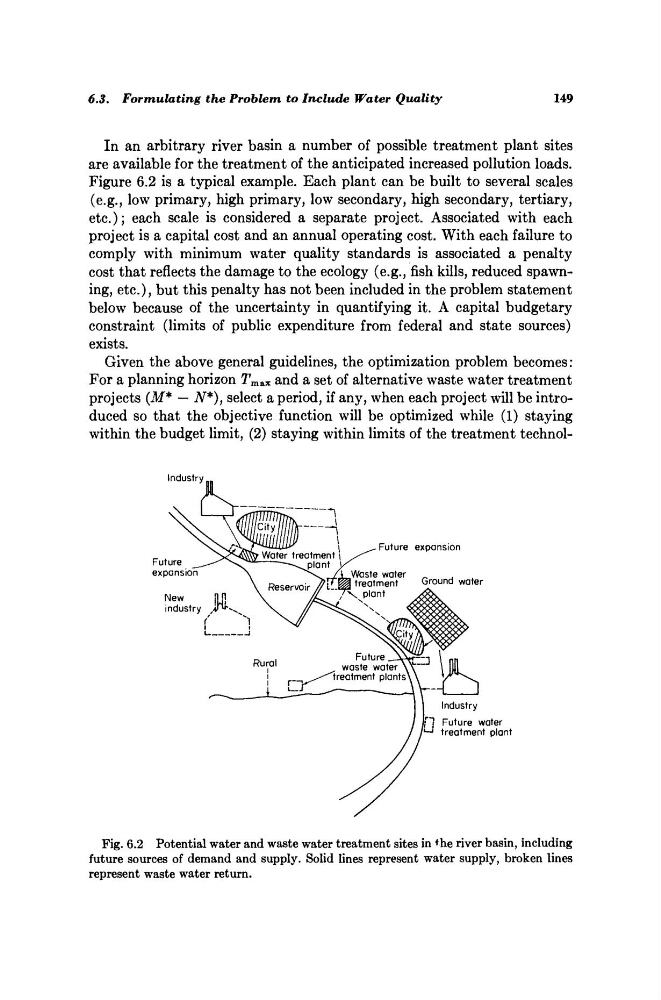
In an arbitrary river basin a number of possible treatment plant sites
are available for the treatment of the anticipated increased pollution loads.
Figure 6.2 is a typical example. Each plant can be built to several scales
(e.g., low primary, high primary, low secondary, high secondary, tertiary,
etc.); each scale is considered a separate project. Associated with each
project is a capital cost and an annual operating cost. With each failure to
comply with minimum water quality standards is associated a penalty
cost that reflects the damage to the ecology (e.g., fish kills, reduced spawning, etc.), but this penalty has not been included in the problem statement
below because of the uncertainty in quantifying it. A capital budgetary
constraint (limits of public expenditure from federal and state sources)
exists.
Given the above general guidelines, the optimization problem becomes:
For a planning horizon T m&x and a set of alternative waste water treatment
projects (M* — JV*), select a period, if any, when each project will be introduced so that the objective function will be optimized while (1) staying
within the budget limit, (2) staying within limits of the treatment technolFig. 6.2 Potential water and waste water treatment sites in *he river basin, including
future sources of demand and supply. Solid lines represent water supply, broken lines
represent waste water return.
the Problem to Include Water
Quality
149
In an arbitrary river basin a number of possible treatment plant sites
are available for the treatment of the anticipated increased pollution loads.
Figure 6.2 is a typical example. Each plant can be built to several scales
(e.g., low primary, high primary, low secondary, high secondary, tertiary,
etc.); each scale is considered a separate project. Associated with each
project is a capital cost and an annual operating cost. With each failure to
comply with minimum water quality standards is associated a penalty
cost that reflects the damage to the ecology (e.g., fish kills, reduced spawning, etc.), but this penalty has not been included in the problem statement
below because of the uncertainty in quantifying it. A capital budgetary
constraint (limits of public expenditure from federal and state sources)
exists.
Given the above general guidelines, the optimization problem becomes:
For a planning horizon T m&x and a set of alternative waste water treatment
projects (M* — JV*), select a period, if any, when each project will be introduced so that the objective function will be optimized while (1) staying
within the budget limit, (2) staying within limits of the treatment technolFig. 6.2 Potential water and waste water treatment sites in *he river basin, including
future sources of demand and supply. Solid lines represent water supply, broken lines
represent waste water return.