

6.2. Concepts Involved in Planning for Water
Quality
147
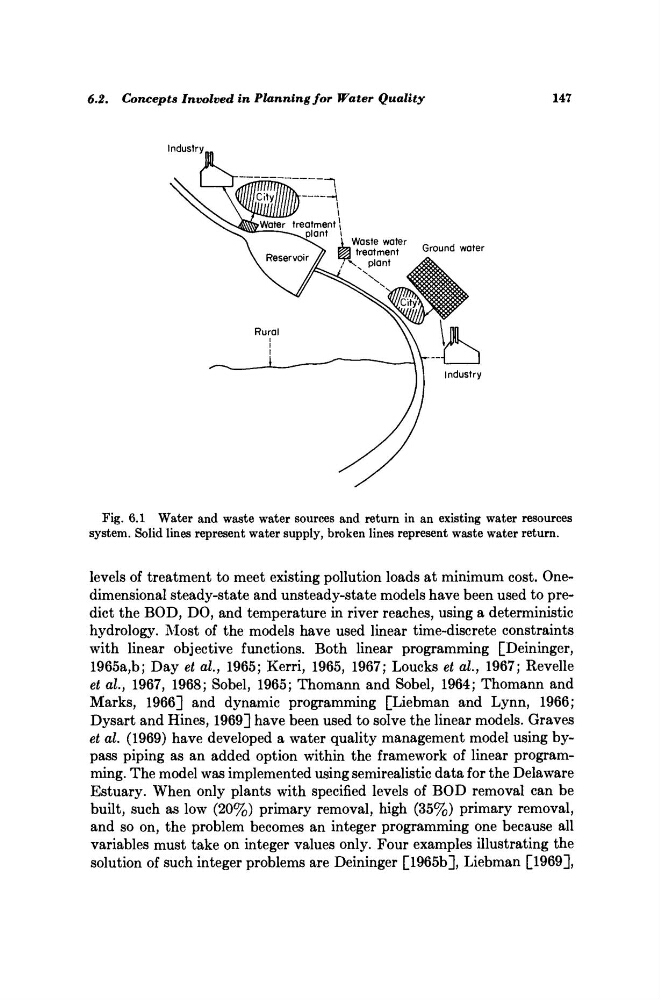
Fig. 6.1 Water and waste water sources and return in an existing water resources
system. Solid lines represent water supply, broken lines represent waste water return.
levels of treatment to meet existing pollution loads at minimum cost. Onedimensional steady-state and unsteady-state models have been used to predict the BOD, DO, and temperature in river reaches, using a deterministic
hydrology. Most of the models have used linear time-discrete constraints
with linear objective functions. Both linear programming [Deininger,
1965a,b; Day et al, 1965; Kerri, 1965, 1967; Loucks et al } 1967; Revelle
et al, 1967, 1968; Sobel, 1965; Thomann and Sobel, 1964; Thomann and
Marks, 1966] and dynamic programming [Liebman and Lynn, 1966;
Dysart and Hines, 1969] have been used to solve the linear models. Graves
et al (1969) have developed a water quality management model using bypass piping as an added option within the framework of linear programming. The model was implemented using semirealistic data for the Delaware
Estuary. When only plants with specified levels of BOD removal can be
built, such as low (20%) primary removal, high (35%) primary removal,
and so on, the problem becomes an integer programming one because all
variables must take on integer values only. Four examples illustrating the
solution of such integer problems are Deininger [1965b], Liebman [1969],
Quality
147
Fig. 6.1 Water and waste water sources and return in an existing water resources
system. Solid lines represent water supply, broken lines represent waste water return.
levels of treatment to meet existing pollution loads at minimum cost. Onedimensional steady-state and unsteady-state models have been used to predict the BOD, DO, and temperature in river reaches, using a deterministic
hydrology. Most of the models have used linear time-discrete constraints
with linear objective functions. Both linear programming [Deininger,
1965a,b; Day et al, 1965; Kerri, 1965, 1967; Loucks et al } 1967; Revelle
et al, 1967, 1968; Sobel, 1965; Thomann and Sobel, 1964; Thomann and
Marks, 1966] and dynamic programming [Liebman and Lynn, 1966;
Dysart and Hines, 1969] have been used to solve the linear models. Graves
et al (1969) have developed a water quality management model using bypass piping as an added option within the framework of linear programming. The model was implemented using semirealistic data for the Delaware
Estuary. When only plants with specified levels of BOD removal can be
built, such as low (20%) primary removal, high (35%) primary removal,
and so on, the problem becomes an integer programming one because all
variables must take on integer values only. Four examples illustrating the
solution of such integer problems are Deininger [1965b], Liebman [1969],