

398
JAMES E. DEACON AND W. L. MINCKLEY
C. LAKES
In some arid regions, water from rivers or springs may accumulate in
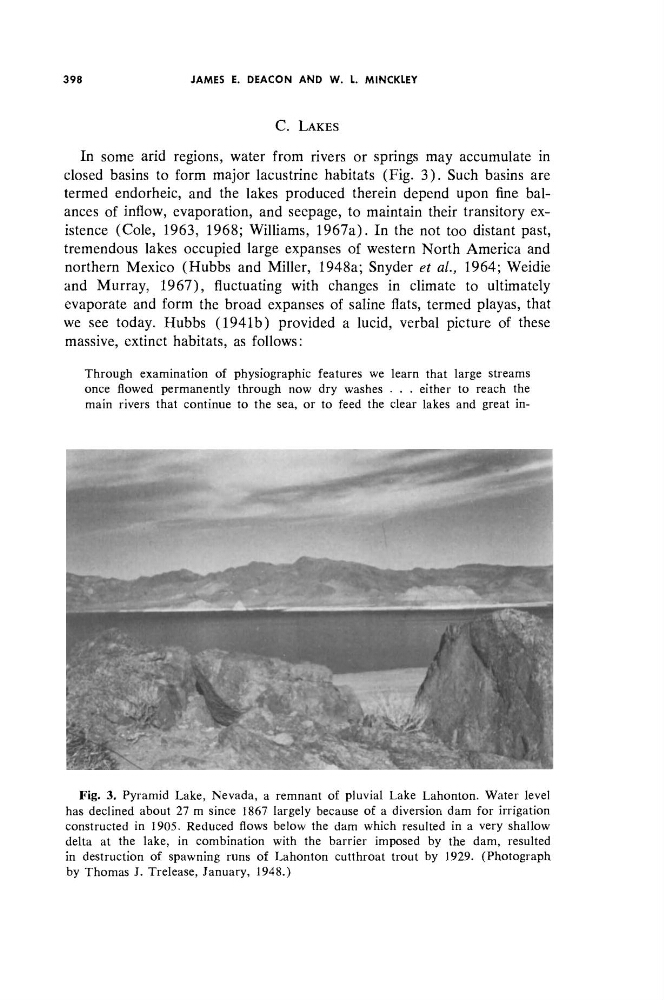
closed basins to form major lacustrine habitats (Fig. 3). Such basins are
termed endorheic, and the lakes produced therein depend upon fine balances of inflow, evaporation, and seepage, to maintain their transitory existence (Cole, 1963, 1968; Williams, 1967a). In the not too distant past,
tremendous lakes occupied large expanses of western North America and
northern Mexico (Hubbs and Miller, 1948a; Snyder et al, 1964; Weidie
and Murray, 1967), fluctuating with changes in climate to ultimately
evaporate and form the broad expanses of saline flats, termed playas, that
we see today. Hubbs (1941b) provided a lucid, verbal picture of these
massive, extinct habitats, as follows:
Through examination of physiographic features we learn that large streams
once flowed permanently through now dry washes . . . either to reach the
main rivers that continue to the sea, or to feed the clear lakes and great inFig. 3. Pyramid Lake, Nevada, a remnant of pluvial Lake Lahonton. Water level
has declined about 27 m since 1867 largely because of a diversion dam for irrigation
constructed in 1905. Reduced flows below the dam which resulted in a very shallow
delta at the lake, in combination with the barrier imposed by the dam, resulted
in destruction of spawning runs of Lahonton cutthroat trout by 1929. (Photograph
by Thomas J. Trelease, January, 1948.)
JAMES E. DEACON AND W. L. MINCKLEY
C. LAKES
In some arid regions, water from rivers or springs may accumulate in
closed basins to form major lacustrine habitats (Fig. 3). Such basins are
termed endorheic, and the lakes produced therein depend upon fine balances of inflow, evaporation, and seepage, to maintain their transitory existence (Cole, 1963, 1968; Williams, 1967a). In the not too distant past,
tremendous lakes occupied large expanses of western North America and
northern Mexico (Hubbs and Miller, 1948a; Snyder et al, 1964; Weidie
and Murray, 1967), fluctuating with changes in climate to ultimately
evaporate and form the broad expanses of saline flats, termed playas, that
we see today. Hubbs (1941b) provided a lucid, verbal picture of these
massive, extinct habitats, as follows:
Through examination of physiographic features we learn that large streams
once flowed permanently through now dry washes . . . either to reach the
main rivers that continue to the sea, or to feed the clear lakes and great inFig. 3. Pyramid Lake, Nevada, a remnant of pluvial Lake Lahonton. Water level
has declined about 27 m since 1867 largely because of a diversion dam for irrigation
constructed in 1905. Reduced flows below the dam which resulted in a very shallow
delta at the lake, in combination with the barrier imposed by the dam, resulted
in destruction of spawning runs of Lahonton cutthroat trout by 1929. (Photograph
by Thomas J. Trelease, January, 1948.)