

VII. DESERT FISHES
389
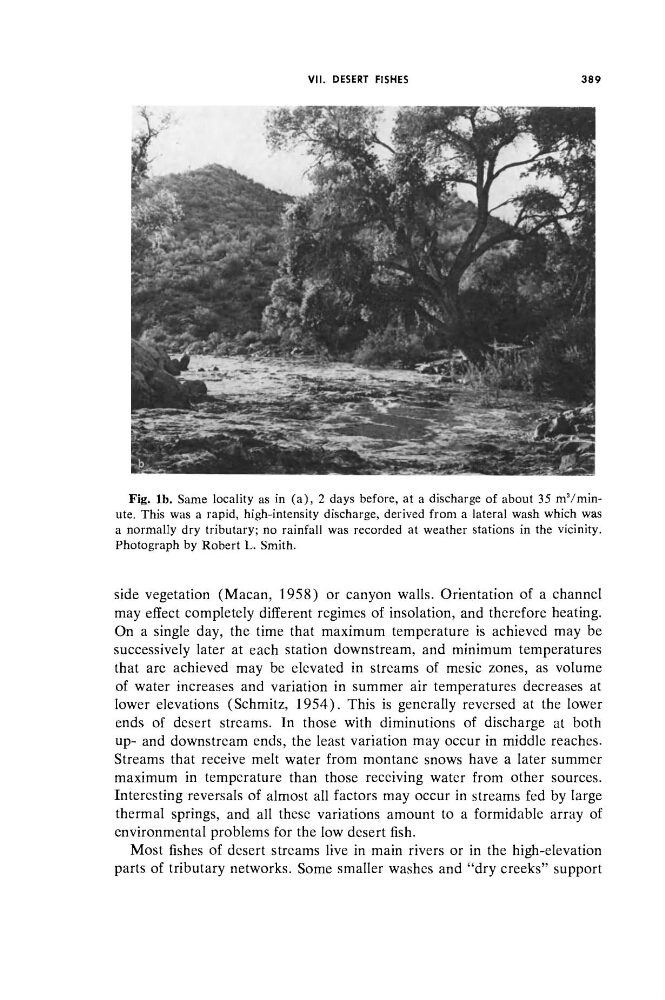
Fig. Ib. Same locality as in (a), 2 days before, at a discharge of about 35 mVminute. This was a rapid, high-intensity discharge, derived from a lateral wash which was
a normally dry tributary; no rainfall was recorded at weather stations in the vicinity.
Photograph by Robert L. Smith.
side vegetation (Macan, 1958) or canyon walls. Orientation of a channel
may effect completely different regimes of insolation, and therefore heating.
On a single day, the time that maximum temperature is achieved may be
successively later at each station downstream, and minimum temperatures
that are achieved may be elevated in streams of mesic zones, as volume
of water increases and variation in summer air temperatures decreases at
lower elevations (Schmitz, 1954). This is generally reversed at the lower
ends of desert streams. In those with diminutions of discharge at both
up- and downstream ends, the least variation may occur in middle reaches.
Streams that receive melt water from montane snows have a later summer
maximum in temperature than those receiving water from other sources.
Interesting reversals of almost all factors may occur in streams fed by large
thermal springs, and all these variations amount to a formidable array of
environmental problems for the low desert fish.
Most fishes of desert streams live in main rivers or in the high-elevation
parts of tributary networks. Some smaller washes and "dry creeks" support
389
Fig. Ib. Same locality as in (a), 2 days before, at a discharge of about 35 mVminute. This was a rapid, high-intensity discharge, derived from a lateral wash which was
a normally dry tributary; no rainfall was recorded at weather stations in the vicinity.
Photograph by Robert L. Smith.
side vegetation (Macan, 1958) or canyon walls. Orientation of a channel
may effect completely different regimes of insolation, and therefore heating.
On a single day, the time that maximum temperature is achieved may be
successively later at each station downstream, and minimum temperatures
that are achieved may be elevated in streams of mesic zones, as volume
of water increases and variation in summer air temperatures decreases at
lower elevations (Schmitz, 1954). This is generally reversed at the lower
ends of desert streams. In those with diminutions of discharge at both
up- and downstream ends, the least variation may occur in middle reaches.
Streams that receive melt water from montane snows have a later summer
maximum in temperature than those receiving water from other sources.
Interesting reversals of almost all factors may occur in streams fed by large
thermal springs, and all these variations amount to a formidable array of
environmental problems for the low desert fish.
Most fishes of desert streams live in main rivers or in the high-elevation
parts of tributary networks. Some smaller washes and "dry creeks" support