

388
JAMES E. DEACON AND W. L. MINCKLEY
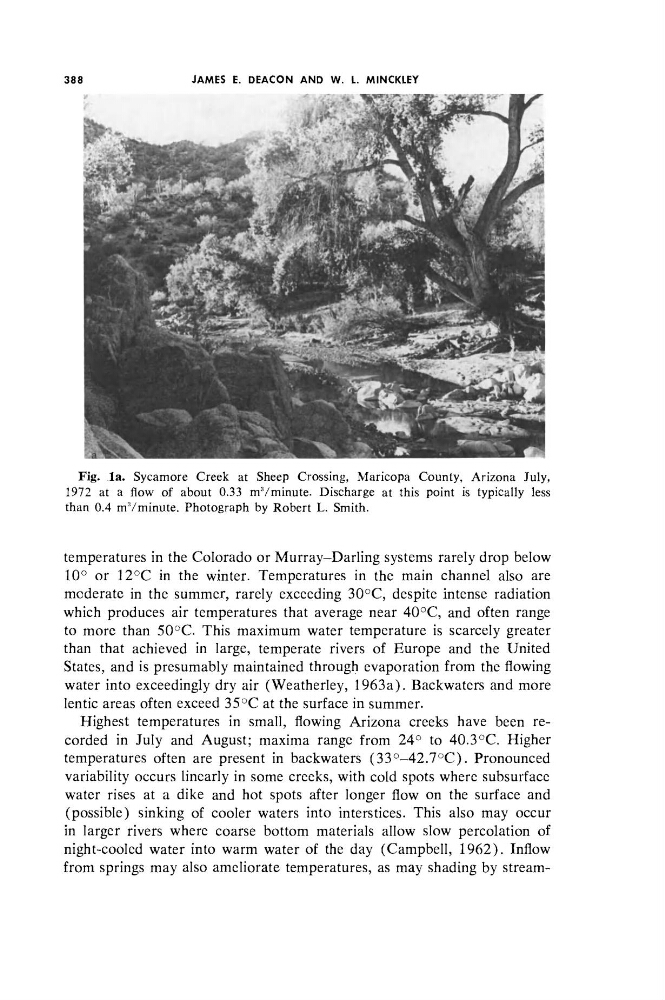
Fig. la. Sycamore Creek at Sheep Crossing, Maricopa County, Arizona July,
1972 at a flow of about 0.33 mVminute. Discharge at this point is typically less
than 0.4 mVminute. Photograph by Robert L. Smith.
temperatures in the Colorado or Murray-Darling systems rarely drop below
10° or 12°C in the winter. Temperatures in the main channel also are
moderate in the summer, rarely exceeding 30°C, despite intense radiation
which produces air temperatures that average near 40°C, and often range
to more than 50°C. This maximum water temperature is scarcely greater
than that achieved in large, temperate rivers of Europe and the United
States, and is presumably maintained through evaporation from the flowing
water into exceedingly dry air (Weatherley, 1963a). Backwaters and more
lentic areas often exceed 35°C at the surface in summer.
Highest temperatures in small, flowing Arizona creeks have been recorded in July and August; maxima range from 24° to 40.3°C. Higher
temperatures often are present in backwaters (33°-42.7°C). Pronounced
variability occurs linearly in some creeks, with cold spots where subsurface
water rises at a dike and hot spots after longer flow on the surface and
(possible) sinking of cooler waters into interstices. This also may occur
in larger rivers where coarse bottom materials allow slow percolation of
night-cooled water into warm water of the day (Campbell, 1962). Inflow
from springs may also ameliorate temperatures, as may shading by stream-
JAMES E. DEACON AND W. L. MINCKLEY
Fig. la. Sycamore Creek at Sheep Crossing, Maricopa County, Arizona July,
1972 at a flow of about 0.33 mVminute. Discharge at this point is typically less
than 0.4 mVminute. Photograph by Robert L. Smith.
temperatures in the Colorado or Murray-Darling systems rarely drop below
10° or 12°C in the winter. Temperatures in the main channel also are
moderate in the summer, rarely exceeding 30°C, despite intense radiation
which produces air temperatures that average near 40°C, and often range
to more than 50°C. This maximum water temperature is scarcely greater
than that achieved in large, temperate rivers of Europe and the United
States, and is presumably maintained through evaporation from the flowing
water into exceedingly dry air (Weatherley, 1963a). Backwaters and more
lentic areas often exceed 35°C at the surface in summer.
Highest temperatures in small, flowing Arizona creeks have been recorded in July and August; maxima range from 24° to 40.3°C. Higher
temperatures often are present in backwaters (33°-42.7°C). Pronounced
variability occurs linearly in some creeks, with cold spots where subsurface
water rises at a dike and hot spots after longer flow on the surface and
(possible) sinking of cooler waters into interstices. This also may occur
in larger rivers where coarse bottom materials allow slow percolation of
night-cooled water into warm water of the day (Campbell, 1962). Inflow
from springs may also ameliorate temperatures, as may shading by stream-