

E. B. EDNEY
Sunrise
a.m.
Hours local time (G.M.T.
7
8
9 10
II 12
1
2
3
20
50
o
£- 40
3 30
CO
0)
B
20
H i o · — · < > -
1) p.m. Sunset
4
5
6
7
—I
1
I
L_
• Ground (sun)
S Ground (shade)
A Air (sun +2 cm)
Jr+*+\
. /
-AS'
•
A '
y \ s — s -
ÀXi-A
I
I
I
_i
I
i
I
I
8
9
10 II 12
1
2
3
4
a. m.
Hours local time (G.M.T. + 1)
5
6
p. m.
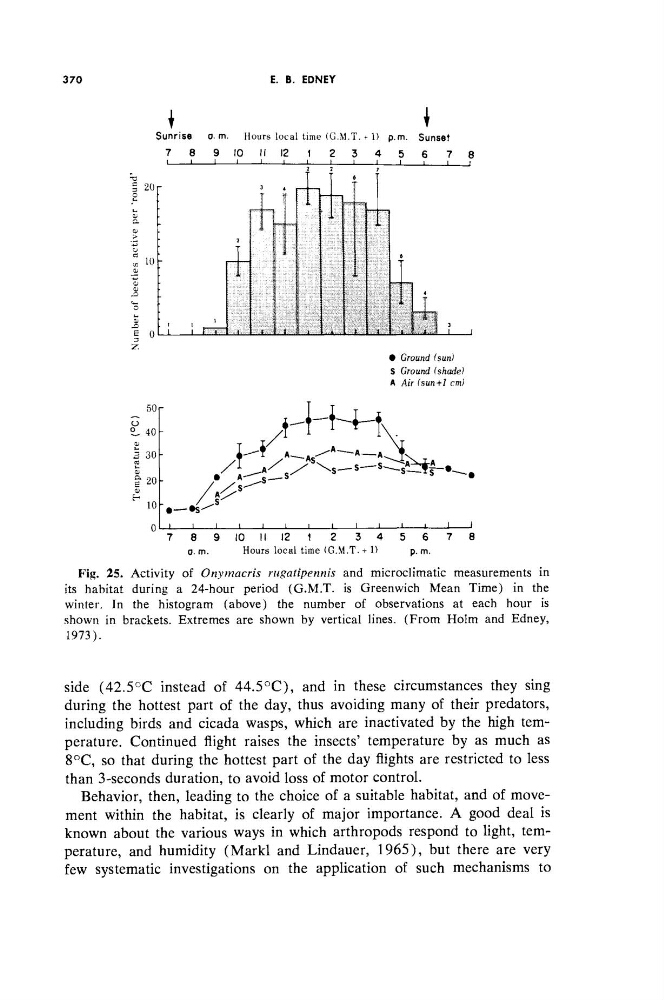
Fig. 25. Activity of Onymacris rugatipennis and microclimatic measurements in
its habitat during a 24-hour period (G.M.T. is Greenwich Mean Time) in the
winter. In the histogram (above) the number of observations at each hour is
shown in brackets. Extremes are shown by vertical lines. (From Holm and Edney,
1973).
side (42.5°C instead of 44.5°C), and in these circumstances they sing
during the hottest part of the day, thus avoiding many of their predators,
including birds and cicada wasps, which are inactivated by the high temperature. Continued flight raises the insects' temperature by as much as
8°C, so that during the hottest part of the day flights are restricted to less
than 3-seconds duration, to avoid loss of motor control.
Behavior, then, leading to the choice of a suitable habitat, and of movement within the habitat, is clearly of major importance. A good deal is
known about the various ways in which arthropods respond to light, temperature, and humidity (Markl and Lindauer, 1965), but there are very
few systematic investigations on the application of such mechanisms to
Sunrise
a.m.
Hours local time (G.M.T.
7
8
9 10
II 12
1
2
3
20
50
o
£- 40
3 30
CO
0)
B
20
H i o · — · < > -
1) p.m. Sunset
4
5
6
7
—I
1
I
L_
• Ground (sun)
S Ground (shade)
A Air (sun +2 cm)
Jr+*+\
. /
-AS'
•
A '
y \ s — s -
ÀXi-A
I
I
I
_i
I
i
I
I
8
9
10 II 12
1
2
3
4
a. m.
Hours local time (G.M.T. + 1)
5
6
p. m.
Fig. 25. Activity of Onymacris rugatipennis and microclimatic measurements in
its habitat during a 24-hour period (G.M.T. is Greenwich Mean Time) in the
winter. In the histogram (above) the number of observations at each hour is
shown in brackets. Extremes are shown by vertical lines. (From Holm and Edney,
1973).
side (42.5°C instead of 44.5°C), and in these circumstances they sing
during the hottest part of the day, thus avoiding many of their predators,
including birds and cicada wasps, which are inactivated by the high temperature. Continued flight raises the insects' temperature by as much as
8°C, so that during the hottest part of the day flights are restricted to less
than 3-seconds duration, to avoid loss of motor control.
Behavior, then, leading to the choice of a suitable habitat, and of movement within the habitat, is clearly of major importance. A good deal is
known about the various ways in which arthropods respond to light, temperature, and humidity (Markl and Lindauer, 1965), but there are very
few systematic investigations on the application of such mechanisms to