

VI. DESERT ARTHROPODS
367
than in the spring and fall, but what triggers this daily rhythm of activity
is not clear. Certainly the actual surface temperatures at the time of activity vary widely from month to month so that this by itself can hardly provide an explanation.
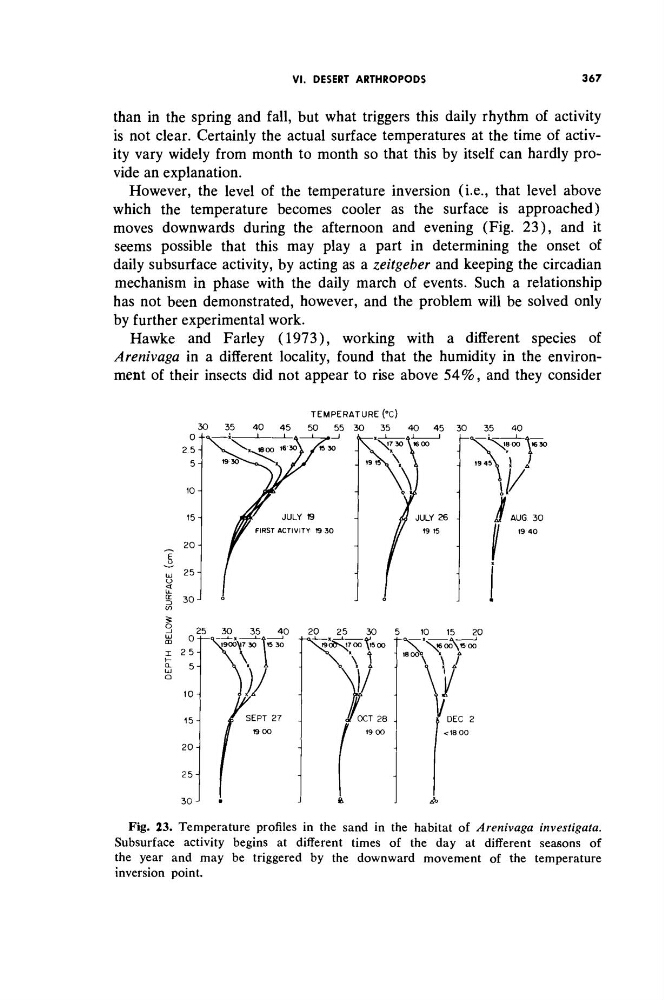
However, the level of the temperature inversion (i.e., that level above
which the temperature becomes cooler as the surface is approached)
moves downwards during the afternoon and evening (Fig. 23), and it
seems possible that this may play a part in determining the onset of
daily subsurface activity, by acting as a Zeitgeber and keeping the circadian
mechanism in phase with the daily march of events. Such a relationship
has not been demonstrated, however, and the problem will be solved only
by further experimental work.
Hawke and Farley (1973), working with a different species of
Arenivaga in a different locality, found that the humidity in the environment of their insects did not appear to rise above 54%, and they consider
TEMPERATURE (°C)
30
35
40
45
50
55 30
35
40
45 30
35
40
Fig. 23. Temperature profiles in the sand in the habitat of Arenivaga investigata.
Subsurface activity begins at different times of the day at different seasons of
the year and may be triggered by the downward movement of the temperature
inversion point.
367
than in the spring and fall, but what triggers this daily rhythm of activity
is not clear. Certainly the actual surface temperatures at the time of activity vary widely from month to month so that this by itself can hardly provide an explanation.
However, the level of the temperature inversion (i.e., that level above
which the temperature becomes cooler as the surface is approached)
moves downwards during the afternoon and evening (Fig. 23), and it
seems possible that this may play a part in determining the onset of
daily subsurface activity, by acting as a Zeitgeber and keeping the circadian
mechanism in phase with the daily march of events. Such a relationship
has not been demonstrated, however, and the problem will be solved only
by further experimental work.
Hawke and Farley (1973), working with a different species of
Arenivaga in a different locality, found that the humidity in the environment of their insects did not appear to rise above 54%, and they consider
TEMPERATURE (°C)
30
35
40
45
50
55 30
35
40
45 30
35
40
Fig. 23. Temperature profiles in the sand in the habitat of Arenivaga investigata.
Subsurface activity begins at different times of the day at different seasons of
the year and may be triggered by the downward movement of the temperature
inversion point.