

VI. DESERT ARTHROPODS
355
is not unknown. An example is that of the sphingid moth, Pholus achemon
(Adams and Heath, 1964b), which extrudes a drop of water from the
proboscis if its body temperature rises above 40°C. The water is cooled
by evaporation and the insect then sucks it in again. Temperature control
by heat distribution around the body in another sphinged is referred to
above on p. 352.
Generally there is a good deal of evidence that the highest temperatures
which insects can withstand are higher in dry than in humid air (Bursell,
1964b), but this can hardly be termed regulation—it is an inevitable result
of high vapor pressure déficit raising the rate of transpiration. In tsetse
flies, Glossina morsitans, however, which are likewise known to resist
higher temperatures in dry air, Edney and Barrass (1962) found a truly
regulatory process.
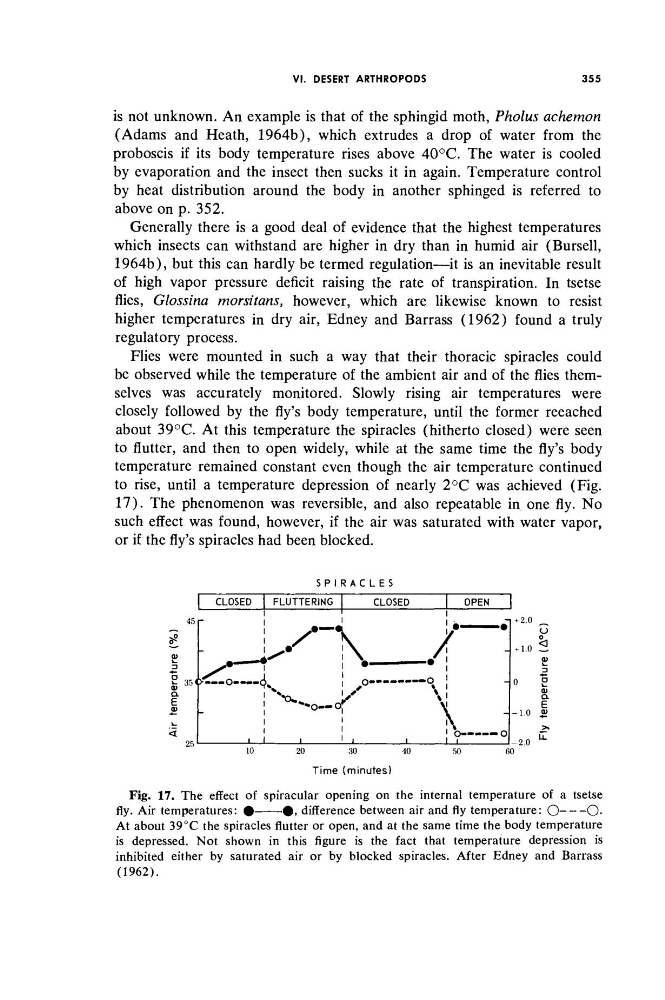
Flies were mounted in such a way that their thoracic spiracles could
be observed while the temperature of the ambient air and of the flies themselves was accurately monitored. Slowly rising air temperatures were
closely followed by the fly's body temperature, until the former reeached
about 39°C. At this temperature the spiracles (hitherto closed) were seen
to flutter, and then to open widely, while at the same time the fly's body
temperature remained constant even though the air temperature continued
to rise, until a temperature depression of nearly 2°C was achieved (Fig.
17). The phenomenon was reversible, and also repeatable in one fly. No
such effect was found, however, if the air was saturated with water vapor,
or if the fly's spiracles had been blocked.
S P I R A C L E S
CLOSED
FLUTTERING
CLOSED
|
OPEN
35 i>
S~\
°-~
I
I
A
1 — o|
Q.
E
- 1 . 0 Q?
10
20
30
40
50
60
Time (minutes)
Fig. 17. The effect of spiracular opening on the internal temperature of a tsetse
fly. Air temperatures: #
# , difference between air and fly temperature: O
O·
At about 39°C the spiracles flutter or open, and at the same time the body temperature
is depressed. Not shown in this figure is the fact that temperature depression is
inhibited either by saturated air or by blocked spiracles. After Edney and Barrass
(1962).
355
is not unknown. An example is that of the sphingid moth, Pholus achemon
(Adams and Heath, 1964b), which extrudes a drop of water from the
proboscis if its body temperature rises above 40°C. The water is cooled
by evaporation and the insect then sucks it in again. Temperature control
by heat distribution around the body in another sphinged is referred to
above on p. 352.
Generally there is a good deal of evidence that the highest temperatures
which insects can withstand are higher in dry than in humid air (Bursell,
1964b), but this can hardly be termed regulation—it is an inevitable result
of high vapor pressure déficit raising the rate of transpiration. In tsetse
flies, Glossina morsitans, however, which are likewise known to resist
higher temperatures in dry air, Edney and Barrass (1962) found a truly
regulatory process.
Flies were mounted in such a way that their thoracic spiracles could
be observed while the temperature of the ambient air and of the flies themselves was accurately monitored. Slowly rising air temperatures were
closely followed by the fly's body temperature, until the former reeached
about 39°C. At this temperature the spiracles (hitherto closed) were seen
to flutter, and then to open widely, while at the same time the fly's body
temperature remained constant even though the air temperature continued
to rise, until a temperature depression of nearly 2°C was achieved (Fig.
17). The phenomenon was reversible, and also repeatable in one fly. No
such effect was found, however, if the air was saturated with water vapor,
or if the fly's spiracles had been blocked.
S P I R A C L E S
CLOSED
FLUTTERING
CLOSED
|
OPEN
35 i>
S~\
°-~
I
I
A
1 — o|
Q.
E
- 1 . 0 Q?
10
20
30
40
50
60
Time (minutes)
Fig. 17. The effect of spiracular opening on the internal temperature of a tsetse
fly. Air temperatures: #
# , difference between air and fly temperature: O
O·
At about 39°C the spiracles flutter or open, and at the same time the body temperature
is depressed. Not shown in this figure is the fact that temperature depression is
inhibited either by saturated air or by blocked spiracles. After Edney and Barrass
(1962).