

VI. DESERT ARTHROPODS
353
Shade
Sun
201
I
I
I
I
I
I
I
I
14:50
14:55
15:00
15:05
15:10
15:15
15:20
1525
15:30
Greenwich mean time
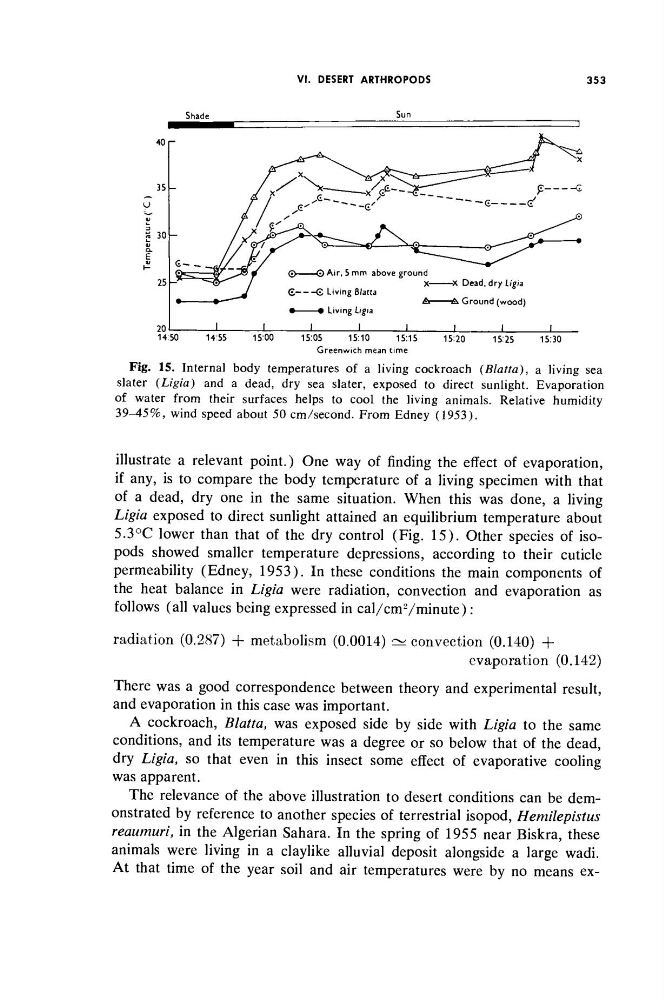
Fig. 15. Internal body temperatures of a living cockroach (Blatta), a living sea
slater (Ligia) and a dead, dry sea slater, exposed to direct sunlight. Evaporation
of water from their surfaces helps to cool the living animals. Relative humidity
39-45%, wind speed about 50 cm/second. From Edney (1953).
illustrate a relevant point.) One way of finding the effect of evaporation,
if any, is to compare the body temperature of a living specimen with that
of a dead, dry one in the same situation. When this was done, a living
Ligia exposed to direct sunlight attained an equilibrium temperature about
5.3°C lower than that of the dry control (Fig. 15). Other species of isopods showed smaller temperature depressions, according to their cuticle
permeability (Edney, 1953). In these conditions the main components of
the heat balance in Ligia were radiation, convection and evaporation as
follows (all values being expressed in cal/cm
2
/minute) :
radiation (0.287) + metabolism (0.0014) ^convection (0.140) +
evaporation (0.142)
There was a good correspondence between theory and experimental result,
and evaporation in this case was important.
A cockroach, Blatta, was exposed side by side with Ligia to the same
conditions, and its temperature was a degree or so below that of the dead,
dry Ligia, so that even in this insect some effect of evaporative cooling
was apparent.
The relevance of the above illustration to desert conditions can be demonstrated by reference to another species of terrestrial isopod, Hemilepistus
reaumuri, in the Algerian Sahara. In the spring of 1955 near Biskra, these
animals were living in a claylike alluvial deposit alongside a large wadi.
At that time of the year soil and air temperatures were by no means ex-
353
Shade
Sun
201
I
I
I
I
I
I
I
I
14:50
14:55
15:00
15:05
15:10
15:15
15:20
1525
15:30
Greenwich mean time
Fig. 15. Internal body temperatures of a living cockroach (Blatta), a living sea
slater (Ligia) and a dead, dry sea slater, exposed to direct sunlight. Evaporation
of water from their surfaces helps to cool the living animals. Relative humidity
39-45%, wind speed about 50 cm/second. From Edney (1953).
illustrate a relevant point.) One way of finding the effect of evaporation,
if any, is to compare the body temperature of a living specimen with that
of a dead, dry one in the same situation. When this was done, a living
Ligia exposed to direct sunlight attained an equilibrium temperature about
5.3°C lower than that of the dry control (Fig. 15). Other species of isopods showed smaller temperature depressions, according to their cuticle
permeability (Edney, 1953). In these conditions the main components of
the heat balance in Ligia were radiation, convection and evaporation as
follows (all values being expressed in cal/cm
2
/minute) :
radiation (0.287) + metabolism (0.0014) ^convection (0.140) +
evaporation (0.142)
There was a good correspondence between theory and experimental result,
and evaporation in this case was important.
A cockroach, Blatta, was exposed side by side with Ligia to the same
conditions, and its temperature was a degree or so below that of the dead,
dry Ligia, so that even in this insect some effect of evaporative cooling
was apparent.
The relevance of the above illustration to desert conditions can be demonstrated by reference to another species of terrestrial isopod, Hemilepistus
reaumuri, in the Algerian Sahara. In the spring of 1955 near Biskra, these
animals were living in a claylike alluvial deposit alongside a large wadi.
At that time of the year soil and air temperatures were by no means ex-