

V I . DESERT ARTHROPODS
319
B. Loss OF WATER THROUGH THE CUTICLE
We have seen that the impermeability to water of an arthropod's cuticle
is largely due to a layer of lipid in the epicuticle. The evidence for this
is compelling and need not be restated here (Beament, 1945; Lees, 1947;
Wigglesworth, 1945, 1965) (see, however p. 315 above). But the effect of
temperature on transpiration must now be considered. In dry air the effect
of raising the temperature is to increase the rate of transpiration, and this
is due in part to the fact that the vapor pressure deficit increases at higher
temperatures, so that the activity gradient across the cuticle and adjacent
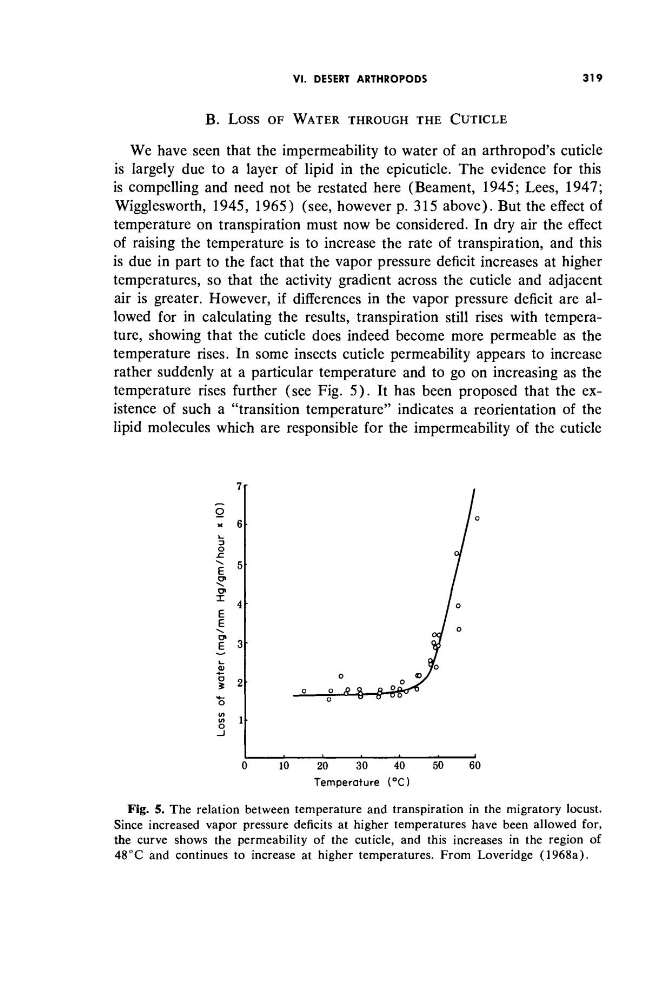
air is greater. However, if differences in the vapor pressure deficit are allowed for in calculating the results, transpiration still rises with temperature, showing that the cuticle does indeed become more permeable as the
temperature rises. In some insects cuticle permeability appears to increase
rather suddenly at a particular temperature and to go on increasing as the
temperature rises further (see Fig. 5). It has been proposed that the existence of such a "transition temperature" indicates a reorientation of the
lipid molecules which are responsible for the impermeability of the cuticle
7
O
x 6
Ό
O
È
5
D»
1
4
E
E
V.
E
3
5
2
8
l
_ l
0
10
20
30
40
50
60
Temperature (°C)
Fig. 5. The relation between temperature and transpiration in the migratory locust.
Since increased vapor pressure deficits at higher temperatures have been allowed for,
the curve shows the permeability of the cuticle, and this increases in the region of
48°C and continues to increase at higher temperatures. From Loveridge (1968a).
319
B. Loss OF WATER THROUGH THE CUTICLE
We have seen that the impermeability to water of an arthropod's cuticle
is largely due to a layer of lipid in the epicuticle. The evidence for this
is compelling and need not be restated here (Beament, 1945; Lees, 1947;
Wigglesworth, 1945, 1965) (see, however p. 315 above). But the effect of
temperature on transpiration must now be considered. In dry air the effect
of raising the temperature is to increase the rate of transpiration, and this
is due in part to the fact that the vapor pressure deficit increases at higher
temperatures, so that the activity gradient across the cuticle and adjacent
air is greater. However, if differences in the vapor pressure deficit are allowed for in calculating the results, transpiration still rises with temperature, showing that the cuticle does indeed become more permeable as the
temperature rises. In some insects cuticle permeability appears to increase
rather suddenly at a particular temperature and to go on increasing as the
temperature rises further (see Fig. 5). It has been proposed that the existence of such a "transition temperature" indicates a reorientation of the
lipid molecules which are responsible for the impermeability of the cuticle
7
O
x 6
Ό
O
È
5
D»
1
4
E
E
V.
E
3
5
2
8
l
_ l
0
10
20
30
40
50
60
Temperature (°C)
Fig. 5. The relation between temperature and transpiration in the migratory locust.
Since increased vapor pressure deficits at higher temperatures have been allowed for,
the curve shows the permeability of the cuticle, and this increases in the region of
48°C and continues to increase at higher temperatures. From Loveridge (1968a).