

272
H. WALTER AND E. STADELMANN
considerable thickness, also has its area of growth extended into the extreme desert. The φ 8 values of the leaf succulents are high (—4 to —10
atm). The Mesembryanthemoideae are exceptions. Their ψ 8 values are
always below — 16 atm, even in areas where they grow together with other
succulents. As the cell sap of the Mesembryanthemoideae contains appreciable chlorides (more than 40% of the osmotically active substance) the
group is intermediate to the halophytes. Some Mesembryanthemoideae
grow also on saline soils where φ 8 decreases to —50 atm and the chloride
fraction of the cell sap may reach 80%.
The true succulents are very sensitive to salt. Cacti are occasionally
found in locations with saline soils (North Venezuela, Argentina). However, they grow on small sand mounds which do not contain salts. The
roots of these cacti do not reach the saline soil and can get fresh water
during rainy periods. The cell sap of these plants contains only traces of
salt.
The succulents lose a large quantity of their water during a drought
period without a significant change in relative water content. For instance,
Opuntia phaeacantha-toumeyi lost 60% of its original weight during a
drought period of 189 days, but the water content on dry weight basis
decreased from 84.75 to 72.68% only (Walter, 1964, p. 366), since during
this long drought not only dehydration occurred but also dry weight decreased because of respiration. If the rate of both processes (dehydration
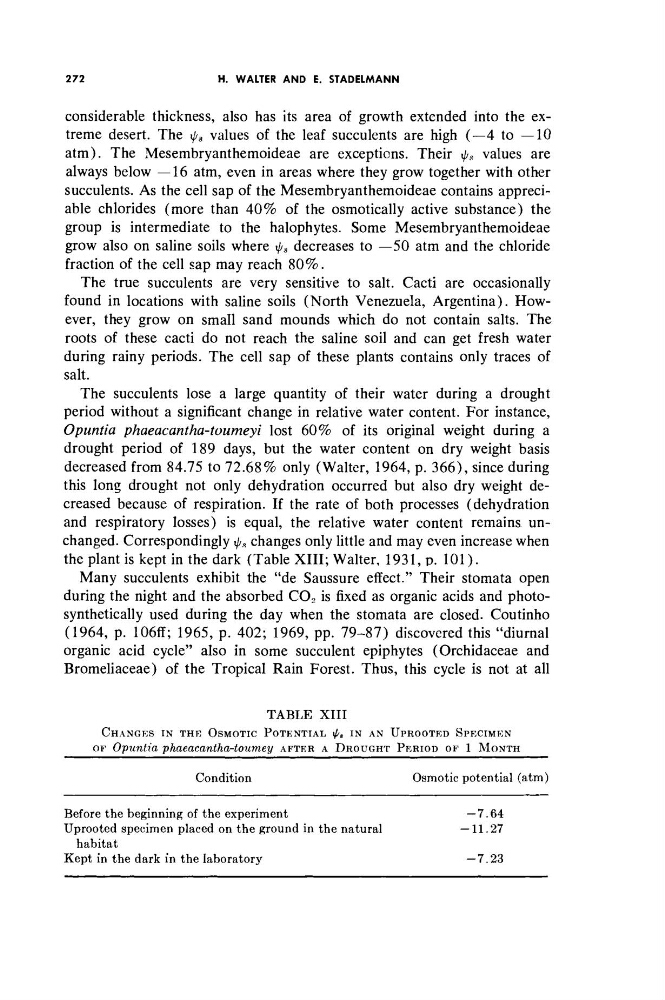
and respiratory losses) is equal, the relative water content remains unchanged. Correspondingly ψ., changes only little and may even increase when
the plant is kept in the dark (Table XIII; Walter, 1931, p. 101).
Many succulents exhibit the "de Saussure effect." Their stomata open
during the night and the absorbed C 0 2 is fixed as organic acids and photosynthetically used during the day when the stomata are closed. Coutinho
(1964, p. 106ff; 1965, p. 402; 1969, pp. 79-87) discovered this "diurnal
organic acid cycle" also in some succulent epiphytes (Orchidaceae and
Bromeliaceae) of the Tropical Rain Forest. Thus, this cycle is not at all
TABLE X I I I
CHANGES IN T H E OSMOTIC POTENTIAL ψ8 IN AN UPROOTED SPECIMEN
OF Opuntia phaeacantha-toumey
AFTER A DROUGHT P E R I O D O F 1 M O N T H
Condition
Osmotic potential (atm)
Before the beginning of the experiment
—7.64
Uprooted specimen placed on t h e ground in the natural
—11.27
habitat
Kept in t h e dark in the laboratory
—7.23
H. WALTER AND E. STADELMANN
considerable thickness, also has its area of growth extended into the extreme desert. The φ 8 values of the leaf succulents are high (—4 to —10
atm). The Mesembryanthemoideae are exceptions. Their ψ 8 values are
always below — 16 atm, even in areas where they grow together with other
succulents. As the cell sap of the Mesembryanthemoideae contains appreciable chlorides (more than 40% of the osmotically active substance) the
group is intermediate to the halophytes. Some Mesembryanthemoideae
grow also on saline soils where φ 8 decreases to —50 atm and the chloride
fraction of the cell sap may reach 80%.
The true succulents are very sensitive to salt. Cacti are occasionally
found in locations with saline soils (North Venezuela, Argentina). However, they grow on small sand mounds which do not contain salts. The
roots of these cacti do not reach the saline soil and can get fresh water
during rainy periods. The cell sap of these plants contains only traces of
salt.
The succulents lose a large quantity of their water during a drought
period without a significant change in relative water content. For instance,
Opuntia phaeacantha-toumeyi lost 60% of its original weight during a
drought period of 189 days, but the water content on dry weight basis
decreased from 84.75 to 72.68% only (Walter, 1964, p. 366), since during
this long drought not only dehydration occurred but also dry weight decreased because of respiration. If the rate of both processes (dehydration
and respiratory losses) is equal, the relative water content remains unchanged. Correspondingly ψ., changes only little and may even increase when
the plant is kept in the dark (Table XIII; Walter, 1931, p. 101).
Many succulents exhibit the "de Saussure effect." Their stomata open
during the night and the absorbed C 0 2 is fixed as organic acids and photosynthetically used during the day when the stomata are closed. Coutinho
(1964, p. 106ff; 1965, p. 402; 1969, pp. 79-87) discovered this "diurnal
organic acid cycle" also in some succulent epiphytes (Orchidaceae and
Bromeliaceae) of the Tropical Rain Forest. Thus, this cycle is not at all
TABLE X I I I
CHANGES IN T H E OSMOTIC POTENTIAL ψ8 IN AN UPROOTED SPECIMEN
OF Opuntia phaeacantha-toumey
AFTER A DROUGHT P E R I O D O F 1 M O N T H
Condition
Osmotic potential (atm)
Before the beginning of the experiment
—7.64
Uprooted specimen placed on t h e ground in the natural
—11.27
habitat
Kept in t h e dark in the laboratory
—7.23