

V. NEW APPROACH TO WATER RELATIONS OF DESERT PLANTS
271
however, is needed for building the internal structures in the cactus plant
since over 90% of the fresh weight of the stem is water.
Succulents grow best in regions with two rainy periods yearly so they
can refill the depleted storage tissue twice a year. But these regions have
to be so dry that fast-growing species cannot compete. Regions with two
seasonal rains (the Karoo in South Africa and the Sonora Desert in Arizona and Northern Mexico) are geographically located between the Mediterranean-like regions with winter rains and areas with summer rains. In
Australia, where the climate is similar, true succulents are absent, and all
species with succulent leaves belong to the halophytes (Chenopodiaceae),
which are a different ecological group (see Section XVIII). Arid regions
with two regular rain periods are absent in Australia.
Water-storage organs in succulent plants may be leaves or above-ground
stems or subterranean parts (morphologically not limited to roots). Most
"root succulents" are not found in deserts but in areas of dry sands such
as the Kalahari region, which should not be considered a climatic desert.
Pachypodium succulentum is an example of a "root succulent." For an
old plant the weight of the subterranean tuber was 7 kg, whereas that of
the shoot was only 68 gm (Marloth, 1908, p. 237). The tuber of another
specimen of this plant had accumulated 266 gm of water (950% of its dry
weight) and the osmotic potential of the cell sap was quite high
(ψ 8 = —4.2 atm; Walter, 1964, p. 439).
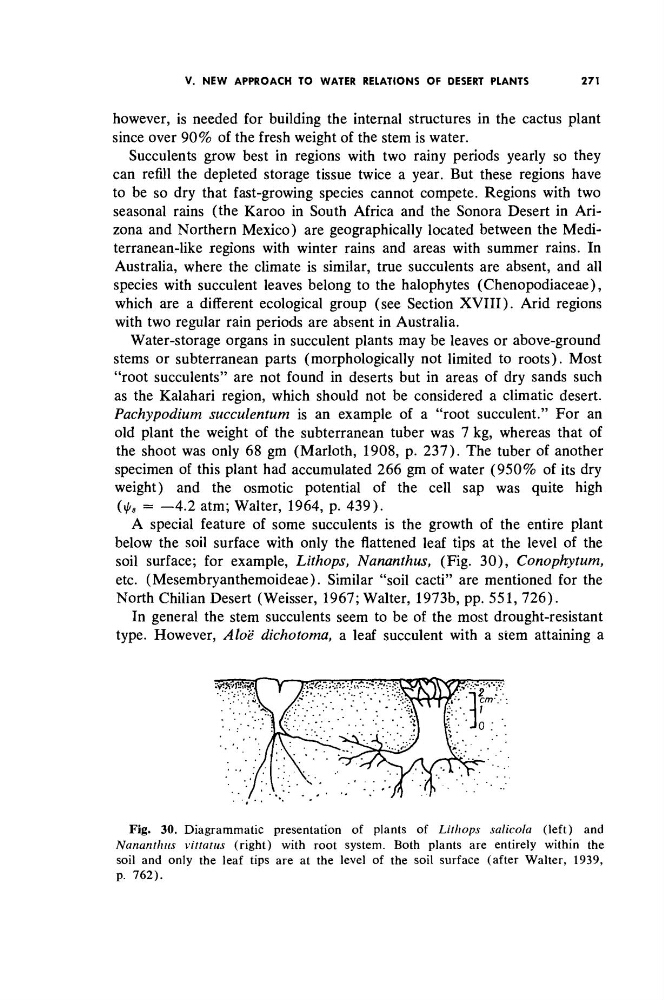
A special feature of some succulents is the growth of the entire plant
below the soil surface with only the flattened leaf tips at the level of the
soil surface; for example, Lithops, Nananthus, (Fig. 30), Conophytum,
etc. (Mesembryanthemoideae). Similar "soil cacti" are mentioned for the
North Chilian Desert (Weisser, 1967; Walter, 1973b, pp. 551, 726).
In general the stem succulents seem to be of the most drought-resistant
type. However, Aloe dichotoma, a leaf succulent with a stem attaining a
Fig. 30. Diagrammatic presentation of plants of Lithops salicola (left) and
Nananthus vittatus (right) with root system. Both plants are entirely within the
soil and only the leaf tips are at the level of the soil surface (after Walter, 1939,
p. 762).
271
however, is needed for building the internal structures in the cactus plant
since over 90% of the fresh weight of the stem is water.
Succulents grow best in regions with two rainy periods yearly so they
can refill the depleted storage tissue twice a year. But these regions have
to be so dry that fast-growing species cannot compete. Regions with two
seasonal rains (the Karoo in South Africa and the Sonora Desert in Arizona and Northern Mexico) are geographically located between the Mediterranean-like regions with winter rains and areas with summer rains. In
Australia, where the climate is similar, true succulents are absent, and all
species with succulent leaves belong to the halophytes (Chenopodiaceae),
which are a different ecological group (see Section XVIII). Arid regions
with two regular rain periods are absent in Australia.
Water-storage organs in succulent plants may be leaves or above-ground
stems or subterranean parts (morphologically not limited to roots). Most
"root succulents" are not found in deserts but in areas of dry sands such
as the Kalahari region, which should not be considered a climatic desert.
Pachypodium succulentum is an example of a "root succulent." For an
old plant the weight of the subterranean tuber was 7 kg, whereas that of
the shoot was only 68 gm (Marloth, 1908, p. 237). The tuber of another
specimen of this plant had accumulated 266 gm of water (950% of its dry
weight) and the osmotic potential of the cell sap was quite high
(ψ 8 = —4.2 atm; Walter, 1964, p. 439).
A special feature of some succulents is the growth of the entire plant
below the soil surface with only the flattened leaf tips at the level of the
soil surface; for example, Lithops, Nananthus, (Fig. 30), Conophytum,
etc. (Mesembryanthemoideae). Similar "soil cacti" are mentioned for the
North Chilian Desert (Weisser, 1967; Walter, 1973b, pp. 551, 726).
In general the stem succulents seem to be of the most drought-resistant
type. However, Aloe dichotoma, a leaf succulent with a stem attaining a
Fig. 30. Diagrammatic presentation of plants of Lithops salicola (left) and
Nananthus vittatus (right) with root system. Both plants are entirely within the
soil and only the leaf tips are at the level of the soil surface (after Walter, 1939,
p. 762).