

V. NEW APPROACH TO WATER RELATIONS OF DESERT PLANTS
247
TABLE VI
DIURNAL VARIATIONS OF OSMOTIC POTENTIAL ψ 8 IN LEAVES
OF Robinia pseudacacia
a
ψ, (atm)
Time of
Sun leaves
Shade leaves
Difference
day
I
II
I-II
Morning
- 1 7 . 3
- 1 2 . 2
- 5 . 1
Noon
- 1 8 . 1
- 1 2 . 6
- 5 . 5
Evening
- 1 7 . 6
- 1 2 . 5
- 5 . 1
a From Walter (1962, p. 337).
date for harvesting would have been about June 15, since harvesting later
does not further increase dry weight and soil water is used up without resulting in higher yield.
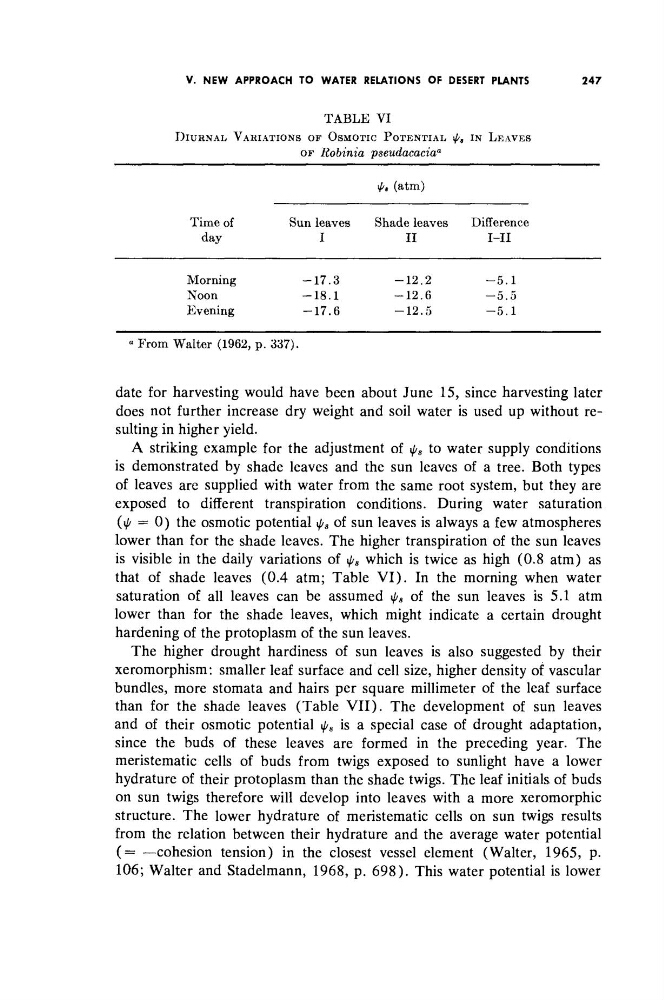
A striking example for the adjustment of ψ 8 to water supply conditions
is demonstrated by shade leaves and the sun leaves of a tree. Both types
of leaves are supplied with water from the same root system, but they are
exposed to different transpiration conditions. During water saturation
(ψ = 0) the osmotic potential ψ 8 of sun leaves is always a few atmospheres
lower than for the shade leaves. The higher transpiration of the sun leaves
is visible in the daily variations of ψ 8 which is twice as high (0.8 atm) as
that of shade leaves (0.4 atm; Table VI). In the morning when water
saturation of all leaves can be assumed φ 8 of the sun leaves is 5.1 atm
lower than for the shade leaves, which might indicate a certain drought
hardening of the protoplasm of the sun leaves.
The higher drought hardiness of sun leaves is also suggested by their
xeromorphism: smaller leaf surface and cell size, higher density of vascular
bundles, more stomata and hairs per square millimeter of the leaf surface
than for the shade leaves (Table VII). The development of sun leaves
and of their osmotic potential ψ 8 is a special case of drought adaptation,
since the buds of these leaves are formed in the preceding year. The
meristematic cells of buds from twigs exposed to sunlight have a lower
hydrature of their protoplasm than the shade twigs. The leaf initials of buds
on sun twigs therefore will develop into leaves with a more xeromorphic
structure. The lower hydrature of meristematic cells on sun twigs results
from the relation between their hydrature and the average water potential
( = —cohesion tension) in the closest vessel element (Walter, 1965, p.
106; Walter and Stadelmann, 1968, p. 698). This water potential is lower
247
TABLE VI
DIURNAL VARIATIONS OF OSMOTIC POTENTIAL ψ 8 IN LEAVES
OF Robinia pseudacacia
a
ψ, (atm)
Time of
Sun leaves
Shade leaves
Difference
day
I
II
I-II
Morning
- 1 7 . 3
- 1 2 . 2
- 5 . 1
Noon
- 1 8 . 1
- 1 2 . 6
- 5 . 5
Evening
- 1 7 . 6
- 1 2 . 5
- 5 . 1
a From Walter (1962, p. 337).
date for harvesting would have been about June 15, since harvesting later
does not further increase dry weight and soil water is used up without resulting in higher yield.
A striking example for the adjustment of ψ 8 to water supply conditions
is demonstrated by shade leaves and the sun leaves of a tree. Both types
of leaves are supplied with water from the same root system, but they are
exposed to different transpiration conditions. During water saturation
(ψ = 0) the osmotic potential ψ 8 of sun leaves is always a few atmospheres
lower than for the shade leaves. The higher transpiration of the sun leaves
is visible in the daily variations of ψ 8 which is twice as high (0.8 atm) as
that of shade leaves (0.4 atm; Table VI). In the morning when water
saturation of all leaves can be assumed φ 8 of the sun leaves is 5.1 atm
lower than for the shade leaves, which might indicate a certain drought
hardening of the protoplasm of the sun leaves.
The higher drought hardiness of sun leaves is also suggested by their
xeromorphism: smaller leaf surface and cell size, higher density of vascular
bundles, more stomata and hairs per square millimeter of the leaf surface
than for the shade leaves (Table VII). The development of sun leaves
and of their osmotic potential ψ 8 is a special case of drought adaptation,
since the buds of these leaves are formed in the preceding year. The
meristematic cells of buds from twigs exposed to sunlight have a lower
hydrature of their protoplasm than the shade twigs. The leaf initials of buds
on sun twigs therefore will develop into leaves with a more xeromorphic
structure. The lower hydrature of meristematic cells on sun twigs results
from the relation between their hydrature and the average water potential
( = —cohesion tension) in the closest vessel element (Walter, 1965, p.
106; Walter and Stadelmann, 1968, p. 698). This water potential is lower