

238
H. WALTER A N D E. STADELMANN
-20
-30
ZÎ -40
- 5 0
c
- 6 0
■2 ^
Ξ 5 20
o E
8? E
CL
^
^i_LL
I J Ll.l lL.Hl
Oct.
Nov. Dec. Jan. Feb. Mar. April May
June July
Aug. Sept.
Month
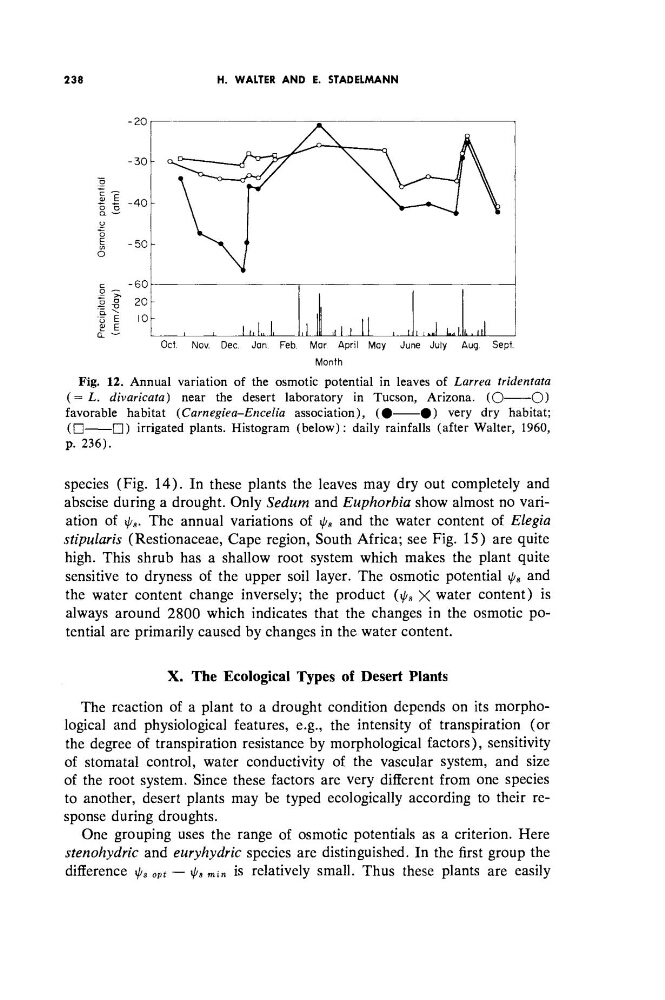
Fig. 12. Annual variation of the osmotic potential in leaves of Larrea tridentata
( = L. divaricata) near the desert laboratory in Tucson, Arizona. (O
O)
favorable habitat (Carnegiea-Encelia association), ( #
# ) very dry habitat;
( □
□ ) irrigated plants. Histogram (below): daily rainfalls (after Walter, 1960,
p. 236).
species (Fig. 14). In these plants the leaves may dry out completely and
abscise during a drought. Only Sedum and Euphorbia show almost no variation of φ 8 . The annual variations of φ 8 and the water content of Elegia
stipularis (Restionaceae, Cape region, South Africa; see Fig. 15) are quite
high. This shrub has a shallow root system which makes the plant quite
sensitive to dryness of the upper soil layer. The osmotic potential ψ 8 and
the water content change inversely; the product (ψ 8 X water content) is
always around 2800 which indicates that the changes in the osmotic potential are primarily caused by changes in the water content.
X. The Ecological Types of Desert Plants
The reaction of a plant to a drought condition depends on its morphological and physiological features, e.g., the intensity of transpiration (or
the degree of transpiration resistance by morphological factors), sensitivity
of stomatal control, water conductivity of the vascular system, and size
of the root system. Since these factors are very different from one species
to another, desert plants may be typed ecologically according to their response during droughts.
One grouping uses the range of osmotic potentials as a criterion. Here
stenohydric and euryhydric species are distinguished. In the first group the
difference ψ 8 0P t — ψ 8 min is relatively small. Thus these plants are easily
H. WALTER A N D E. STADELMANN
-20
-30
ZÎ -40
- 5 0
c
- 6 0
■2 ^
Ξ 5 20
o E
8? E
CL
^
^i_LL
I J Ll.l lL.Hl
Oct.
Nov. Dec. Jan. Feb. Mar. April May
June July
Aug. Sept.
Month
Fig. 12. Annual variation of the osmotic potential in leaves of Larrea tridentata
( = L. divaricata) near the desert laboratory in Tucson, Arizona. (O
O)
favorable habitat (Carnegiea-Encelia association), ( #
# ) very dry habitat;
( □
□ ) irrigated plants. Histogram (below): daily rainfalls (after Walter, 1960,
p. 236).
species (Fig. 14). In these plants the leaves may dry out completely and
abscise during a drought. Only Sedum and Euphorbia show almost no variation of φ 8 . The annual variations of φ 8 and the water content of Elegia
stipularis (Restionaceae, Cape region, South Africa; see Fig. 15) are quite
high. This shrub has a shallow root system which makes the plant quite
sensitive to dryness of the upper soil layer. The osmotic potential ψ 8 and
the water content change inversely; the product (ψ 8 X water content) is
always around 2800 which indicates that the changes in the osmotic potential are primarily caused by changes in the water content.
X. The Ecological Types of Desert Plants
The reaction of a plant to a drought condition depends on its morphological and physiological features, e.g., the intensity of transpiration (or
the degree of transpiration resistance by morphological factors), sensitivity
of stomatal control, water conductivity of the vascular system, and size
of the root system. Since these factors are very different from one species
to another, desert plants may be typed ecologically according to their response during droughts.
One grouping uses the range of osmotic potentials as a criterion. Here
stenohydric and euryhydric species are distinguished. In the first group the
difference ψ 8 0P t — ψ 8 min is relatively small. Thus these plants are easily