

V. NEW APPROACH TO WATER RELATIONS OF DESERT PLANTS
219
' ■ ' ^ f ^ - ^ S ^
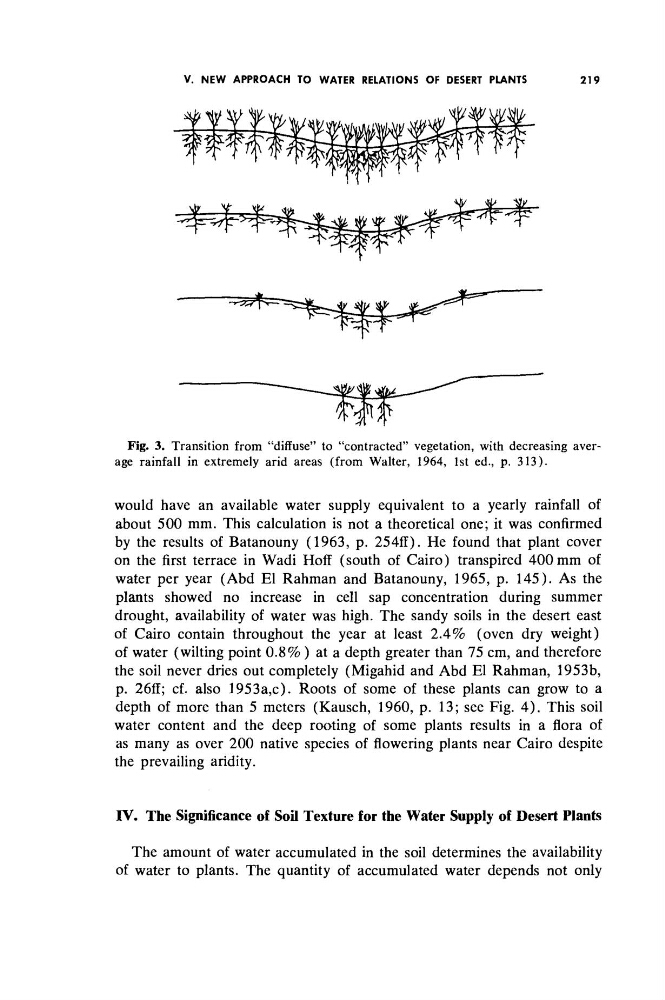
Fig. 3. Transition from "diffuse" to "contracted" vegetation, with decreasing average rainfall in extremely arid areas (from Walter, 1964, 1st ed., p. 313).
would have an available water supply equivalent to a yearly rainfall of
about 500 mm. This calculation is not a theoretical one; it was confirmed
by the results of Batanouny (1963, p. 254ff). He found that plant cover
on the first terrace in Wadi Hoff (south of Cairo) transpired 400 mm of
water per year (Abd El Rahman and Batanouny, 1965, p. 145). As the
plants showed no increase in cell sap concentration during summer
drought, availability of water was high. The sandy soils in the desert east
of Cairo contain throughout the year at least 2.4% (oven dry weight)
of water (wilting point 0.8% ) at a depth greater than 75 cm, and therefore
the soil never dries out completely (Migahid and Abd El Rahman, 1953b,
p. 26ff; cf. also 1953a,c). Roots of some of these plants can grow to a
depth of more than 5 meters (Kausch, 1960, p. 13; see Fig. 4). This soil
water content and the deep rooting of some plants results in a flora of
as many as over 200 native species of flowering plants near Cairo despite
the prevailing aridity.
IV. The Significance of Soil Texture for the Water Supply of Desert Plants
The amount of water accumulated in the soil determines the availability
of water to plants. The quantity of accumulated water depends not only
219
' ■ ' ^ f ^ - ^ S ^
Fig. 3. Transition from "diffuse" to "contracted" vegetation, with decreasing average rainfall in extremely arid areas (from Walter, 1964, 1st ed., p. 313).
would have an available water supply equivalent to a yearly rainfall of
about 500 mm. This calculation is not a theoretical one; it was confirmed
by the results of Batanouny (1963, p. 254ff). He found that plant cover
on the first terrace in Wadi Hoff (south of Cairo) transpired 400 mm of
water per year (Abd El Rahman and Batanouny, 1965, p. 145). As the
plants showed no increase in cell sap concentration during summer
drought, availability of water was high. The sandy soils in the desert east
of Cairo contain throughout the year at least 2.4% (oven dry weight)
of water (wilting point 0.8% ) at a depth greater than 75 cm, and therefore
the soil never dries out completely (Migahid and Abd El Rahman, 1953b,
p. 26ff; cf. also 1953a,c). Roots of some of these plants can grow to a
depth of more than 5 meters (Kausch, 1960, p. 13; see Fig. 4). This soil
water content and the deep rooting of some plants results in a flora of
as many as over 200 native species of flowering plants near Cairo despite
the prevailing aridity.
IV. The Significance of Soil Texture for the Water Supply of Desert Plants
The amount of water accumulated in the soil determines the availability
of water to plants. The quantity of accumulated water depends not only