

218
H. WALTER AND E. STADELMANN
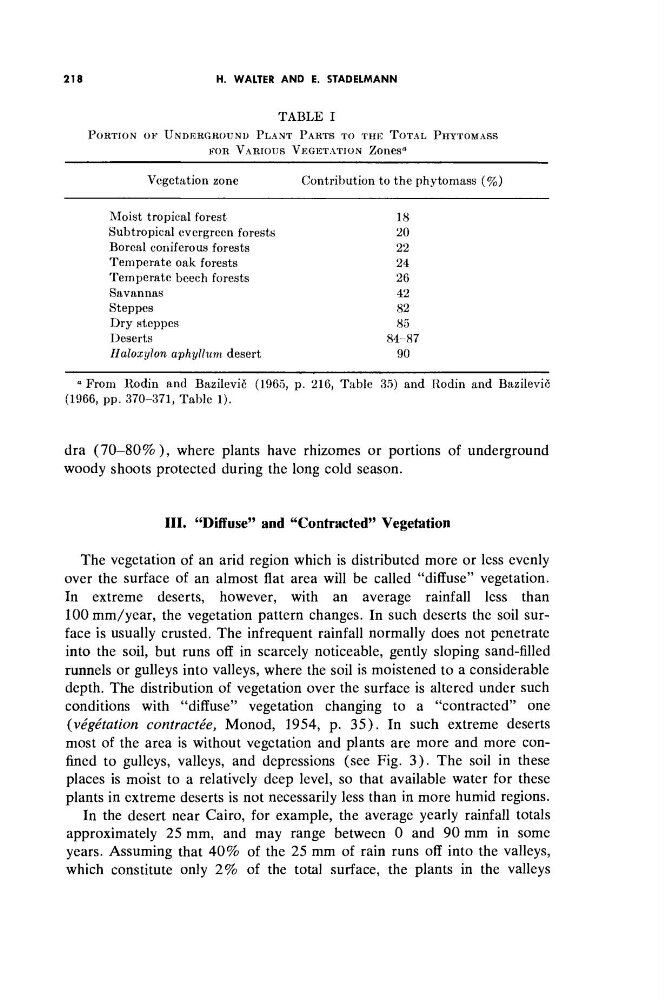
TABLE I
PORTION OF UNDERGROUND PLANT PARTS TO THE TOTAL PHYTOMASS
FOR VARIOUS VEGETATION Zones
0
Vegetation zone
Contribution to the phytomass (%)
Moist tropical forest
Subtropical evergreen forests
Boreal coniferous forests
Temperate oak forests
Temperate beech forests
Savannas
Steppes
Dry steppes
Deserts
Haloxylon aphyllum desert
18
20
22
24
26
42
82
85
84-87
90
α From Rodin and Bazilevic (1965, p. 216, Table 35) and Rodin and Bazilevic
(1966, pp. 370-371, Table 1).
dra ( 7 0 - 8 0 % ) , where plants have rhizomes or portions of underground
woody shoots protected during the long cold season.
III. "Diffuse" and "Contracted" Vegetation
The vegetation of an arid region which is distributed more or less evenly
over the surface of an almost flat area will be called "diffuse" vegetation.
In extreme deserts, however, with an average rainfall less than
100 mm/year, the vegetation pattern changes. In such deserts the soil surface is usually crusted. The infrequent rainfall normally does not penetrate
into the soil, but runs off in scarcely noticeable, gently sloping sand-filled
runnels or gulleys into valleys, where the soil is moistened to a considerable
depth. The distribution of vegetation over the surface is altered under such
conditions with "diffuse" vegetation changing to a "contracted" one
(végétation contractée, Monod, 1954, p. 35). In such extreme deserts
most of the area is without vegetation and plants are more and more confined to gulleys, valleys, and depressions (see Fig. 3). The soil in these
places is moist to a relatively deep level, so that available water for these
plants in extreme deserts is not necessarily less than in more humid regions.
In the desert near Cairo, for example, the average yearly rainfall totals
approximately 25 mm, and may range between 0 and 90 mm in some
years. Assuming that 40% of the 25 mm of rain runs off into the valleys,
which constitute only 2% of the total surface, the plants in the valleys
H. WALTER AND E. STADELMANN
TABLE I
PORTION OF UNDERGROUND PLANT PARTS TO THE TOTAL PHYTOMASS
FOR VARIOUS VEGETATION Zones
0
Vegetation zone
Contribution to the phytomass (%)
Moist tropical forest
Subtropical evergreen forests
Boreal coniferous forests
Temperate oak forests
Temperate beech forests
Savannas
Steppes
Dry steppes
Deserts
Haloxylon aphyllum desert
18
20
22
24
26
42
82
85
84-87
90
α From Rodin and Bazilevic (1965, p. 216, Table 35) and Rodin and Bazilevic
(1966, pp. 370-371, Table 1).
dra ( 7 0 - 8 0 % ) , where plants have rhizomes or portions of underground
woody shoots protected during the long cold season.
III. "Diffuse" and "Contracted" Vegetation
The vegetation of an arid region which is distributed more or less evenly
over the surface of an almost flat area will be called "diffuse" vegetation.
In extreme deserts, however, with an average rainfall less than
100 mm/year, the vegetation pattern changes. In such deserts the soil surface is usually crusted. The infrequent rainfall normally does not penetrate
into the soil, but runs off in scarcely noticeable, gently sloping sand-filled
runnels or gulleys into valleys, where the soil is moistened to a considerable
depth. The distribution of vegetation over the surface is altered under such
conditions with "diffuse" vegetation changing to a "contracted" one
(végétation contractée, Monod, 1954, p. 35). In such extreme deserts
most of the area is without vegetation and plants are more and more confined to gulleys, valleys, and depressions (see Fig. 3). The soil in these
places is moist to a relatively deep level, so that available water for these
plants in extreme deserts is not necessarily less than in more humid regions.
In the desert near Cairo, for example, the average yearly rainfall totals
approximately 25 mm, and may range between 0 and 90 mm in some
years. Assuming that 40% of the 25 mm of rain runs off into the valleys,
which constitute only 2% of the total surface, the plants in the valleys