

IV. DESERT ALGAE, LICHENS, AND FUNGI
197
mgCOa
+ 1.00
+ 0.75
+ 0.50
I
26727 9 1967
Romalina maciformis
C02 gas exchange
Λ.
balance
/ü\
assimilation-gain respiration-loss-yield
U \
1 32
0.78
= 0.54mq C02/gm
JM \
^
w e i
9
n i
/ΙΙΙΙΙΙΙΙΙΙΠν
= O.I46mgC/gm
/Uli \
° ^
we| Q*
ii
"^^^^SewsteÄ,--;^,: : " ■■ :
'^: ;* ■ : | /
"™~~'
" ί ί | 1
" " "
5040"
10^^ ^ ^ P — T — ^ — ■
%
y
^ ^ ^ ■ ■ "
• X
^ ·
s
t *
S* 5\ι
* *\ ·
y
"V
Water content
s
κ ^ . _^—*—--*"^^
1
1
.
1
.
1
1
1
1
1
1
1
1
18
20
22
24
2
4
6
8
10
12
14
16
18
20
22
Time (hours)
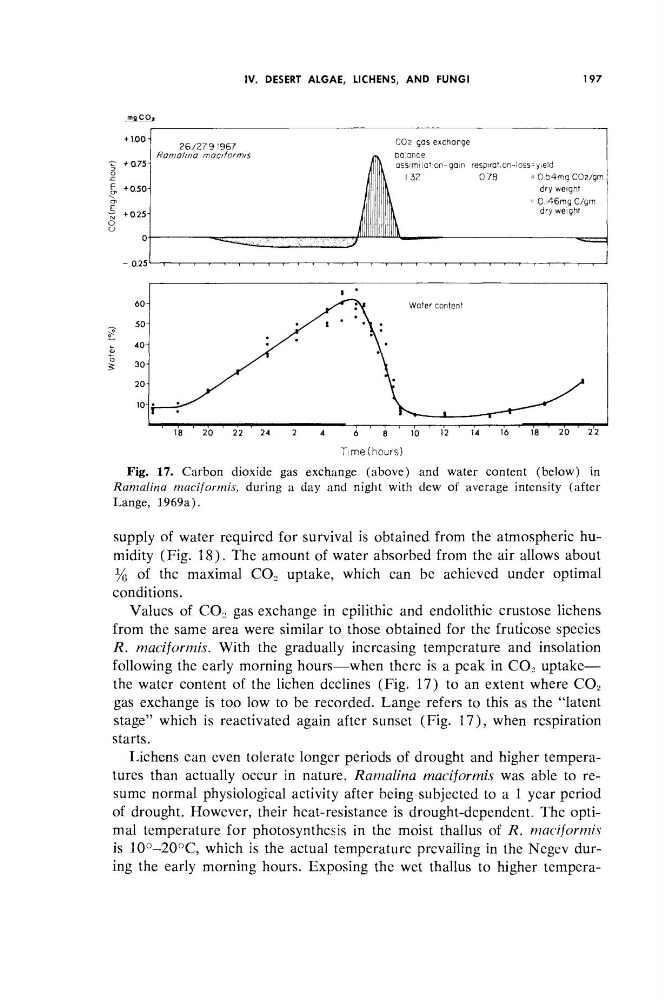
Fig. 17. Carbon dioxide gas exchange (above) and water content (below) in
Ramalina maciformis, during a day and night with dew of average intensity (after
Lange, 1969a).
supply of water required for survival is obtained from the atmospheric humidity (Fig. 18). The amount of water absorbed from the air allows about
% of the maximal CO L . uptake, which can be achieved under optimal
conditions.
Values of C 0 2 gas exchange in epilithic and endolithic crustose lichens
from the same area were similar to those obtained for the fruticose species
R. maciformis. With the gradually increasing temperature and insolation
following the early morning hours—when there is a peak in C 0 2 uptake—
the water content of the lichen declines (Fig. 17) to an extent where C 0 2
gas exchange is too low to be recorded. Lange refers to this as the "latent
stage" which is reactivated again after sunset (Fig. 17), when respiration
starts.
Lichens can even tolerate longer periods of drought and higher temperatures than actually occur in nature. Ramalina maciformis was able to resume normal physiological activity after being subjected to a 1 year period
of drought. However, their heat-resistance is drought-dependent. The optimal temperature for photosynthesis in the moist thallus of R. maciformis
is 10°-20°C, which is the actual temperature prevailing in the Negev during the early morning hours. Exposing the wet thallus to higher tempera-
197
mgCOa
+ 1.00
+ 0.75
+ 0.50
I
26727 9 1967
Romalina maciformis
C02 gas exchange
Λ.
balance
/ü\
assimilation-gain respiration-loss-yield
U \
1 32
0.78
= 0.54mq C02/gm
JM \
^
w e i
9
n i
/ΙΙΙΙΙΙΙΙΙΙΠν
= O.I46mgC/gm
/Uli \
° ^
we| Q*
ii
"^^^^SewsteÄ,--;^,: : " ■■ :
'^: ;* ■ : | /
"™~~'
" ί ί | 1
" " "
5040"
10^^ ^ ^ P — T — ^ — ■
%
y
^ ^ ^ ■ ■ "
• X
^ ·
s
t *
S* 5\ι
* *\ ·
y
"V
Water content
s
κ ^ . _^—*—--*"^^
1
1
.
1
.
1
1
1
1
1
1
1
1
18
20
22
24
2
4
6
8
10
12
14
16
18
20
22
Time (hours)
Fig. 17. Carbon dioxide gas exchange (above) and water content (below) in
Ramalina maciformis, during a day and night with dew of average intensity (after
Lange, 1969a).
supply of water required for survival is obtained from the atmospheric humidity (Fig. 18). The amount of water absorbed from the air allows about
% of the maximal CO L . uptake, which can be achieved under optimal
conditions.
Values of C 0 2 gas exchange in epilithic and endolithic crustose lichens
from the same area were similar to those obtained for the fruticose species
R. maciformis. With the gradually increasing temperature and insolation
following the early morning hours—when there is a peak in C 0 2 uptake—
the water content of the lichen declines (Fig. 17) to an extent where C 0 2
gas exchange is too low to be recorded. Lange refers to this as the "latent
stage" which is reactivated again after sunset (Fig. 17), when respiration
starts.
Lichens can even tolerate longer periods of drought and higher temperatures than actually occur in nature. Ramalina maciformis was able to resume normal physiological activity after being subjected to a 1 year period
of drought. However, their heat-resistance is drought-dependent. The optimal temperature for photosynthesis in the moist thallus of R. maciformis
is 10°-20°C, which is the actual temperature prevailing in the Negev during the early morning hours. Exposing the wet thallus to higher tempera-