

IV. DESERT ALGAE, LICHENS, AND FUNGI
169
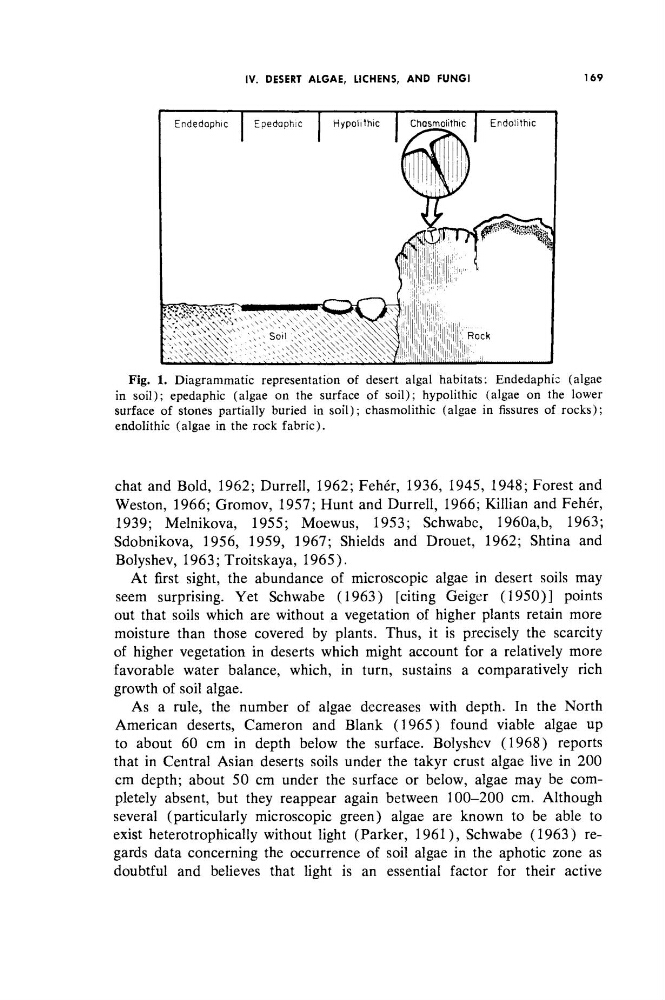
Fig. 1. Diagrammatic representation of desert algal habitats: Endedaphic (algae
in soil); epedaphic (algae on the surface of soil); hypolithic (algae on the lower
surface of stones partially buried in soil); chasmolithic (algae in fissures of rocks);
endolithic (algae in the rock fabric).
chat and Bold, 1962; Durrell, 1962; Fehér, 1936, 1945, 1948; Forest and
Weston, 1966; Gromov, 1957; Hunt and Durrell, 1966; Killian and Fehér,
1939; Melnikova, 1955; Moewus, 1953; Schwabe, 1960a,b, 1963;
Sdobnikova, 1956, 1959, 1967; Shields and Drouet, 1962; Shtina and
Bolyshev, 1963; Troitskaya, 1965).
At first sight, the abundance of microscopic algae in desert soils may
seem surprising. Yet Schwabe (1963) [citing Geiger (1950)] points
out that soils which are without a vegetation of higher plants retain more
moisture than those covered by plants. Thus, it is precisely the scarcity
of higher vegetation in deserts which might account for a relatively more
favorable water balance, which, in turn, sustains a comparatively rich
growth of soil algae.
As a rule, the number of algae decreases with depth. In the North
American deserts, Cameron and Blank (1965) found viable algae up
to about 60 cm in depth below the surface. Bolyshev (1968) reports
that in Central Asian deserts soils under the takyr crust algae live in 200
cm depth; about 50 cm under the surface or below, algae may be completely absent, but they reappear again between 100-200 cm. Although
several (particularly microscopic green) algae are known to be able to
exist heterotrophically without light (Parker, 1961), Schwabe (1963) regards data concerning the occurrence of soil algae in the aphotic zone as
doubtful and believes that light is an essential factor for their active
169
Fig. 1. Diagrammatic representation of desert algal habitats: Endedaphic (algae
in soil); epedaphic (algae on the surface of soil); hypolithic (algae on the lower
surface of stones partially buried in soil); chasmolithic (algae in fissures of rocks);
endolithic (algae in the rock fabric).
chat and Bold, 1962; Durrell, 1962; Fehér, 1936, 1945, 1948; Forest and
Weston, 1966; Gromov, 1957; Hunt and Durrell, 1966; Killian and Fehér,
1939; Melnikova, 1955; Moewus, 1953; Schwabe, 1960a,b, 1963;
Sdobnikova, 1956, 1959, 1967; Shields and Drouet, 1962; Shtina and
Bolyshev, 1963; Troitskaya, 1965).
At first sight, the abundance of microscopic algae in desert soils may
seem surprising. Yet Schwabe (1963) [citing Geiger (1950)] points
out that soils which are without a vegetation of higher plants retain more
moisture than those covered by plants. Thus, it is precisely the scarcity
of higher vegetation in deserts which might account for a relatively more
favorable water balance, which, in turn, sustains a comparatively rich
growth of soil algae.
As a rule, the number of algae decreases with depth. In the North
American deserts, Cameron and Blank (1965) found viable algae up
to about 60 cm in depth below the surface. Bolyshev (1968) reports
that in Central Asian deserts soils under the takyr crust algae live in 200
cm depth; about 50 cm under the surface or below, algae may be completely absent, but they reappear again between 100-200 cm. Although
several (particularly microscopic green) algae are known to be able to
exist heterotrophically without light (Parker, 1961), Schwabe (1963) regards data concerning the occurrence of soil algae in the aphotic zone as
doubtful and believes that light is an essential factor for their active