

I. HYDROGEOLOGY OF ARID REGIONS
7
Surface of equal
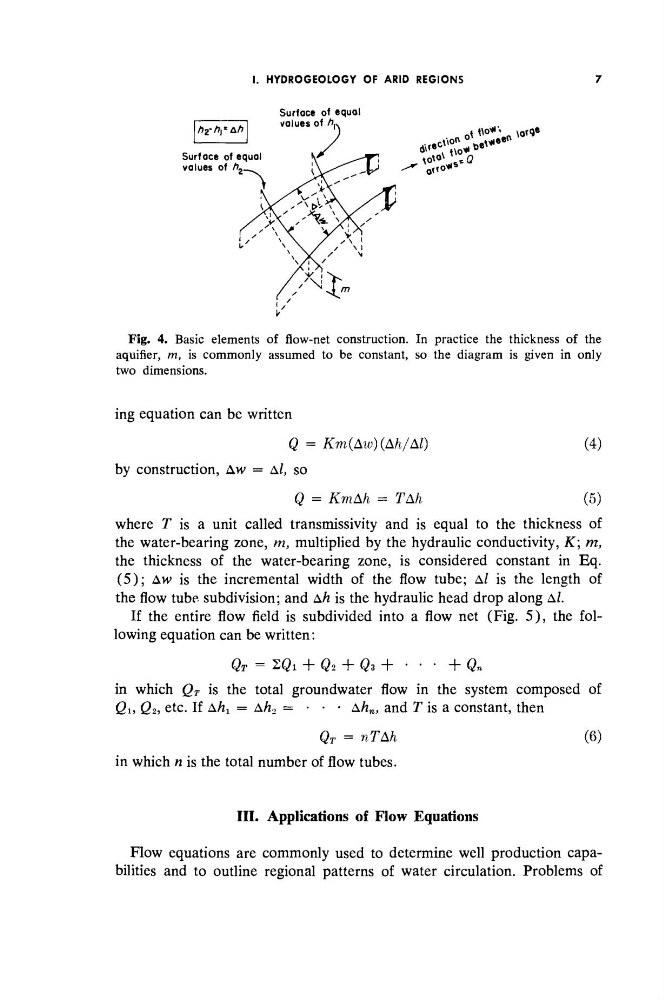
Fig. 4. Basic elements of flow-net construction. In practice the thickness of the
aquifier, m, is commonly assumed to be constant, so the diagram is given in only
two dimensions.
ing equation can be written
Q = Km(Aw)(Ah/Al)
(4)
by construction, Aw = Al, so
Q = KmAh = TAh
(5)
where T is a unit called transmissivity and is equal to the thickness of
the water-bearing zone, m, multiplied by the hydraulic conductivity, K; m,
the thickness of the water-bearing zone, is considered constant in Eq.
(5); Aw is the incremental width of the flow tube; Δ/ is the length of
the flow tube subdivision; and Ah is the hydraulic head drop along Δ/.
If the entire flow field is subdivided into a flow net (Fig. 5), the following equation can be written :
QT = ZQi + Q 2 + Q 3 + · · · + Q n
in which Q T is the total groundwater flow in the system composed of
Qu Ô2, etc. If Δ/*! = Ah 2 = · · · Ah n , and T is a constant, then
Q T = nTAh
(6)
in which n is the total number of flow tubes.
III. Applications of Flow Equations
Flow equations are commonly used to determine well production capabilities and to outline regional patterns of water circulation. Problems of
7
Surface of equal
Fig. 4. Basic elements of flow-net construction. In practice the thickness of the
aquifier, m, is commonly assumed to be constant, so the diagram is given in only
two dimensions.
ing equation can be written
Q = Km(Aw)(Ah/Al)
(4)
by construction, Aw = Al, so
Q = KmAh = TAh
(5)
where T is a unit called transmissivity and is equal to the thickness of
the water-bearing zone, m, multiplied by the hydraulic conductivity, K; m,
the thickness of the water-bearing zone, is considered constant in Eq.
(5); Aw is the incremental width of the flow tube; Δ/ is the length of
the flow tube subdivision; and Ah is the hydraulic head drop along Δ/.
If the entire flow field is subdivided into a flow net (Fig. 5), the following equation can be written :
QT = ZQi + Q 2 + Q 3 + · · · + Q n
in which Q T is the total groundwater flow in the system composed of
Qu Ô2, etc. If Δ/*! = Ah 2 = · · · Ah n , and T is a constant, then
Q T = nTAh
(6)
in which n is the total number of flow tubes.
III. Applications of Flow Equations
Flow equations are commonly used to determine well production capabilities and to outline regional patterns of water circulation. Problems of