

III. PHYSICAL AND VEGETATIONAL ASPECTS OF THE SAHARA
147
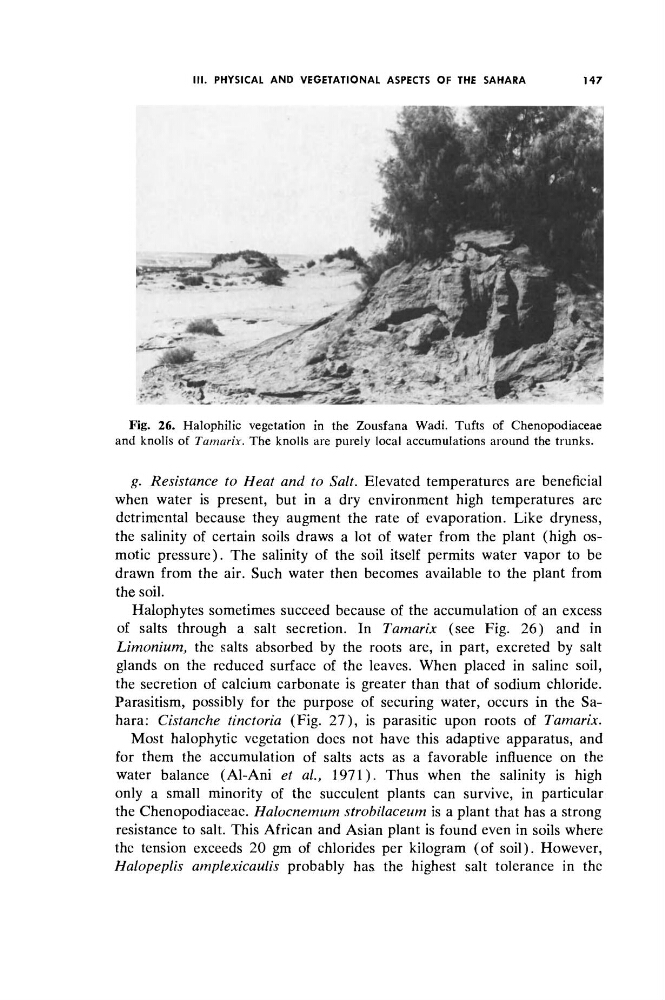
Fig. 26. Halophilic vegetation in the Zousfana Wadi. Tufts of Chenopodiaceae
and knolls of Tamarix. The knolls are purely local accumulations around the trunks.
g. Resistance to Heat and to Salt. Elevated temperatures are beneficial
when water is present, but in a dry environment high temperatures are
detrimental because they augment the rate of evaporation. Like dryness,
the salinity of certain soils draws a lot of water from the plant (high osmotic pressure). The salinity of the soil itself permits water vapor to be
drawn from the air. Such water then becomes available to the plant from
the soil.
Halophytes sometimes succeed because of the accumulation of an excess
of salts through a salt secretion. In Tamarix (see Fig. 26) and in
Limonium, the salts absorbed by the roots are, in part, excreted by salt
glands on the reduced surface of the leaves. When placed in saline soil,
the secretion of calcium carbonate is greater than that of sodium chloride.
Parasitism, possibly for the purpose of securing water, occurs in the Sahara: Cistanche tinctoria (Fig. 27), is parasitic upon roots of Tamarix.
Most halophytic vegetation does not have this adaptive apparatus, and
for them the accumulation of salts acts as a favorable influence on the
water balance (Al-Ani et al, 1971). Thus when the salinity is high
only a small minority of the succulent plants can survive, in particular
the Chenopodiaceae. Halocnemum strobilaceum is a plant that has a strong
resistance to salt. This African and Asian plant is found even in soils where
the tension exceeds 20 gm of chlorides per kilogram (of soil). However,
Halopeplis amplexicaulis probably has the highest salt tolerance in the
147
Fig. 26. Halophilic vegetation in the Zousfana Wadi. Tufts of Chenopodiaceae
and knolls of Tamarix. The knolls are purely local accumulations around the trunks.
g. Resistance to Heat and to Salt. Elevated temperatures are beneficial
when water is present, but in a dry environment high temperatures are
detrimental because they augment the rate of evaporation. Like dryness,
the salinity of certain soils draws a lot of water from the plant (high osmotic pressure). The salinity of the soil itself permits water vapor to be
drawn from the air. Such water then becomes available to the plant from
the soil.
Halophytes sometimes succeed because of the accumulation of an excess
of salts through a salt secretion. In Tamarix (see Fig. 26) and in
Limonium, the salts absorbed by the roots are, in part, excreted by salt
glands on the reduced surface of the leaves. When placed in saline soil,
the secretion of calcium carbonate is greater than that of sodium chloride.
Parasitism, possibly for the purpose of securing water, occurs in the Sahara: Cistanche tinctoria (Fig. 27), is parasitic upon roots of Tamarix.
Most halophytic vegetation does not have this adaptive apparatus, and
for them the accumulation of salts acts as a favorable influence on the
water balance (Al-Ani et al, 1971). Thus when the salinity is high
only a small minority of the succulent plants can survive, in particular
the Chenopodiaceae. Halocnemum strobilaceum is a plant that has a strong
resistance to salt. This African and Asian plant is found even in soils where
the tension exceeds 20 gm of chlorides per kilogram (of soil). However,
Halopeplis amplexicaulis probably has the highest salt tolerance in the