

146
CLAUDE J. GRENOT
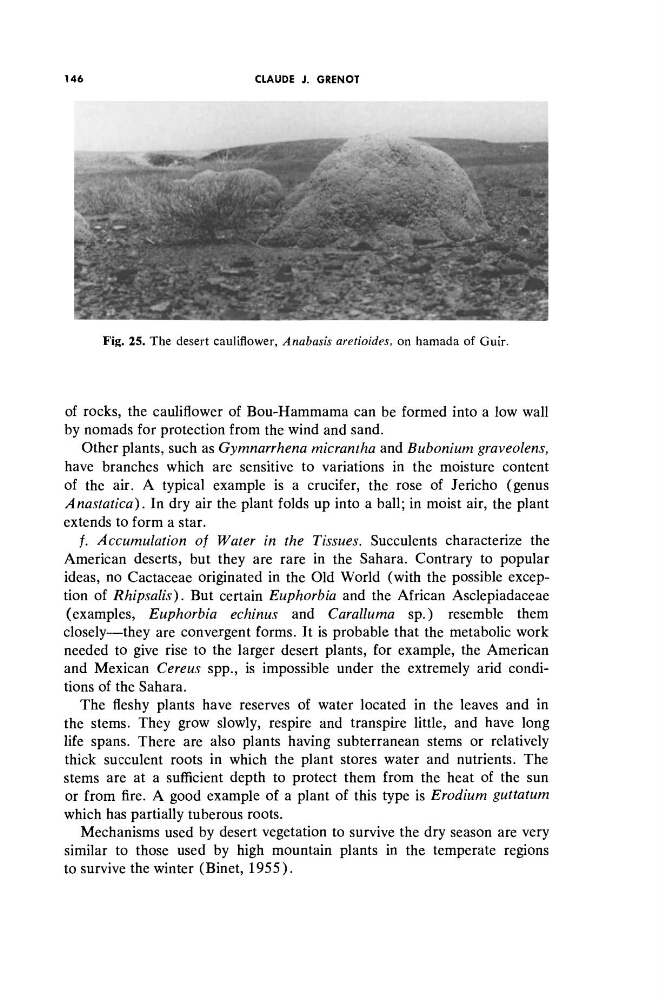
Fig. 25. The desert cauliflower, Anabasis aretioides, on hamada of Guir.
of rocks, the cauliflower of Bou-Hammama can be formed into a low wall
by nomads for protection from the wind and sand.
Other plants, such as Gymnarrhena micrantha and Bubonium graveolens,
have branches which are sensitive to variations in the moisture content
of the air. A typical example is a crucifer, the rose of Jericho (genus
Anastatica). In dry air the plant folds up into a ball; in moist air, the plant
extends to form a star.
/. Accumulation of Water in the Tissues. Succulents characterize the
American deserts, but they are rare in the Sahara. Contrary to popular
ideas, no Cactaceae originated in the Old World (with the possible exception of Rhipsalis). But certain Euphorbia and the African Asclepiadaceae
(examples, Euphorbia echinus and Caralluma sp.) resemble them
closely—they are convergent forms. It is probable that the metabolic work
needed to give rise to the larger desert plants, for example, the American
and Mexican Cereus spp., is impossible under the extremely arid conditions of the Sahara.
The fleshy plants have reserves of water located in the leaves and in
the stems. They grow slowly, respire and transpire little, and have long
life spans. There are also plants having subterranean stems or relatively
thick succulent roots in which the plant stores water and nutrients. The
stems are at a sufficient depth to protect them from the heat of the sun
or from fire. A good example of a plant of this type is Erodium guttatum
which has partially tuberous roots.
Mechanisms used by desert vegetation to survive the dry season are very
similar to those used by high mountain plants in the temperate regions
to survive the winter (Binet, 1955).
CLAUDE J. GRENOT
Fig. 25. The desert cauliflower, Anabasis aretioides, on hamada of Guir.
of rocks, the cauliflower of Bou-Hammama can be formed into a low wall
by nomads for protection from the wind and sand.
Other plants, such as Gymnarrhena micrantha and Bubonium graveolens,
have branches which are sensitive to variations in the moisture content
of the air. A typical example is a crucifer, the rose of Jericho (genus
Anastatica). In dry air the plant folds up into a ball; in moist air, the plant
extends to form a star.
/. Accumulation of Water in the Tissues. Succulents characterize the
American deserts, but they are rare in the Sahara. Contrary to popular
ideas, no Cactaceae originated in the Old World (with the possible exception of Rhipsalis). But certain Euphorbia and the African Asclepiadaceae
(examples, Euphorbia echinus and Caralluma sp.) resemble them
closely—they are convergent forms. It is probable that the metabolic work
needed to give rise to the larger desert plants, for example, the American
and Mexican Cereus spp., is impossible under the extremely arid conditions of the Sahara.
The fleshy plants have reserves of water located in the leaves and in
the stems. They grow slowly, respire and transpire little, and have long
life spans. There are also plants having subterranean stems or relatively
thick succulent roots in which the plant stores water and nutrients. The
stems are at a sufficient depth to protect them from the heat of the sun
or from fire. A good example of a plant of this type is Erodium guttatum
which has partially tuberous roots.
Mechanisms used by desert vegetation to survive the dry season are very
similar to those used by high mountain plants in the temperate regions
to survive the winter (Binet, 1955).