

ιο,οοο A
I. HYDROGEOLOGY OF ARID REGIONS
5
0.1 I
i
i
i
i
1
i
0.01
0.1
1.0
10
100
1000
10,000
Time (years)
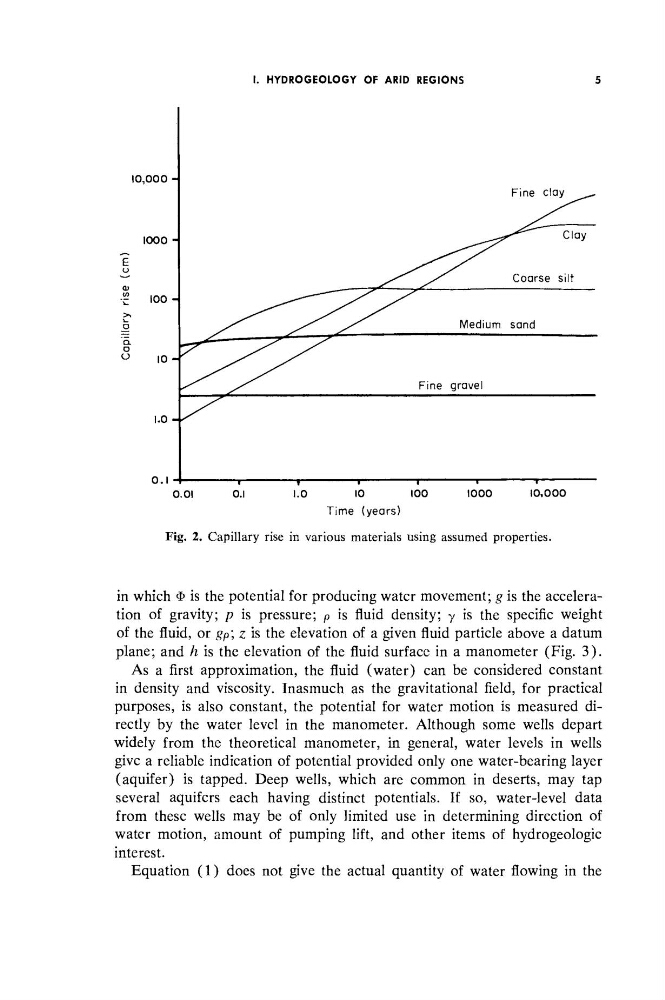
Fig. 2. Capillary rise in various materials using assumed properties.
in which Φ is the potential for producing water movement; g is the acceleration of gravity; p is pressure; p is fluid density; y is the specific weight
of the fluid, or g P \ z is the elevation of a given fluid particle above a datum
plane; and h is the elevation of the fluid surface in a manometer (Fig. 3).
As a first approximation, the fluid (water) can be considered constant
in density and viscosity. Inasmuch as the gravitational field, for practical
purposes, is also constant, the potential for water motion is measured directly by the water level in the manometer. Although some wells depart
widely from the theoretical manometer, in general, water levels in wells
give a reliable indication of potential provided only one water-bearing layer
(aquifer) is tapped. Deep wells, which are common in deserts, may tap
several aquifers each having distinct potentials. If so, water-level data
from these wells may be of only limited use in determining direction of
water motion, amount of pumping lift, and other items of hydrogeologic
interest.
Equation ( 1 ) does not give the actual quantity of water flowing in the
I. HYDROGEOLOGY OF ARID REGIONS
5
0.1 I
i
i
i
i
1
i
0.01
0.1
1.0
10
100
1000
10,000
Time (years)
Fig. 2. Capillary rise in various materials using assumed properties.
in which Φ is the potential for producing water movement; g is the acceleration of gravity; p is pressure; p is fluid density; y is the specific weight
of the fluid, or g P \ z is the elevation of a given fluid particle above a datum
plane; and h is the elevation of the fluid surface in a manometer (Fig. 3).
As a first approximation, the fluid (water) can be considered constant
in density and viscosity. Inasmuch as the gravitational field, for practical
purposes, is also constant, the potential for water motion is measured directly by the water level in the manometer. Although some wells depart
widely from the theoretical manometer, in general, water levels in wells
give a reliable indication of potential provided only one water-bearing layer
(aquifer) is tapped. Deep wells, which are common in deserts, may tap
several aquifers each having distinct potentials. If so, water-level data
from these wells may be of only limited use in determining direction of
water motion, amount of pumping lift, and other items of hydrogeologic
interest.
Equation ( 1 ) does not give the actual quantity of water flowing in the