

4
STANLEY IM. DAVIS
forces if they are developed within small openings. If the surface tension
is constant, as it would be at constant temperature and water chemistry,
and if all the solid soil particles are assumed to be of the same composition,
then capillary forces are inversely proportional to the diameters of the interconnected pores. As an example, if a glass tube could be constructed
with an internal radius of exactly 1.0 μτη, water would eventually rise in
the tube to about 15 meters above the level to which it is emersed in water.
An imaginary tube with an internal radius of only 0.1 μτη would produce
a water rise of about 150 meters. Natural deposits of clay size materials
should have intergranular openings which range from 0.1 to 10 μτη. One
is tempted, therefore, to make a direct comparison between tubes and soil
systems. This cannot be done for at least two reasons:
First, the irregular nature of the openings and the natural variations
of bedded sedimentary materials means that the capillary effects are far
from uniform and that a thin seam of sand or gravel could contain relatively large openings which are able to produce a capillary rise of only
a few centimeters.
Second, the time required for the capillary rise of water increases as
the grain diameter decreases.
For example, Terzaghi's equation (Terzaghi, 1942) can be used to calculate the time that it would take water to rise 135 meters in a very fine
clay which has a potential ultimate rise of 150 meters. Making an assumption of a porosity of 45% and a hydraulic conductivity of
4.2 X 1 0
4
cm/day, the calculated time is 61,000 years (Fig. 2). Although the assumptions made are reasonable, the greatest value of the calculations is to emphasize the fact that a capillary rise of more than 100
meters is a very slow process, if it occurs at all. After reviewing all data
available at his time, Tolman (1937) concluded that the natural capillary
rise in fine material was less than about 3 meters. Although this is probably
too conservative, assumptions of significant capillary rises of more than
20 meters are highly speculative.
From the standpoint of long-distance horizontal transfer of water below
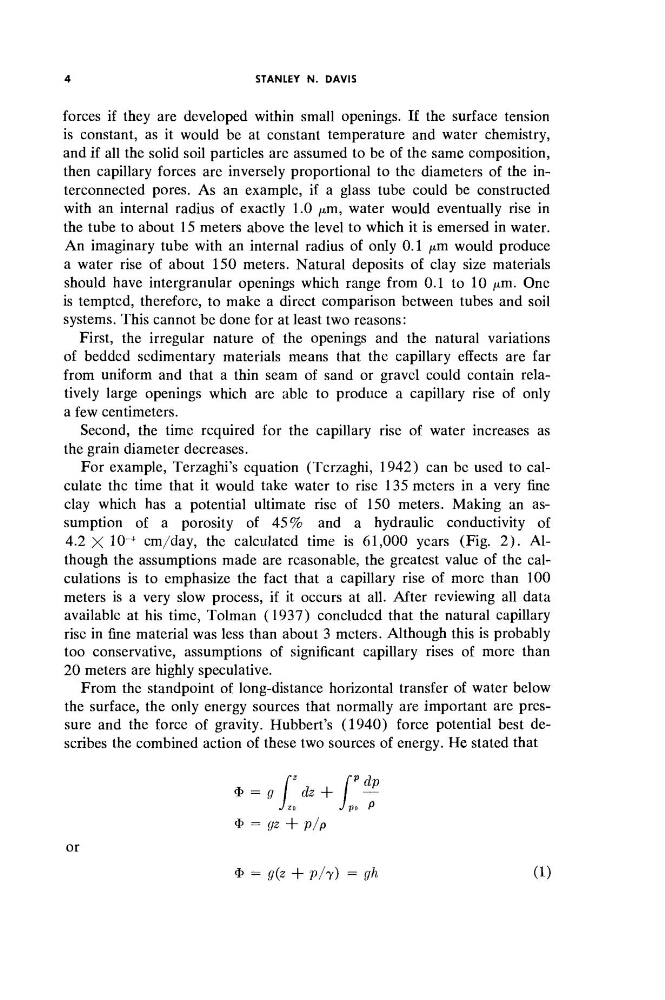
the surface, the only energy sources that normally are important are pressure and the force of gravity. Hubbert's (1940) force potential best describes the combined action of these two sources of energy. He stated that
Φ = g f dz + Γ —
Φ = gz + p/p
or
Φ = g(z + p/y) = gh
(1)
STANLEY IM. DAVIS
forces if they are developed within small openings. If the surface tension
is constant, as it would be at constant temperature and water chemistry,
and if all the solid soil particles are assumed to be of the same composition,
then capillary forces are inversely proportional to the diameters of the interconnected pores. As an example, if a glass tube could be constructed
with an internal radius of exactly 1.0 μτη, water would eventually rise in
the tube to about 15 meters above the level to which it is emersed in water.
An imaginary tube with an internal radius of only 0.1 μτη would produce
a water rise of about 150 meters. Natural deposits of clay size materials
should have intergranular openings which range from 0.1 to 10 μτη. One
is tempted, therefore, to make a direct comparison between tubes and soil
systems. This cannot be done for at least two reasons:
First, the irregular nature of the openings and the natural variations
of bedded sedimentary materials means that the capillary effects are far
from uniform and that a thin seam of sand or gravel could contain relatively large openings which are able to produce a capillary rise of only
a few centimeters.
Second, the time required for the capillary rise of water increases as
the grain diameter decreases.
For example, Terzaghi's equation (Terzaghi, 1942) can be used to calculate the time that it would take water to rise 135 meters in a very fine
clay which has a potential ultimate rise of 150 meters. Making an assumption of a porosity of 45% and a hydraulic conductivity of
4.2 X 1 0
4
cm/day, the calculated time is 61,000 years (Fig. 2). Although the assumptions made are reasonable, the greatest value of the calculations is to emphasize the fact that a capillary rise of more than 100
meters is a very slow process, if it occurs at all. After reviewing all data
available at his time, Tolman (1937) concluded that the natural capillary
rise in fine material was less than about 3 meters. Although this is probably
too conservative, assumptions of significant capillary rises of more than
20 meters are highly speculative.
From the standpoint of long-distance horizontal transfer of water below
the surface, the only energy sources that normally are important are pressure and the force of gravity. Hubbert's (1940) force potential best describes the combined action of these two sources of energy. He stated that
Φ = g f dz + Γ —
Φ = gz + p/p
or
Φ = g(z + p/y) = gh
(1)