

124
CLAUDE J. GRENOT
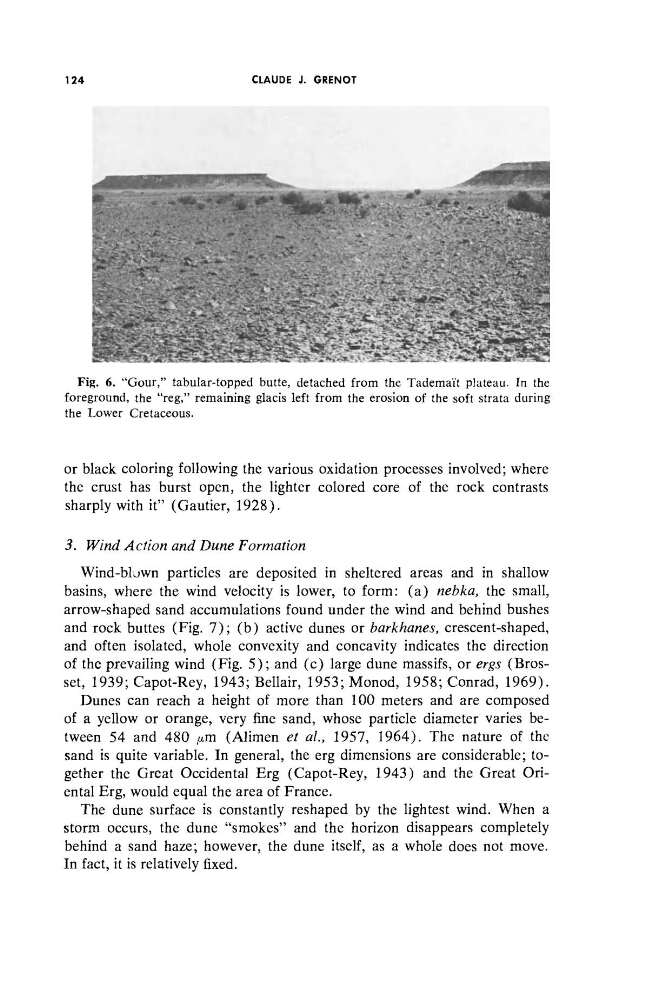
Fig. 6. "Gour," tabular-topped butte, detached from the Tademaït plateau. In the
foreground, the "reg," remaining glacis left from the erosion of the soft strata during
the Lower Cretaceous.
or black coloring following the various oxidation processes involved; where
the crust has burst open, the lighter colored core of the rock contrasts
sharply with it" (Gautier, 1928).
3. Wind Action and Dune Formation
Wind-bluwn particles are deposited in sheltered areas and in shallow
basins, where the wind velocity is lower, to form: (a) nebka, the small,
arrow-shaped sand accumulations found under the wind and behind bushes
and rock buttes (Fig. 7 ) ; (b) active dunes or barkhanes, crescent-shaped,
and often isolated, whole convexity and concavity indicates the direction
of the prevailing wind (Fig. 5 ) ; and (c) large dune massifs, or ergs (Brosser, 1939; Capot-Rey, 1943; Bellair, 1953; Monod, 1958; Conrad, 1969).
Dunes can reach a height of more than 100 meters and are composed
of a yellow or orange, very fine sand, whose particle diameter varies between 54 and 480 ^m (Alimen et ai, 1957, 1964). The nature of the
sand is quite variable. In general, the erg dimensions are considerable; together the Great Occidental Erg (Capot-Rey, 1943) and the Great Oriental Erg, would equal the area of France.
The dune surface is constantly reshaped by the lightest wind. When a
storm occurs, the dune "smokes" and the horizon disappears completely
behind a sand haze; however, the dune itself, as a whole does not move.
In fact, it is relatively fixed.
CLAUDE J. GRENOT
Fig. 6. "Gour," tabular-topped butte, detached from the Tademaït plateau. In the
foreground, the "reg," remaining glacis left from the erosion of the soft strata during
the Lower Cretaceous.
or black coloring following the various oxidation processes involved; where
the crust has burst open, the lighter colored core of the rock contrasts
sharply with it" (Gautier, 1928).
3. Wind Action and Dune Formation
Wind-bluwn particles are deposited in sheltered areas and in shallow
basins, where the wind velocity is lower, to form: (a) nebka, the small,
arrow-shaped sand accumulations found under the wind and behind bushes
and rock buttes (Fig. 7 ) ; (b) active dunes or barkhanes, crescent-shaped,
and often isolated, whole convexity and concavity indicates the direction
of the prevailing wind (Fig. 5 ) ; and (c) large dune massifs, or ergs (Brosser, 1939; Capot-Rey, 1943; Bellair, 1953; Monod, 1958; Conrad, 1969).
Dunes can reach a height of more than 100 meters and are composed
of a yellow or orange, very fine sand, whose particle diameter varies between 54 and 480 ^m (Alimen et ai, 1957, 1964). The nature of the
sand is quite variable. In general, the erg dimensions are considerable; together the Great Occidental Erg (Capot-Rey, 1943) and the Great Oriental Erg, would equal the area of France.
The dune surface is constantly reshaped by the lightest wind. When a
storm occurs, the dune "smokes" and the horizon disappears completely
behind a sand haze; however, the dune itself, as a whole does not move.
In fact, it is relatively fixed.