

46
/. Isoprenoids
111
and Hemiselmis virescens) three apparently new carotenoids ; Mallams et al.
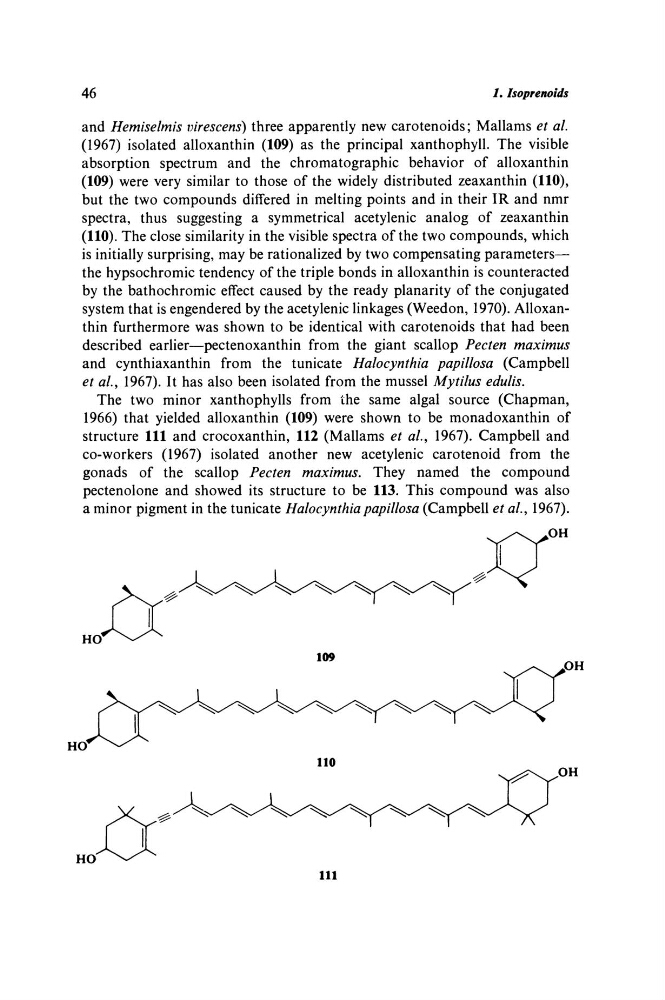
(1967) isolated alloxanthin (109) as the principal xanthophyll. The visible
absorption spectrum and the chromatographic behavior of alloxanthin
(109) were very similar to those of the widely distributed zeaxanthin (110),
but the two compounds differed in melting points and in their IR and nmr
spectra, thus suggesting a symmetrical acetylenic analog of zeaxanthin
(110). The close similarity in the visible spectra of the two compounds, which
is initially surprising, may be rationalized by two compensating parameters—
the hypsochromic tendency of the triple bonds in alloxanthin is counteracted
by the bathochromic effect caused by the ready planarity of the conjugated
system that is engendered by the acetylenic linkages (Weedon, 1970). Alloxanthin furthermore was shown to be identical with carotenoids that had been
described earlier—pectenoxanthin from the giant scallop Pecten maximus
and cynthiaxanthin from the tunicate Halocynthia papulosa (Campbell
et al., 1967). It has also been isolated from the mussel Mytilus edulis.
The two minor xanthophylls from the same algal source (Chapman,
1966) that yielded alloxanthin (109) were shown to be monadoxanthin of
structure 111 and crocoxanthin, 112 (Mallams et al, 1967). Campbell and
co-workers (1967) isolated another new acetylenic carotenoid from the
gonads of the scallop Pecten maximus. They named the compound
pectenolone and showed its structure to be 113. This compound was also
a minor pigment in the tunicate Halocynthia papulosa (Campbell et al., 1967).
109
110
/. Isoprenoids
111
and Hemiselmis virescens) three apparently new carotenoids ; Mallams et al.
(1967) isolated alloxanthin (109) as the principal xanthophyll. The visible
absorption spectrum and the chromatographic behavior of alloxanthin
(109) were very similar to those of the widely distributed zeaxanthin (110),
but the two compounds differed in melting points and in their IR and nmr
spectra, thus suggesting a symmetrical acetylenic analog of zeaxanthin
(110). The close similarity in the visible spectra of the two compounds, which
is initially surprising, may be rationalized by two compensating parameters—
the hypsochromic tendency of the triple bonds in alloxanthin is counteracted
by the bathochromic effect caused by the ready planarity of the conjugated
system that is engendered by the acetylenic linkages (Weedon, 1970). Alloxanthin furthermore was shown to be identical with carotenoids that had been
described earlier—pectenoxanthin from the giant scallop Pecten maximus
and cynthiaxanthin from the tunicate Halocynthia papulosa (Campbell
et al., 1967). It has also been isolated from the mussel Mytilus edulis.
The two minor xanthophylls from the same algal source (Chapman,
1966) that yielded alloxanthin (109) were shown to be monadoxanthin of
structure 111 and crocoxanthin, 112 (Mallams et al, 1967). Campbell and
co-workers (1967) isolated another new acetylenic carotenoid from the
gonads of the scallop Pecten maximus. They named the compound
pectenolone and showed its structure to be 113. This compound was also
a minor pigment in the tunicate Halocynthia papulosa (Campbell et al., 1967).
109
110