

D. Carotenoids
45
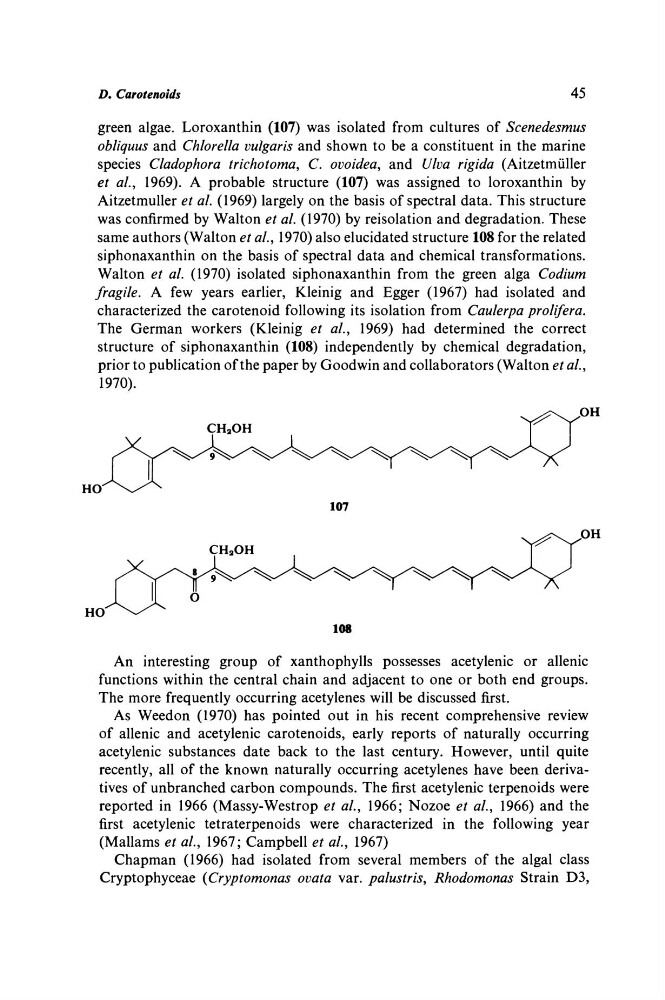
green algae. Loroxanthin (107) was isolated from cultures of Scenedesmus
obliquus and Chlorella vulgaris and shown to be a constituent in the marine
species Cladophora trichotoma, C. ovoidea, and Ulva rigida (Aitzetmüller
et al, 1969). A probable structure (107) was assigned to loroxanthin by
Aitzetmüller et al. (1969) largely on the basis of spectral data. This structure
was confirmed by Walton et al. (1970) by reisolation and degradation. These
same authors (Walton et al, 1970) also elucidated structure 108 for the related
siphonaxanthin on the basis of spectral data and chemical transformations.
Walton et al. (1970) isolated siphonaxanthin from the green alga Codium
fragile. A few years earlier, Kleinig and Egger (1967) had isolated and
characterized the carotenoid following its isolation from Caulerpa proliféra.
The German workers (Kleinig et al., 1969) had determined the correct
structure of siphonaxanthin (108) independently by chemical degradation,
prior to publication of the paper by Goodwin and collaborators (Walton et al,
1970).
v
^ v OH
CH 2 OH
I
107
CH 2 OH
I
108
An interesting group of xanthophylls possesses acetylenic or allenic
functions within the central chain and adjacent to one or both end groups.
The more frequently occurring acetylenes will be discussed first.
As Weedon (1970) has pointed out in his recent comprehensive review
of allenic and acetylenic carotenoids, early reports of naturally occurring
acetylenic substances date back to the last century. However, until quite
recently, all of the known naturally occurring acetylenes have been derivatives of unbranched carbon compounds. The first acetylenic terpenoids were
reported in 1966 (Massy-Westrop et al, 1966; Nozoe et al, 1966) and the
first acetylenic tetraterpenoids were characterized in the following year
(Mallams et al, 1967; Campbell et al, 1967)
Chapman (1966) had isolated from several members of the algal class
Cryptophyceae {Cryptomonas ovata var. palustris, Rhodomonas Strain D3,
D. Carotenoids
45
green algae. Loroxanthin (107) was isolated from cultures of Scenedesmus
obliquus and Chlorella vulgaris and shown to be a constituent in the marine
species Cladophora trichotoma, C. ovoidea, and Viva rigida (Aitzetmiiller
et al., 1969). A probable structure (107) was assigned to loroxanthin by
Aitzetmuller et al. (1969) largely on the basis of spectral data. This structure
was confirmed by Walton et al. (1970) by reisolation and degradation. These
same authors (Walton et al., 1970) also elucidated structure 108 for the related
siphonaxanthin on the basis of spectral data and chelnical transformations.
Walton et al. (1970) isolated siphonaxanthin from the green alga Codium
fragile. A few years earlier, Kleinig and Egger (1967) had isolated and
characterized the carotenoid following its isolation from Caulerpa prolifera.
The German workers (Kleinig et al., 1969) had determined the correct
structure of siphonaxanthin (108) independently by chemical degradation,
prior to publication of the paper by Goodwin and collaborators (Walton et al.,
1970).
OR
CH 2 0H
~
9~
~
~
~
~
~
~
~
107
OR
CH20H
I
9~
~
~
~
~
~
~
~
0
108
HO
HO
An interesting group of xanthophylls possesses acetylenic or allenic
functions within the central chain and adjacent to one or both end groups.
The more frequently occurring acetylenes will be discussed first.
As Weedon (1970) has pointed out in his recent comprehensive review
of allenic and acetylenic carotenoids, early reports of naturally occurring
acetylenic substances date back to the last century. However, until quite
recently, all of the known naturally occurring acetylenes have been derivatives of unbranched carbon compounds. The first acetylenic terpenoids were
reported in 1966 (Massy-Westrop et al., 1966; Nozoe et al., 1966) and the
first acetylenic tetraterpenoids were characterized in the following year
(Mallams et al., 1967; Campbell et al., 1967)
Chapman (1966) had isolated from several members of the algal class
Cryptophyceae (Cryptomonas ovata var. palustris, Rhodomonas Strain D3,
45
green algae. Loroxanthin (107) was isolated from cultures of Scenedesmus
obliquus and Chlorella vulgaris and shown to be a constituent in the marine
species Cladophora trichotoma, C. ovoidea, and Ulva rigida (Aitzetmüller
et al, 1969). A probable structure (107) was assigned to loroxanthin by
Aitzetmüller et al. (1969) largely on the basis of spectral data. This structure
was confirmed by Walton et al. (1970) by reisolation and degradation. These
same authors (Walton et al, 1970) also elucidated structure 108 for the related
siphonaxanthin on the basis of spectral data and chemical transformations.
Walton et al. (1970) isolated siphonaxanthin from the green alga Codium
fragile. A few years earlier, Kleinig and Egger (1967) had isolated and
characterized the carotenoid following its isolation from Caulerpa proliféra.
The German workers (Kleinig et al., 1969) had determined the correct
structure of siphonaxanthin (108) independently by chemical degradation,
prior to publication of the paper by Goodwin and collaborators (Walton et al,
1970).
v
^ v OH
CH 2 OH
I
107
CH 2 OH
I
108
An interesting group of xanthophylls possesses acetylenic or allenic
functions within the central chain and adjacent to one or both end groups.
The more frequently occurring acetylenes will be discussed first.
As Weedon (1970) has pointed out in his recent comprehensive review
of allenic and acetylenic carotenoids, early reports of naturally occurring
acetylenic substances date back to the last century. However, until quite
recently, all of the known naturally occurring acetylenes have been derivatives of unbranched carbon compounds. The first acetylenic terpenoids were
reported in 1966 (Massy-Westrop et al, 1966; Nozoe et al, 1966) and the
first acetylenic tetraterpenoids were characterized in the following year
(Mallams et al, 1967; Campbell et al, 1967)
Chapman (1966) had isolated from several members of the algal class
Cryptophyceae {Cryptomonas ovata var. palustris, Rhodomonas Strain D3,
D. Carotenoids
45
green algae. Loroxanthin (107) was isolated from cultures of Scenedesmus
obliquus and Chlorella vulgaris and shown to be a constituent in the marine
species Cladophora trichotoma, C. ovoidea, and Viva rigida (Aitzetmiiller
et al., 1969). A probable structure (107) was assigned to loroxanthin by
Aitzetmuller et al. (1969) largely on the basis of spectral data. This structure
was confirmed by Walton et al. (1970) by reisolation and degradation. These
same authors (Walton et al., 1970) also elucidated structure 108 for the related
siphonaxanthin on the basis of spectral data and chelnical transformations.
Walton et al. (1970) isolated siphonaxanthin from the green alga Codium
fragile. A few years earlier, Kleinig and Egger (1967) had isolated and
characterized the carotenoid following its isolation from Caulerpa prolifera.
The German workers (Kleinig et al., 1969) had determined the correct
structure of siphonaxanthin (108) independently by chemical degradation,
prior to publication of the paper by Goodwin and collaborators (Walton et al.,
1970).
OR
CH 2 0H
~
9~
~
~
~
~
~
~
~
107
OR
CH20H
I
9~
~
~
~
~
~
~
~
0
108
HO
HO
An interesting group of xanthophylls possesses acetylenic or allenic
functions within the central chain and adjacent to one or both end groups.
The more frequently occurring acetylenes will be discussed first.
As Weedon (1970) has pointed out in his recent comprehensive review
of allenic and acetylenic carotenoids, early reports of naturally occurring
acetylenic substances date back to the last century. However, until quite
recently, all of the known naturally occurring acetylenes have been derivatives of unbranched carbon compounds. The first acetylenic terpenoids were
reported in 1966 (Massy-Westrop et al., 1966; Nozoe et al., 1966) and the
first acetylenic tetraterpenoids were characterized in the following year
(Mallams et al., 1967; Campbell et al., 1967)
Chapman (1966) had isolated from several members of the algal class
Cryptophyceae (Cryptomonas ovata var. palustris, Rhodomonas Strain D3,