

D. Carotenoids
43
One of the simplest of the oxygenated carotenoids isolated from marine
sources was also one of the earliest. Lederer (1935), one of the pioneers of
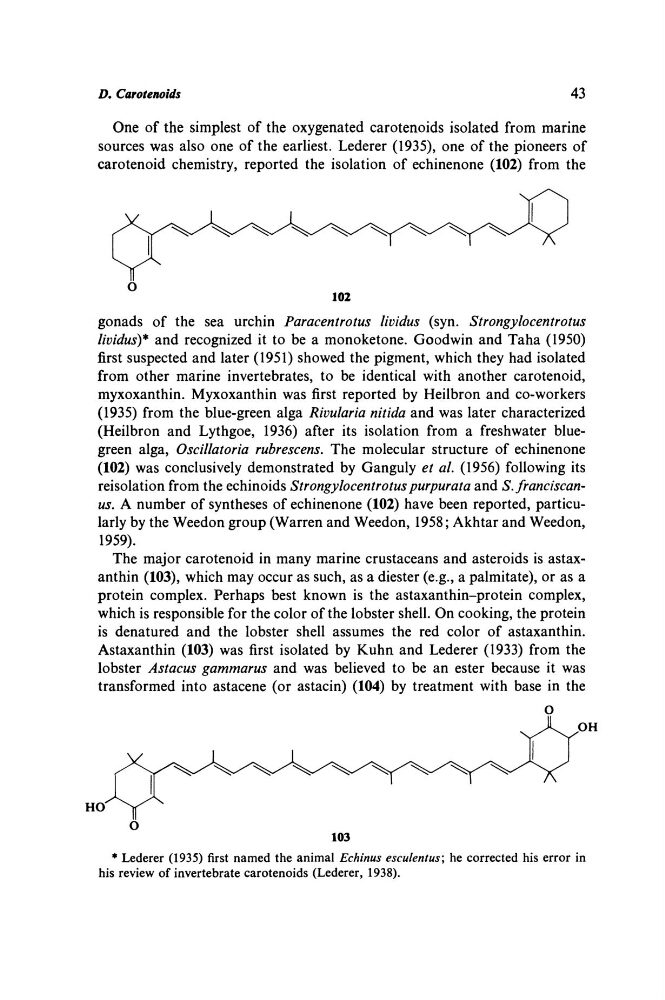
carotenoid chemistry, reported the isolation of echinenone (102) from the
Ο
102
gonads of the sea urchin Paracentrotus
lividus (syn.
Strongylocentrotus
lividus)* and recognized it to be a monoketone. Goodwin and Taha (1950)
first suspected and later (1951) showed the pigment, which they had isolated
from other marine invertebrates, to be identical with another carotenoid,
myxoxanthin. Myxoxanthin was first reported by Heilbron and co-workers
(1935) from the blue-green alga Rivularia nitida and was later characterized
(Heilbron and Lythgoe, 1936) after its isolation from a freshwater bluegreen alga, Oscillatoria rubrescens. The molecular structure of echinenone
(102) was conclusively demonstrated by Ganguly et al. (1956) following its
reisolation from the echinoids Strongylocentrotus purpurata and S.franciscanus. A number of syntheses of echinenone (102) have been reported, particularly by the Weedon group (Warren and Weedon, 1958; Akhtar and Weedon,
1959).
The major carotenoid in many marine crustaceans and asteroids is astaxanthin (103), which may occur as such, as a diester (e.g., a palmitate), or as a
protein complex. Perhaps best known is the astaxanthin-protein complex,
which is responsible for the color of the lobster shell. On cooking, the protein
is denatured and the lobster shell assumes the red color of astaxanthin.
Astaxanthin (103) was first isolated by Kuhn and Lederer (1933) from the
lobster Astacus gammarus and was believed to be an ester because it was
transformed into astacene (or astacin) (104) by treatment with base in the
Ο
^Jl
OH
ο
103
* Lederer (1935) first named the animal Echinus esculent us; he corrected his error in
his review of invertebrate carotenoids (Lederer, 1938).
43
One of the simplest of the oxygenated carotenoids isolated from marine
sources was also one of the earliest. Lederer (1935), one of the pioneers of
carotenoid chemistry, reported the isolation of echinenone (102) from the
Ο
102
gonads of the sea urchin Paracentrotus
lividus (syn.
Strongylocentrotus
lividus)* and recognized it to be a monoketone. Goodwin and Taha (1950)
first suspected and later (1951) showed the pigment, which they had isolated
from other marine invertebrates, to be identical with another carotenoid,
myxoxanthin. Myxoxanthin was first reported by Heilbron and co-workers
(1935) from the blue-green alga Rivularia nitida and was later characterized
(Heilbron and Lythgoe, 1936) after its isolation from a freshwater bluegreen alga, Oscillatoria rubrescens. The molecular structure of echinenone
(102) was conclusively demonstrated by Ganguly et al. (1956) following its
reisolation from the echinoids Strongylocentrotus purpurata and S.franciscanus. A number of syntheses of echinenone (102) have been reported, particularly by the Weedon group (Warren and Weedon, 1958; Akhtar and Weedon,
1959).
The major carotenoid in many marine crustaceans and asteroids is astaxanthin (103), which may occur as such, as a diester (e.g., a palmitate), or as a
protein complex. Perhaps best known is the astaxanthin-protein complex,
which is responsible for the color of the lobster shell. On cooking, the protein
is denatured and the lobster shell assumes the red color of astaxanthin.
Astaxanthin (103) was first isolated by Kuhn and Lederer (1933) from the
lobster Astacus gammarus and was believed to be an ester because it was
transformed into astacene (or astacin) (104) by treatment with base in the
Ο
^Jl
OH
ο
103
* Lederer (1935) first named the animal Echinus esculent us; he corrected his error in
his review of invertebrate carotenoids (Lederer, 1938).