

42
1. Isoprenoids
designated e l9 that had been synthesized by Karrer and Eugster (1950).
Improved syntheses have been reported by the Weedon group (Manchand
et al, 1965).
Carotenes with benzenoid end groups are rare and have so far been
detected only in marine sources and in microorganisms. The first such
compounds, a group of three closely related isomers, were first isolated from
the sponge Reniera japonica (syn. Halychondria panicea) and their structures
elucidated by Yamaguchi (1957a,b; 1958a,b), who also synthesized them
(Yamaguchi, 1959, 1960). Yamaguchi was reluctant to accept the unprecedented aromatic end groups, but eventually yielded to convincing degradative
evidence, including permanganate oxidation to trialkylbenzaldehydes. The
three hydrocarbons, isolated from the sponge in relative ratios of 20:10:1
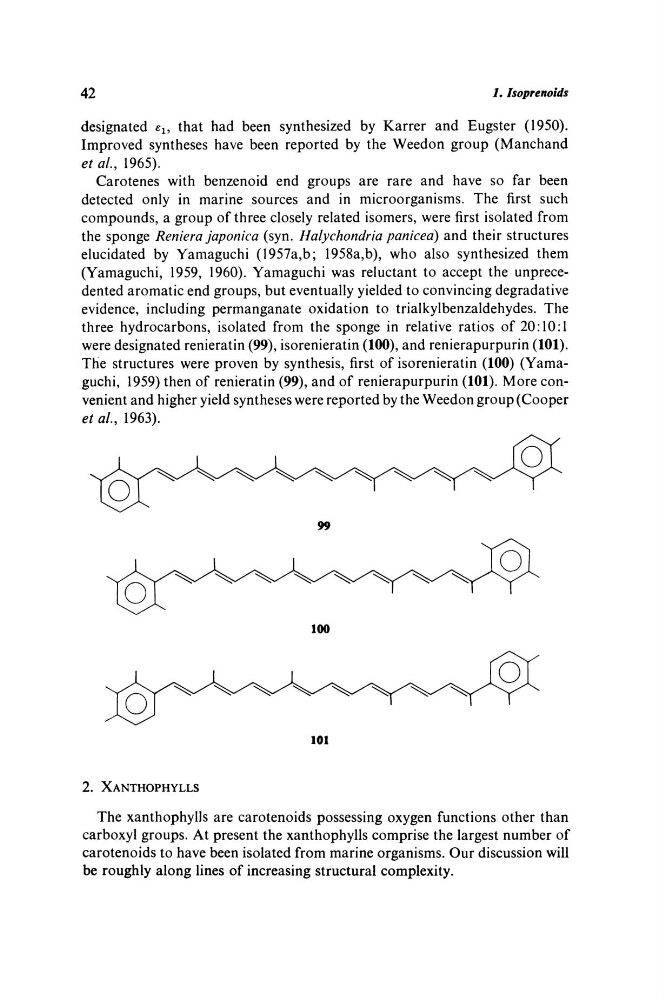
were designated renieratin (99), isorenieratin (100), and renierapurpurin (101).
The structures were proven by synthesis, first of isorenieratin (100) (Yamaguchi, 1959) then of renieratin (99), and of renierapurpurin (101). More convenient and higher yield syntheses were reported by the Weedon group (Cooper
et ai, 1963).
99
100
101
2. XANTHOPHYLLS
The xanthophylls are carotenoids possessing oxygen functions other than
carboxyl groups. At present the xanthophylls comprise the largest number of
carotenoids to have been isolated from marine organisms. Our discussion will
be roughly along lines of increasing structural complexity.
1. Isoprenoids
designated e l9 that had been synthesized by Karrer and Eugster (1950).
Improved syntheses have been reported by the Weedon group (Manchand
et al, 1965).
Carotenes with benzenoid end groups are rare and have so far been
detected only in marine sources and in microorganisms. The first such
compounds, a group of three closely related isomers, were first isolated from
the sponge Reniera japonica (syn. Halychondria panicea) and their structures
elucidated by Yamaguchi (1957a,b; 1958a,b), who also synthesized them
(Yamaguchi, 1959, 1960). Yamaguchi was reluctant to accept the unprecedented aromatic end groups, but eventually yielded to convincing degradative
evidence, including permanganate oxidation to trialkylbenzaldehydes. The
three hydrocarbons, isolated from the sponge in relative ratios of 20:10:1
were designated renieratin (99), isorenieratin (100), and renierapurpurin (101).
The structures were proven by synthesis, first of isorenieratin (100) (Yamaguchi, 1959) then of renieratin (99), and of renierapurpurin (101). More convenient and higher yield syntheses were reported by the Weedon group (Cooper
et ai, 1963).
99
100
101
2. XANTHOPHYLLS
The xanthophylls are carotenoids possessing oxygen functions other than
carboxyl groups. At present the xanthophylls comprise the largest number of
carotenoids to have been isolated from marine organisms. Our discussion will
be roughly along lines of increasing structural complexity.