

C. Triterpenoids
35
with Shimada's (1969) holotoxin has been made, but the nonconjugated diene
system in 82 and 84 is compatible with the lack of UV absorption that
Shimada (1969) reports for holotoxin.
In an interesting attempt to discover the biological precursors of the holothurins (and the holothurian sterols as well) Nomura et al. (1969a,b) recently
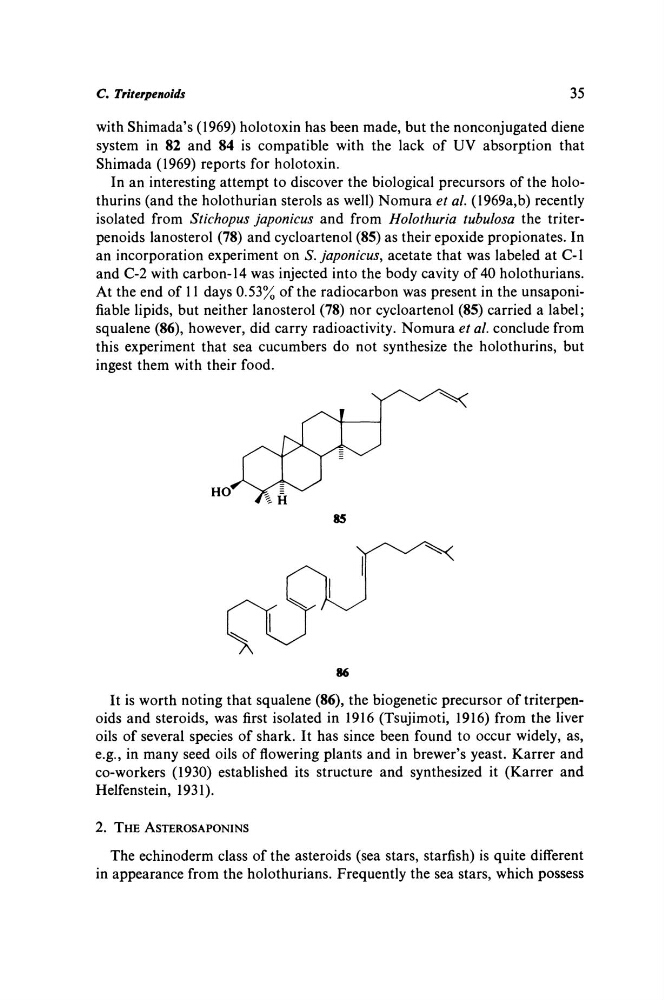
isolated from Stichopus japonicus and from Holothuria tubulosa the triterpenoids lanosterol (78) and cycloartenol (85) as their epoxide propionates. In
an incorporation experiment on S. japonicus, acetate that was labeled at C-1
and C-2 with carbon-14 was injected into the body cavity of 40 holothurians.
At the end of 11 days 0.53% of the radiocarbon was present in the unsaponifiable lipids, but neither lanosterol (78) nor cycloartenol (85) carried a label;
squalene (86), however, did carry radioactivity. Nomura et al. conclude from
this experiment that sea cucumbers do not synthesize the holothurins, but
ingest them with their food.
85
86
It is worth noting that squalene (86), the biogenetic precursor of triterpenoids and steroids, was first isolated in 1916 (Tsujimoti, 1916) from the liver
oils of several species of shark. It has since been found to occur widely, as,
e.g., in many seed oils of flowering plants and in brewer's yeast. Karrer and
co-workers (1930) established its structure and synthesized it (Karrer and
Helfenstein, 1931).
2. THE ASTEROSAPONINS
The echinoderm class of the asteroids (sea stars, starfish) is quite different
in appearance from the holothurians. Frequently the sea stars, which possess
c. Triterpenoids
35
with Shimada's (1969) holotoxin has been made, but the nonconjugated diene
system in 82 and 84 is compatible with the lack of UV absorption that
Shimada (1969) reports for holotoxin.
In an interesting attempt to discover the biological precursors of the holothurins (and the holothurian sterols as well) Nomura et ale (1969a,b) recently
isolated from Stichopus japonicus and from Holothuria tubulosa the triterpenoids lanosterol (78) and cycloartenol (85) as their epoxide propionates. In
an incorporation experiment on S. japonicus, acetate that was labeled at C-l
and C-2 with carbon-14 was injected into the body cavity of 40 holothurians.
At the end of 11 days 0.53% of the radiocarbon was present in the unsaponifiable lipids, but neither lanosterol (78) nor cycloartenol (85) carried a label;
squalene (86), however, did carry radioactivity. Nomura et ale conclude from
this experiment that sea cucumbers do not synthesize the holothurins, but
ingest them with their food.
85
86
It is worth noting that squalene (86), the biogenetic precursor of triterpenoids and steroids, was first isolated in 1916 (Tsujimoti, 1916) from the liver
oils of several species of shark. It has since been found to occur widely, as,
e.g., in many seed oils of flowering plants and in brewer's yeast. Karrer and
co-workers (1930) established its structure and synthesized it (Karrer and
Helfenstein, 1931).
2. THE ASTEROSAPONINS
The echinoderm class of the asteroids (sea stars, starfish) is quite different
in appearance from the holothurians. Frequently the sea stars, which possess
35
with Shimada's (1969) holotoxin has been made, but the nonconjugated diene
system in 82 and 84 is compatible with the lack of UV absorption that
Shimada (1969) reports for holotoxin.
In an interesting attempt to discover the biological precursors of the holothurins (and the holothurian sterols as well) Nomura et al. (1969a,b) recently
isolated from Stichopus japonicus and from Holothuria tubulosa the triterpenoids lanosterol (78) and cycloartenol (85) as their epoxide propionates. In
an incorporation experiment on S. japonicus, acetate that was labeled at C-1
and C-2 with carbon-14 was injected into the body cavity of 40 holothurians.
At the end of 11 days 0.53% of the radiocarbon was present in the unsaponifiable lipids, but neither lanosterol (78) nor cycloartenol (85) carried a label;
squalene (86), however, did carry radioactivity. Nomura et al. conclude from
this experiment that sea cucumbers do not synthesize the holothurins, but
ingest them with their food.
85
86
It is worth noting that squalene (86), the biogenetic precursor of triterpenoids and steroids, was first isolated in 1916 (Tsujimoti, 1916) from the liver
oils of several species of shark. It has since been found to occur widely, as,
e.g., in many seed oils of flowering plants and in brewer's yeast. Karrer and
co-workers (1930) established its structure and synthesized it (Karrer and
Helfenstein, 1931).
2. THE ASTEROSAPONINS
The echinoderm class of the asteroids (sea stars, starfish) is quite different
in appearance from the holothurians. Frequently the sea stars, which possess
c. Triterpenoids
35
with Shimada's (1969) holotoxin has been made, but the nonconjugated diene
system in 82 and 84 is compatible with the lack of UV absorption that
Shimada (1969) reports for holotoxin.
In an interesting attempt to discover the biological precursors of the holothurins (and the holothurian sterols as well) Nomura et ale (1969a,b) recently
isolated from Stichopus japonicus and from Holothuria tubulosa the triterpenoids lanosterol (78) and cycloartenol (85) as their epoxide propionates. In
an incorporation experiment on S. japonicus, acetate that was labeled at C-l
and C-2 with carbon-14 was injected into the body cavity of 40 holothurians.
At the end of 11 days 0.53% of the radiocarbon was present in the unsaponifiable lipids, but neither lanosterol (78) nor cycloartenol (85) carried a label;
squalene (86), however, did carry radioactivity. Nomura et ale conclude from
this experiment that sea cucumbers do not synthesize the holothurins, but
ingest them with their food.
85
86
It is worth noting that squalene (86), the biogenetic precursor of triterpenoids and steroids, was first isolated in 1916 (Tsujimoti, 1916) from the liver
oils of several species of shark. It has since been found to occur widely, as,
e.g., in many seed oils of flowering plants and in brewer's yeast. Karrer and
co-workers (1930) established its structure and synthesized it (Karrer and
Helfenstein, 1931).
2. THE ASTEROSAPONINS
The echinoderm class of the asteroids (sea stars, starfish) is quite different
in appearance from the holothurians. Frequently the sea stars, which possess