

34
1, Isoprenoids
It is therefore evident that the 7:8, 9:11 diene system of the holothurinogenins is generated from a 9,1 l-en-12a-ol precursor, while the lactone and the
sometimes tetrahydrofuran functions are present in the natural compounds.
The presence of a holothurin, designated holothurin B, that possesses the
same mixture of aglycones as does holothurin A, but differs from it in its
sugars was established by Yasumoto et al. (1967). These workers isolated
from Holothuria vagabunda and H. lubrica holothurins A and B. Holothurin
B, on acid hydrolysis, furnished only two sugars, D-xylose (60) and D-quinovose (62), in addition to sodium hydrogen sulfate.
A likely variant of the holothurins is Shimada's (1969) holotoxin, which
he isolated from the body wall of the sea cucumber Stichopus japonicus. This
colorless crystalline substance shows high activity against pathogenic fungi, a
property that distinguishes it from the holothurins. The reported physical
and chemical properties, however, would tend to place holotoxin in a close
structural relationship with the holothurins.
("""^N
IIIIIIOH
83
IIIHlOH
84
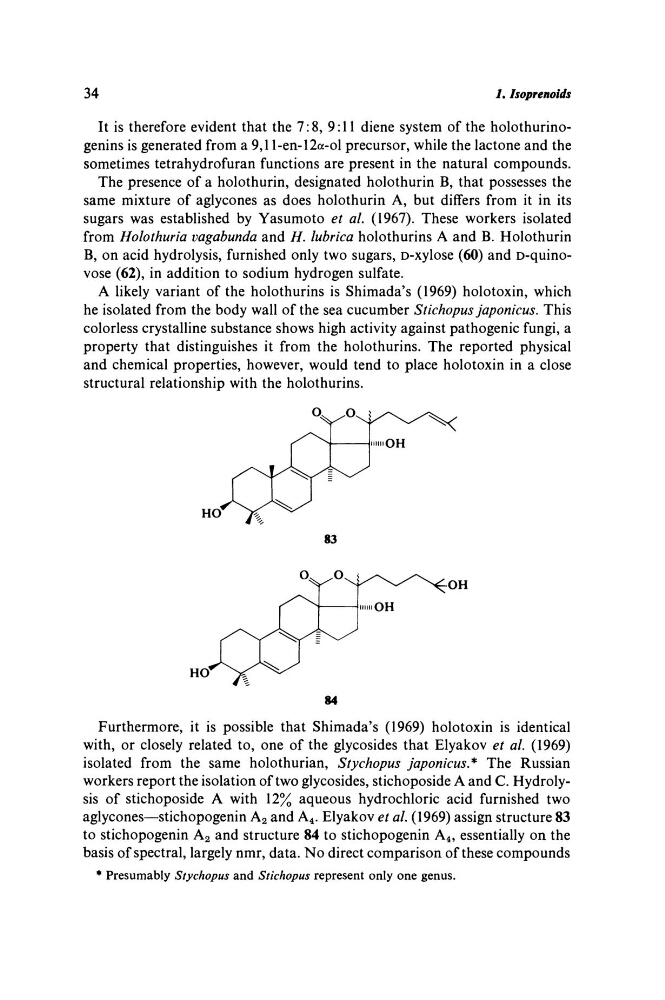
Furthermore, it is possible that Shimada's (1969) holotoxin is identical
with, or closely related to, one of the glycosides that Elyakov et al. (1969)
isolated from the same holothurian, Stychopus japonicus.* The Russian
workers report the isolation of two glycosides, stichoposide A and C. Hydrolysis of stichoposide A with 12% aqueous hydrochloric acid furnished two
aglycones—stichopogenin A 2 and A 4 . Elyakov et al. (1969) assign structure 83
to stichopogenin A 2 and structure 84 to stichopogenin A 4 , essentially on the
basis of spectral, largely nmr, data. No direct comparison of these compounds
* Presumably Stychopus and Stichopus represent only one genus.
1, Isoprenoids
It is therefore evident that the 7:8, 9:11 diene system of the holothurinogenins is generated from a 9,1 l-en-12a-ol precursor, while the lactone and the
sometimes tetrahydrofuran functions are present in the natural compounds.
The presence of a holothurin, designated holothurin B, that possesses the
same mixture of aglycones as does holothurin A, but differs from it in its
sugars was established by Yasumoto et al. (1967). These workers isolated
from Holothuria vagabunda and H. lubrica holothurins A and B. Holothurin
B, on acid hydrolysis, furnished only two sugars, D-xylose (60) and D-quinovose (62), in addition to sodium hydrogen sulfate.
A likely variant of the holothurins is Shimada's (1969) holotoxin, which
he isolated from the body wall of the sea cucumber Stichopus japonicus. This
colorless crystalline substance shows high activity against pathogenic fungi, a
property that distinguishes it from the holothurins. The reported physical
and chemical properties, however, would tend to place holotoxin in a close
structural relationship with the holothurins.
("""^N
IIIIIIOH
83
IIIHlOH
84
Furthermore, it is possible that Shimada's (1969) holotoxin is identical
with, or closely related to, one of the glycosides that Elyakov et al. (1969)
isolated from the same holothurian, Stychopus japonicus.* The Russian
workers report the isolation of two glycosides, stichoposide A and C. Hydrolysis of stichoposide A with 12% aqueous hydrochloric acid furnished two
aglycones—stichopogenin A 2 and A 4 . Elyakov et al. (1969) assign structure 83
to stichopogenin A 2 and structure 84 to stichopogenin A 4 , essentially on the
basis of spectral, largely nmr, data. No direct comparison of these compounds
* Presumably Stychopus and Stichopus represent only one genus.