

A. Sesquiterpenoids
13
their following publication Irie and co-workers (1965) revealed the structure
of a hydrocarbon laurene (29), which they had isolated from L. glandulifera.
29
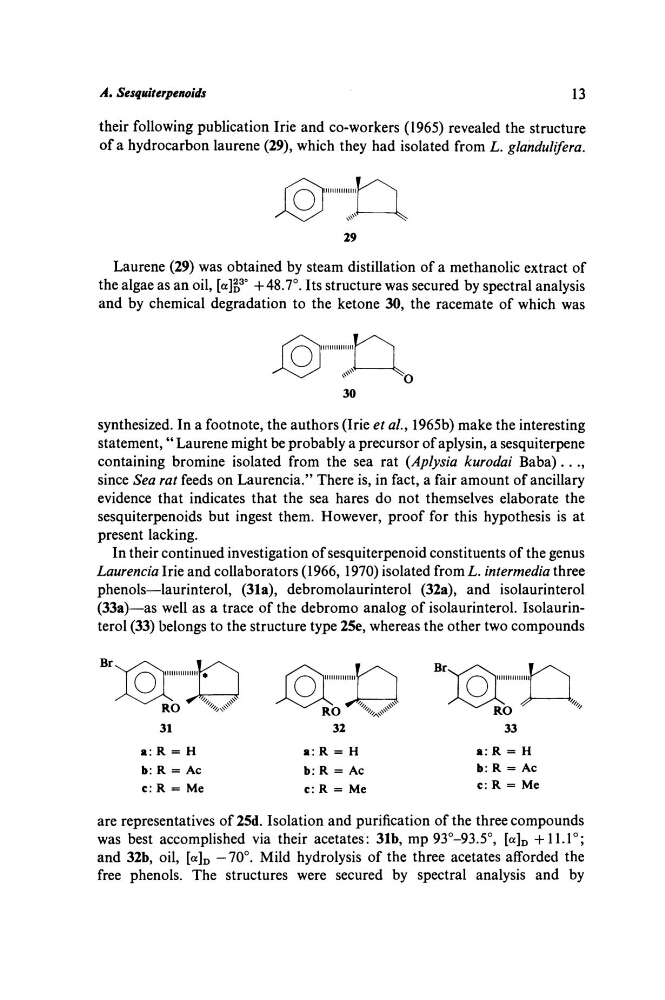
Laurene (29) was obtained by steam distillation of a methanolic extract of
the algae as an oil, [a]f>
3
° +48.7°. Its structure was secured by spectral analysis
and by chemical degradation to the ketone 30, the racemate of which was
j
^ 0
30
synthesized. In a footnote, the authors (Irie et al., 1965b) make the interesting
statement, '* Laurene might be probably a precursor of aplysin, a sesquiterpene
containing bromine isolated from the sea rat (Aplysia kurodai Baba)...,
since Sea rat feeds on Laurencia." There is, in fact, a fair amount of ancillary
evidence that indicates that the sea hares do not themselves elaborate the
sesquiterpenoids but ingest them. However, proof for this hypothesis is at
present lacking.
In their continued investigation of sesquiterpenoid constituents of the genus
Laurencia Irie and collaborators (1966, 1970) isolated from L. intermedia three
phenols—laurinterol, (31a), debromolaurinterol (32a), and isolaurinterol
(33a)—as well as a trace of the debromo analog of isolaurinterol. Isolaurinterol (33) belongs to the structure type 25e, whereas the other two compounds
"Mb
^ 0 "k?
1
J
1
* > « >
31
32
33
a: R = H
a: R = H
a: R = Η
b: R = Ac
b: R = Ac
b: R = Ac
c: R = Me
c: R = Me
c: R = Me
are representatives of 25d. Isolation and purification of the three compounds
was best accomplished via their acetates: 31b, mp 93°-93.5°, [a] D +11.1°;
and 32b, oil, [α] Ό — 70°. Mild hydrolysis of the three acetates afforded the
free phenols. The structures were secured by spectral analysis and by
13
their following publication Irie and co-workers (1965) revealed the structure
of a hydrocarbon laurene (29), which they had isolated from L. glandulifera.
29
Laurene (29) was obtained by steam distillation of a methanolic extract of
the algae as an oil, [a]f>
3
° +48.7°. Its structure was secured by spectral analysis
and by chemical degradation to the ketone 30, the racemate of which was
j
^ 0
30
synthesized. In a footnote, the authors (Irie et al., 1965b) make the interesting
statement, '* Laurene might be probably a precursor of aplysin, a sesquiterpene
containing bromine isolated from the sea rat (Aplysia kurodai Baba)...,
since Sea rat feeds on Laurencia." There is, in fact, a fair amount of ancillary
evidence that indicates that the sea hares do not themselves elaborate the
sesquiterpenoids but ingest them. However, proof for this hypothesis is at
present lacking.
In their continued investigation of sesquiterpenoid constituents of the genus
Laurencia Irie and collaborators (1966, 1970) isolated from L. intermedia three
phenols—laurinterol, (31a), debromolaurinterol (32a), and isolaurinterol
(33a)—as well as a trace of the debromo analog of isolaurinterol. Isolaurinterol (33) belongs to the structure type 25e, whereas the other two compounds
"Mb
^ 0 "k?
1
J
1
* > « >
31
32
33
a: R = H
a: R = H
a: R = Η
b: R = Ac
b: R = Ac
b: R = Ac
c: R = Me
c: R = Me
c: R = Me
are representatives of 25d. Isolation and purification of the three compounds
was best accomplished via their acetates: 31b, mp 93°-93.5°, [a] D +11.1°;
and 32b, oil, [α] Ό — 70°. Mild hydrolysis of the three acetates afforded the
free phenols. The structures were secured by spectral analysis and by