

12
i. Isoprenoids
26
27
28
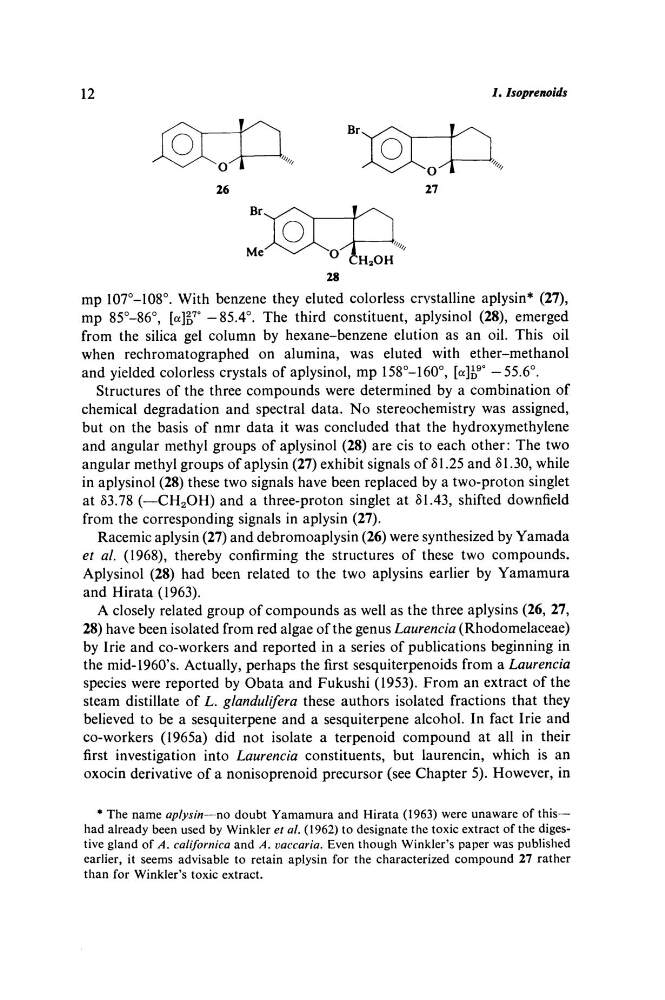
mp 107°-108°. With benzene they eluted colorless crystalline aplysin* (27),
mp 85°-86°, [αβ
7 ° -85.4°. The third constituent, aplysinol (28), emerged
from the silica gel column by hexane-benzene elution as an oil. This oil
when rechromatographed on alumina, was eluted with ether-methanol
and yielded colorless crystals of aplysinol, mp 158°-160°, [a]l
9
° —55.6°.
Structures of the three compounds were determined by a combination of
chemical degradation and spectral data. No stereochemistry was assigned,
but on the basis of nmr data it was concluded that the hydroxymethylene
and angular methyl groups of aplysinol (28) are eis to each other: The two
angular methyl groups of aplysin (27) exhibit signals of 81.25 and δ 1.30, while
in aplysinol (28) these two signals have been replaced by a two-proton singlet
at £3.78 (—CH 2 OH) and a three-proton singlet at δΐ.43, shifted downfield
from the corresponding signals in aplysin (27).
Racemic aplysin (27) and debromoaplysin (26) were synthesized by Yamada
et al. (1968), thereby confirming the structures of these two compounds.
Aplysinol (28) had been related to the two aplysins earlier by Yamamura
and Hirata (1963).
A closely related group of compounds as well as the three aplysins (26, 27,
28) have been isolated from red algae of the genus Laurencia (Rhodomelaceae)
by Irie and co-workers and reported in a series of publications beginning in
the mid-1960's. Actually, perhaps the first sesquiterpenoids from a Laurencia
species were reported by Obata and Fukushi (1953). From an extract of the
steam distillate of L. glandulifera these authors isolated fractions that they
believed to be a sesquiterpene and a sesquiterpene alcohol. In fact Irie and
co-workers (1965a) did not isolate a terpenoid compound at all in their
first investigation into Laurencia constituents, but laurencin, which is an
oxocin derivative of a nonisoprenoid precursor (see Chapter 5). However, in
* The name aplysin—no doubt Yamamura and Hirata (1963) were unaware of this—
had already been used by Winkler et al. (1962) to designate the toxic extract of the digestive gland of A. californica and A. vaccaria. Even though Winkler's paper was published
earlier, it seems advisable to retain aplysin for the characterized compound 27 rather
than for Winkler's toxic extract.
12
26
Br
1. Isoprenoids
Br
Me
28
mp 107°-108°. With benzene they eluted colorless crYstalline aplysin* (27),
mp 85°-86°, [a]~7° - 85.4°. The third constituent, aplysinol (28), emerged
from the silica gel column by hexane-benzene elution as an oil. This oil
when rechromatographed on alumina, was eluted with ether-methanol
and yielded colorless crystals of aplysinol, mp 158°-160°, [a]b
9 ° - 55.6°.
Structures of the three compounds were determined by a combination of
chemical degradation and spectral data. No stereochemistry was assigned,
but on the basis of nmr data it was concluded that the hydroxymethylene
and angular methyl groups of aplysinol (28) are cis to each other: The two
angular methyl groups of aplysin (27) exhibit signals of S1.25 and S1.30, while
in aplysinol (28) these two signals have been replaced by a two-proton singlet
at 83.78 (-CH 2 0H) and a three-proton singlet at 81.43, shifted downfield
from the corresponding signals in aplysin (27).
Racemic aplysin (27) and debromoaplysin (26) were synthesized by Yamada
et ale (1968), thereby confirming the structures of these two compounds.
Aplysinol (28) had been related to the two aplysins earlier by Yamamura
and Hirata (1963).
A closely related group of compounds as well as the three aplysins (26, 27,
28) have been isolated from red algae of the genus Laurencia (Rhodomelaceae)
by Irie and co-workers and reported in a series of publications beginning in
the mid-1960's. Actually, perhaps the first sesquiterpenoids from a Laurencia
species were reported by Obata and Fukushi (1953). From an extract of the
steam distillate of L. glandulifera these authors isolated fractions that they
believed to be a sesquiterpene and a sesquiterpene alcohol. In fact Irie and
co-workers (1965a) did not isolate a terpenoid compound at all in their
first investigation into Laurencia constituents, but laurencin, which is an
oxocin derivative of a nonisoprenoid precursor (see Chapter 5). However, in
* The name aplysin-no doubt Yamamura and Hirata (1963) were unaware of thishad already been used by Winkler et ale (1962) to designate the toxic extract of the digestive gland of A. cali/ornica and A. vaccaria. Even though Winkler's paper was published
earlier, it seems advisable to retain aplysin for the characterized compound 27 rather
than for Winkler's toxic extract.
i. Isoprenoids
26
27
28
mp 107°-108°. With benzene they eluted colorless crystalline aplysin* (27),
mp 85°-86°, [αβ
7 ° -85.4°. The third constituent, aplysinol (28), emerged
from the silica gel column by hexane-benzene elution as an oil. This oil
when rechromatographed on alumina, was eluted with ether-methanol
and yielded colorless crystals of aplysinol, mp 158°-160°, [a]l
9
° —55.6°.
Structures of the three compounds were determined by a combination of
chemical degradation and spectral data. No stereochemistry was assigned,
but on the basis of nmr data it was concluded that the hydroxymethylene
and angular methyl groups of aplysinol (28) are eis to each other: The two
angular methyl groups of aplysin (27) exhibit signals of 81.25 and δ 1.30, while
in aplysinol (28) these two signals have been replaced by a two-proton singlet
at £3.78 (—CH 2 OH) and a three-proton singlet at δΐ.43, shifted downfield
from the corresponding signals in aplysin (27).
Racemic aplysin (27) and debromoaplysin (26) were synthesized by Yamada
et al. (1968), thereby confirming the structures of these two compounds.
Aplysinol (28) had been related to the two aplysins earlier by Yamamura
and Hirata (1963).
A closely related group of compounds as well as the three aplysins (26, 27,
28) have been isolated from red algae of the genus Laurencia (Rhodomelaceae)
by Irie and co-workers and reported in a series of publications beginning in
the mid-1960's. Actually, perhaps the first sesquiterpenoids from a Laurencia
species were reported by Obata and Fukushi (1953). From an extract of the
steam distillate of L. glandulifera these authors isolated fractions that they
believed to be a sesquiterpene and a sesquiterpene alcohol. In fact Irie and
co-workers (1965a) did not isolate a terpenoid compound at all in their
first investigation into Laurencia constituents, but laurencin, which is an
oxocin derivative of a nonisoprenoid precursor (see Chapter 5). However, in
* The name aplysin—no doubt Yamamura and Hirata (1963) were unaware of this—
had already been used by Winkler et al. (1962) to designate the toxic extract of the digestive gland of A. californica and A. vaccaria. Even though Winkler's paper was published
earlier, it seems advisable to retain aplysin for the characterized compound 27 rather
than for Winkler's toxic extract.
12
26
Br
1. Isoprenoids
Br
Me
28
mp 107°-108°. With benzene they eluted colorless crYstalline aplysin* (27),
mp 85°-86°, [a]~7° - 85.4°. The third constituent, aplysinol (28), emerged
from the silica gel column by hexane-benzene elution as an oil. This oil
when rechromatographed on alumina, was eluted with ether-methanol
and yielded colorless crystals of aplysinol, mp 158°-160°, [a]b
9 ° - 55.6°.
Structures of the three compounds were determined by a combination of
chemical degradation and spectral data. No stereochemistry was assigned,
but on the basis of nmr data it was concluded that the hydroxymethylene
and angular methyl groups of aplysinol (28) are cis to each other: The two
angular methyl groups of aplysin (27) exhibit signals of S1.25 and S1.30, while
in aplysinol (28) these two signals have been replaced by a two-proton singlet
at 83.78 (-CH 2 0H) and a three-proton singlet at 81.43, shifted downfield
from the corresponding signals in aplysin (27).
Racemic aplysin (27) and debromoaplysin (26) were synthesized by Yamada
et ale (1968), thereby confirming the structures of these two compounds.
Aplysinol (28) had been related to the two aplysins earlier by Yamamura
and Hirata (1963).
A closely related group of compounds as well as the three aplysins (26, 27,
28) have been isolated from red algae of the genus Laurencia (Rhodomelaceae)
by Irie and co-workers and reported in a series of publications beginning in
the mid-1960's. Actually, perhaps the first sesquiterpenoids from a Laurencia
species were reported by Obata and Fukushi (1953). From an extract of the
steam distillate of L. glandulifera these authors isolated fractions that they
believed to be a sesquiterpene and a sesquiterpene alcohol. In fact Irie and
co-workers (1965a) did not isolate a terpenoid compound at all in their
first investigation into Laurencia constituents, but laurencin, which is an
oxocin derivative of a nonisoprenoid precursor (see Chapter 5). However, in
* The name aplysin-no doubt Yamamura and Hirata (1963) were unaware of thishad already been used by Winkler et ale (1962) to designate the toxic extract of the digestive gland of A. cali/ornica and A. vaccaria. Even though Winkler's paper was published
earlier, it seems advisable to retain aplysin for the characterized compound 27 rather
than for Winkler's toxic extract.